

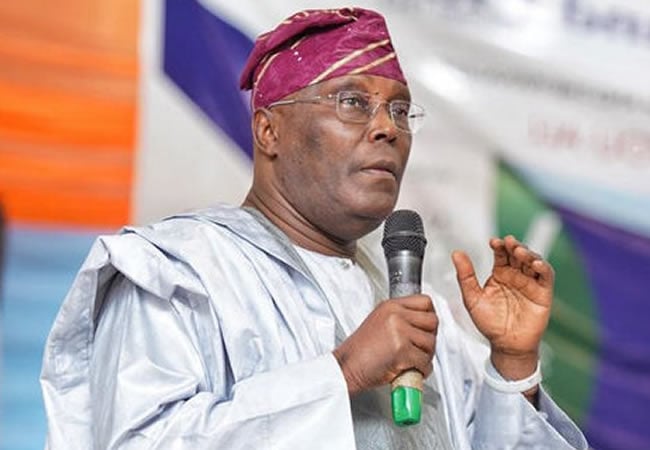
…Ex-VP: Under Tinubu, Nigerians Have Endured Pain With No Gain
…Tinubu: Ex-VP ‘Seriously Ignorant of Economics’
…Onanuga: Atiku is Desperate, Wants to Drag Nigeria Back to the Past
…Wike: He’s Confused, Inconsistent
By Our Reporters
A major political and economic storm erupted on Thursday over a pledge by former Vice President and African Democratic Congress (ADC) presidential candidate, Atiku Abubakar, to restore petrol subsidy if elected President in 2027, drawing blistering attacks from President Bola Tinubu, the Presidency and Federal Capital Territory Minister, Nyesom Wike.
Atiku, who supported the removal of petrol subsidy ahead of the 2023 presidential election, said he had reconsidered his position because more than three years after President Tinubu abolished the scheme, Nigerians had endured enormous economic pain without seeing sufficient evidence that the savings from the policy had translated into better healthcare, education, security or living standards.
Speaking during a Facebook Live session, the former Vice President challenged the Federal Government to account for the money supposedly saved from ending the subsidy regime, declaring that an Atiku administration would restore subsidy and recover any funds found to have been misappropriated.
“I initially did not oppose the removal of the fuel subsidy. But now that it has been removed, where is the money? Where has the subsidy money gone? Has it been used to improve healthcare, education, or security?” Atiku asked.
“If I win the presidential election, I will restore the subsidy. And anyone who stole Nigeria’s subsidy funds must return the money.”
The declaration immediately thrust one of Nigeria’s most contentious economic issues into the heart of the 2027 presidential campaign, opening a potentially defining policy battle between Atiku and Tinubu over the cost-of-living crisis and the direction of the economy.
Tinubu abolished petrol subsidy during his inaugural address on May 29, 2023, with the now famous declaration that “subsidy is gone.”
The decision triggered steep increases in petrol prices, transportation costs, and the prices of goods and services across the economy. The administration has, however, consistently maintained that the subsidy system was fiscally unsustainable, riddled with corruption, and deprived federal, state, and local governments of resources required for development.
Atiku said the central question was no longer merely whether subsidy was economically desirable, but whether Nigerians had received the benefits promised when they were asked to endure the painful reform.
Tinubu fired back on Thursday, describing Atiku’s proposal to return to fuel subsidy as evidence of “serious ignorance of governance and the economy.”
Speaking while receiving newly re-elected Osun State Governor, Ademola Adeleke, the President argued that Atiku’s position showed a fundamental misunderstanding of the damage the former subsidy regime had inflicted on public finances.
“I saw one of my opponents say that he’ll go back to fuel subsidy. I read it. That’s a demonstration of serious ignorance of governance and the economy,” Tinubu said.
The President said the subsidy system he terminated in 2023 had financially crippled governments across the federation, leaving many states unable to meet basic obligations to workers and pensioners.
“Before I came here, 27 states couldn’t pay the salaries of workers, not to talk of pensioners. In Osun State, I know a man who is nicknamed ‘Half Salary’,” Tinubu said.
“Governors used to come to Abuja, cap in hand, because they could not do anything in their states. Even the local governments.”
The Presidency followed the President’s attack with an unusually lengthy response, accusing Atiku of making a desperate volte-face in pursuit of power and warning that restoring petrol subsidy could destabilise public finances and undermine Nigeria’s emerging domestic refining industry.
In a statement titled, “Restoring petrol subsidies: Atiku’s volte-face and desperation for power,” presidential spokesman Bayo Onanuga described the proposal as retrogressive and inconsistent with the position Atiku canvassed before the 2023 election.
According to Onanuga, the ADC presidential candidate had failed to explain how his proposed subsidy would be financed, what Nigerians would pay for petrol under the arrangement, and whether an Atiku administration intended to borrow to fund the programme.
The Presidency also rejected Atiku’s suggestion that a huge pool of subsidy savings should be sitting somewhere waiting to be accounted for.
It explained that the previous subsidy was essentially an under-recovery arrangement in which the Nigerian National Petroleum Company Limited absorbed the difference between the actual cost of supplying petrol and the regulated pump price.
“Contrary to Atiku’s claim in his interview, no N30 trillion subsidy windfall or savings exists anywhere except in his imagination,” Onanuga said.
The Presidency further argued that the Petroleum Industry Act had already provided for the termination of petrol subsidy by the end of June 2023 and that Tinubu merely accelerated its removal by a few weeks.
It said restoring subsidy would therefore require much more than a presidential announcement reducing petrol prices, as a future administration would have to establish the legal, fiscal and administrative framework for financing and operating such a scheme.
The government also argued that Nigeria’s petroleum industry had changed fundamentally since 2023, particularly following the emergence of large-scale domestic refining led by the Dangote Refinery.
According to the Presidency, a return to the old subsidy structure could threaten billions of dollars invested in domestic refining, hurt smaller local refineries, endanger jobs and reverse progress towards ending Nigeria’s dependence on imported petroleum products.
Onanuga maintained that subsidy removal, together with foreign exchange reforms, had instead significantly strengthened revenues accruing to the three tiers of government.
He said about N15 trillion that might otherwise have been borrowed and spent subsidising petrol had become available to government, while increased Federation Account revenues had helped states become more financially stable, pay salaries and undertake infrastructure projects.
The Presidency pointed to the approximately N3 trillion shared by the federal, state and local governments from the Federation Account in July as evidence of the improvement in government revenues.
It put the current economic cost of petrol at between N1,200 and N1,300 per litre and challenged Atiku to tell Nigerians exactly what pump price he intended to introduce.
“What will the new pump price be? N200 or N500?” the Presidency asked.
It argued that if an Atiku government sold petrol substantially below its economic cost, somebody would inevitably have to pay the difference.
According to the Presidency, the burden would ultimately return to Nigerians through reduced expenditure on infrastructure and social services, lower allocations to states and the 774 local government councils, increased borrowing or higher public debt.
While acknowledging that high petrol prices had imposed considerable hardship on households and businesses, the Presidency insisted that recreating the old subsidy system was not the answer.
It cited the Tinubu administration’s promotion of Compressed Natural Gas, which it said was about 70 per cent cheaper than petrol, as one of the measures being pursued to reduce transportation and energy costs.
“Political promises must be backed by fiscal arithmetic,” the Presidency said.
It challenged Atiku to disclose the projected annual cost of his subsidy programme, its source of funding and the mechanisms he would establish to prevent the fraud and abuse historically associated with the subsidy regime.
The Presidency also questioned precisely what an Atiku government intended to subsidise in an increasingly domestically supplied petrol market — production, transportation, distribution or another component of the petroleum value chain.
“Nigeria cannot afford to return to policies whose costs are hidden from citizens until they appear later as debt, reduced government spending on social services, and further pressure on the national currency,” it said.
Wike separately entered the fray on Thursday, accusing Atiku of political confusion and inconsistency.
Speaking with journalists in Abuja, the FCT minister recalled that Atiku had campaigned for the abolition of petrol subsidy ahead of the 2023 election and questioned why the former Vice President was now promising to restore a policy he had previously condemned as unsustainable.
“Atiku is confused. He said in 2022 that he was going to remove the subsidy, now in 2026 he wants to restore fuel subsidy. Are you going back to the fraud?” Wike asked.
The former Rivers State governor said leadership demanded consistency and accused politicians of changing fundamental policy positions merely to suit changing political circumstances.
“We need to be consistent in what we say to our people. That is what leadership is,” Wike said.
“Leadership is not you coming out in the morning to say a thing and come back in the afternoon to say a different thing.”
Atiku’s latest position marks a significant departure from the policy he advocated during the 2023 presidential campaign, when he argued that the petrol subsidy regime was unsustainable and promised to abolish it if elected.
His disagreement with the Tinubu administration subsequently shifted towards the manner in which subsidy removal was implemented, whether government continued to subsidise petrol indirectly and what happened to the fiscal resources supposedly freed by the reform.
In June 2024, Atiku accused the Federal Government of continuing to shoulder subsidy-related costs despite officially declaring the regime abolished, following reports that expenditure associated with petrol subsidy could reach N5.4 trillion that year.
“Paying subsidies and lying about it is nothing to brag about. Nigerians deserve better than this deception,” Atiku said at the time.
The Presidency denied the allegation, insisting that no N5.4 trillion had been provided for petrol subsidy in the 2024 budget.
Tinubu has repeatedly ruled out reversing the policy, including during the nationwide economic protests of August 2024, describing subsidy removal as painful but necessary to tackle structural weaknesses in the Nigerian economy.
Although the President has repeatedly acknowledged the hardship arising from his economic reforms, he maintains that returning to the subsidy era would recreate the fiscal crisis his administration says it inherited in 2023 from the Muhammadu Buhari government.
Discover more from Keeping Them Honest
Subscribe to get the latest posts sent to your email.