

…Opposition tears themselves apart as Tinubu deploys Soludo against Obi in Anambra, Adeleke against Aregbesola in Osun
By Jeremy Fregene
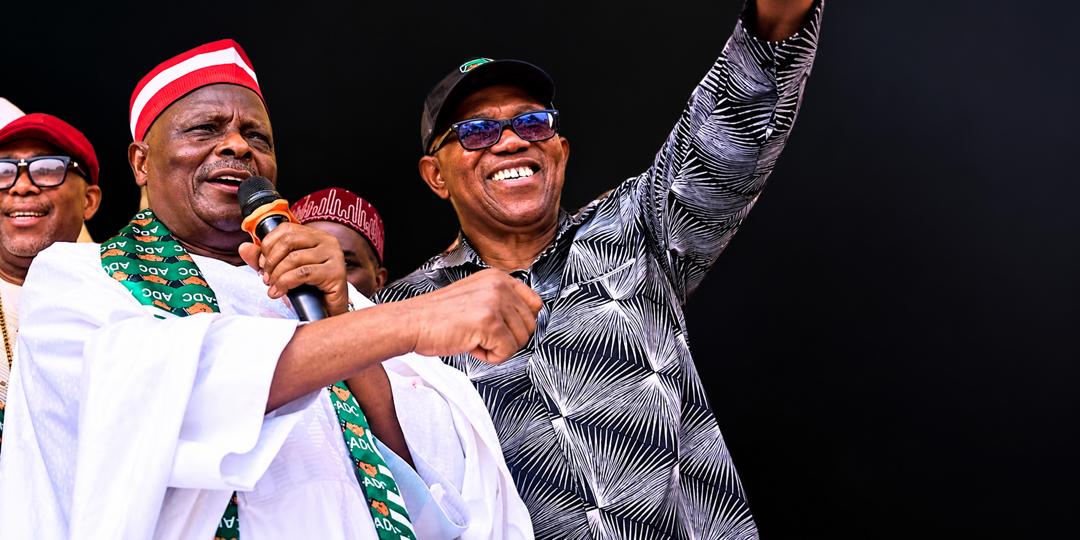
The political war between the African Democratic Congress, ADC, and the Nigeria Democratic Congress, NDC, exploded on Sunday as former Kano State Governor Rabiu Musa Kwankwaso raised the alarm over what he described as a possible last-minute attempt to spread claims that Peter Obi and himself had withdrawn from the 2027 presidential race for Atiku Abubakar.
Kwankwaso, the NDC vice-presidential candidate, specifically warned supporters to be on guard against any election-eve announcement suggesting that the Obi-Kwankwaso ticket had stepped down for Atiku, the presidential candidate of the ADC.
“We are aware that the ADC-PCC may try to mislead our supporters on the eve of the election by claiming that we intend to withdraw in their favour,” Kwankwaso said in his Sunday statement.
He immediately shut the door on such a possibility: “Let me state clearly and unequivocally: we will not withdraw our candidature for the ADC or any other party. We remain confident in our capacity, competence, and readiness to lead Nigeria.”
The warning marked a dramatic escalation of the increasingly bitter confrontation between two major opposition camps ahead of the January 16, 2027 presidential election, with the Atiku and Obi camps trading accusations over who is undermining the opposition and indirectly helping President Bola Tinubu and the ruling All Progressives Congress, APC.
But while ADC and NDC turn their political firepower on each other, political observers say Tinubu is pursuing an entirely different strategy — consolidating the APC while simultaneously building alliances beyond the formal boundaries of the ruling party.
At the centre of that emerging coalition is effectively a 33-governor political bloc: 31 APC governors alongside Anambra Governor Chukwuma Soludo of APGA and Osun Governor Ademola Adeleke of Accord, both formally appointed to coordinate Tinubu’s presidential campaign in their respective states.
Political analysts say the choice of Soludo and Adeleke is particularly significant because of the political battle over Anambra and Osun.
In Anambra, Soludo is bringing the authority, grassroots structures, and political clout of an incumbent governor to Tinubu’s campaign in the home state of Peter Obi, the NDC presidential candidate and a former governor of the state.
Obi remains a major political figure in Anambra, but analysts say Soludo’s decision to throw APGA’s political machinery behind Tinubu sets up an unusual home-front confrontation in which the sitting governor will be campaigning directly against the presidential ambition of his predecessor.
Political watchers therefore see Soludo’s appointment as potentially giving Tinubu a powerful counterweight to Obi in a state where the NDC candidate would ordinarily expect his roots and political history to count heavily.
A similar political chessboard is emerging in Osun.
Adeleke, who won re-election as governor on the Accord platform in August, has been appointed Tinubu’s Osun campaign coordinator, placing the machinery and political influence of the incumbent governor behind the President.
His assignment also puts him on the opposite side of one of Tinubu’s most consequential former political allies — former Osun Governor Rauf Aregbesola, now National Secretary of the ADC and a prominent figure in Atiku’s wing of the opposition.
Aregbesola was for years one of Tinubu’s closest political associates and a major player in the progressive political movement before their relationship deteriorated. He has since become bitterly critical of the President and is now a key operative of the ADC opposition platform.
Political observers say Adeleke’s deployment in Osun therefore has significance beyond merely adding another governor to Tinubu’s campaign council: it potentially provides the President with an incumbent governor and his organisation to counter Aregbesola in the former governor’s own political backyard.
Adeleke’s Imole Campaign Council has already pledged to mobilise 1.5 million Osun votes for Tinubu.
Also inside the President’s cross-party campaign structure is FCT Minister Nyesom Wike, who remains a PDP member but has been handed responsibility for coordinating Tinubu’s campaign in Rivers State and the Federal Capital Territory.
Political analysts say the appointments illustrate an emerging strategy of placing powerful local political actors at the centre of the President’s campaign in potentially difficult territories.
Analysts say the contrast with the opposition is becoming increasingly striking: Tinubu is attempting to bring political forces from APC, APGA, Accord, and PDP into a single presidential campaign structure at the same time that ADC and NDC are locked in a bitter struggle over which opposition candidate should step aside.
Kwankwaso categorically rejected ADC allegations that the Obi-Kwankwaso ticket was secretly working for Tinubu.
“The OK ticket is neither working for nor acting on behalf of APC or any of its candidates,” he said.
“We see no possibility or reason to withdraw from the presidential race in favour of the ADC candidate or any other. These claims are unfounded and should be treated as such.”
The confrontation followed Kwankwaso’s public call on Atiku to abandon his latest presidential bid and support Obi — an intervention that provoked a blistering response from the ADC Presidential Campaign Council.
The Atiku campaign accused Kwankwaso of weakening the opposition in a manner that could ultimately benefit Tinubu and questioned why he was directing political attacks at the ADC candidate rather than concentrating on the APC administration.
Kwankwaso returned fire on Sunday, accusing the ADC campaign of devoting its energy to attacking Obi and himself instead of presenting Atiku’s credentials and programme to Nigerians.
“Rather than presenting the competence, credibility, and capacity of their own candidate, as we have consistently done by putting our credentials and record of achievements before Nigerians, the ADC Presidential Campaign Council appears intent on creating mischief against our party and ticket,” he said.
The ADC promptly fired back, challenging Kwankwaso to declare openly for the APC if he shared its political agenda and maintaining that his political attacks appeared increasingly directed at Atiku rather than Tinubu.
Political observers say the exchanges expose a potentially consequential contradiction for the opposition: ADC and NDC both insist their objective is to defeat Tinubu, yet their presidential camps are increasingly directing some of their fiercest attacks at each other.
Tinubu, meanwhile, has formally inaugurated an unprecedented campaign command centre, incorporating governors, federal lawmakers, ministers, APC structures, and influential politicians outside his party.
Analysts say Soludo’s deployment in Obi’s Anambra stronghold, Adeleke’s assignment in Aregbesola’s Osun base, and Wike’s responsibility for Rivers and the FCT demonstrate the geographical dimension of the President’s expanding cross-party coalition.
For now, however, neither Atiku nor Obi is blinking.
Kwankwaso’s Sunday declaration leaves little ambiguity about the NDC position: whatever withdrawal claims may emerge in the closing stages of the campaign, Obi and Kwankwaso say they intend to remain on the ballot.
Atiku’s ADC is equally adamant that its candidate will not surrender his presidential ambition.
Political analysts say that leaves a dramatic contrast heading towards January 16: while Tinubu is assembling allies across party lines and deploying influential political figures into strategic battlegrounds, two of the principal opposition forces seeking to defeat him are ripping ferociously into each other.
Discover more from Keeping Them Honest
Subscribe to get the latest posts sent to your email.