

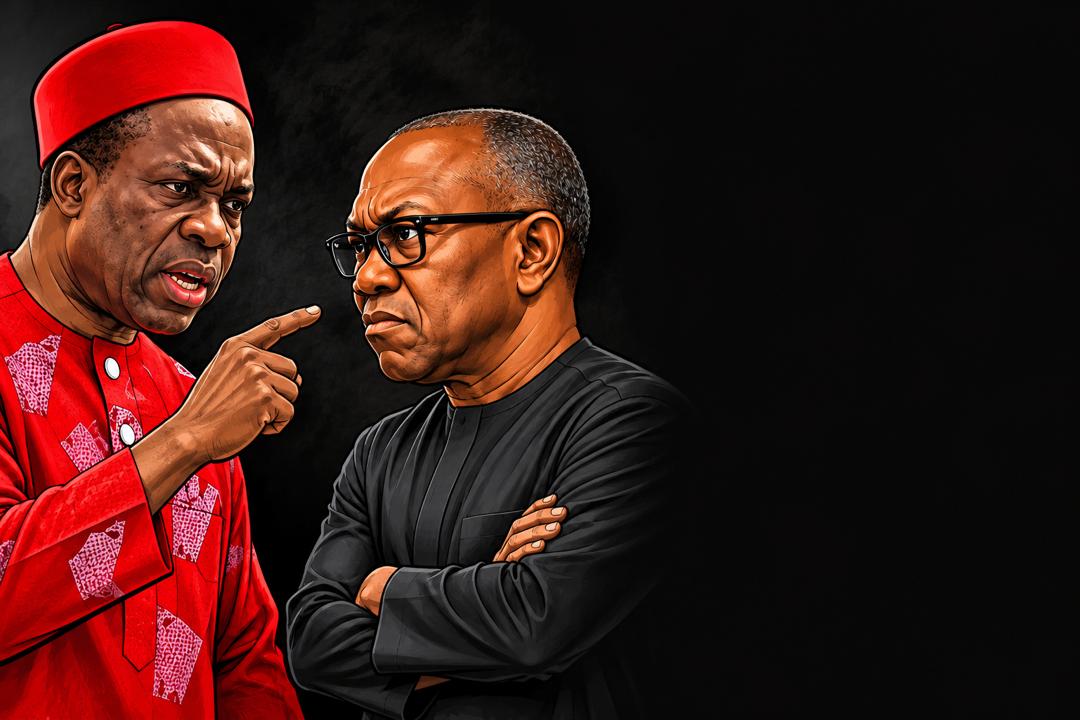
…Anambra governor turns more heat on predecessor as bitter 2010 rivalry explodes into 2027 presidential battle
By Chike Ofili
The long-running political rivalry between Anambra State Governor, Prof. Charles Chukwuma Soludo, and his predecessor, Peter Obi, has burst into open warfare, with disputes over debts, unpaid salaries and the stewardship of the state increasingly becoming ammunition in the battle for political supremacy ahead of the 2027 elections.
At the heart of the latest confrontation is a fundamental disagreement over the financial legacy Obi left behind when he departed Government House, Awka, in March 2014.
The Soludo administration has now escalated the battle by releasing what it says are documentary records contradicting Obi’s repeated claims of leaving Anambra without outstanding financial liabilities and challenging the Nigeria Democratic Congress (NDC) presidential candidate to make good his pledge to quit the 2027 race if the claims against his record are established.
On Tuesday, the Anambra State Government’s New Media Office released a letter dated April 25, 2006, purportedly written by Obi’s then Chief of Staff, Chuks Iloegbunam, appealing to the governor to intervene over unpaid salaries at the Anambra State Water Corporation.
The letter said workers of the corporation, whose monthly wage bill was put at about N15 million, had last received salaries in February and appealed to Obi to place the corporation on regular government subvention.
The document also referred to a campaign pledge attributed to Obi that he would resign if workers were not paid as and when due.
Armed with the document, the state government asked pointedly: “When will Peter Obi quit presidential campaign?”
There is, however, an important qualification to the latest evidence. Obi was sworn in as governor on March 17, 2006, only about five weeks before the April 25 letter. Since it said the Water Corporation workers had last been paid in February, the arrears referred to in the document appear to have begun before Obi assumed office. The document nevertheless indicates that unpaid salaries remained an issue requiring gubernatorial intervention after he took office.
But the salary controversy is only the latest front in a much bigger fight.
Days earlier, Soludo’s government released loan records which it said showed that eight external loans contracted during Obi’s administration had an outstanding balance equivalent to about N127.4 billion as of June 30, 2026.
Commissioner for Information and Value Reorientation, Dr Law Mefor, said the loans, originally valued at about $123.77 million, were contracted for projects covering malaria control, erosion, education, healthcare and other programmes.
According to the government, Anambra continues to service the obligations through deductions running into hundreds of millions of naira monthly.
The Soludo administration has also alleged that Obi left other liabilities, including pension and gratuity arrears, challenging the former governor’s carefully cultivated image as an exceptionally frugal administrator who handed his successor a financially pristine state.
Obi has fought back vigorously.
The former governor insists that he left no unpaid salaries, pensions, gratuities, or certified contractor obligations when he left office. He has maintained that his government cleared more than N35 billion in inherited gratuities and arrears and left substantial savings and investments for Anambra.
Former Secretary to the State Government under Obi, Oseloka Obaze, has also entered the dispute, saying the administration handed over N86.6 billion in cash and investments in 2014.
Obi then raised the stakes dramatically by declaring that he would stop campaigning for the presidency if Soludo’s government could establish that he left debts behind.
That challenge appears to have transformed what might ordinarily have remained an argument over government accounts into a potentially consequential 2027 political confrontation.
Behind the competing figures lies a political relationship that has been strained for years.
The two men were direct rivals in the 2010 Anambra governorship election. Obi, then the incumbent APGA governor, faced Soludo, a former CBN governor who contested on the PDP platform. Obi prevailed.
Their political paths subsequently diverged further, particularly after Obi left APGA and eventually emerged as the Labour Party presidential candidate ahead of the 2023 election.
The rupture became unmistakable in November 2022 when Soludo published his controversial essay, History Beckons and I Will Not Be Silent, after controversy over his assessment of investments made by the Obi administration.
In the intervention, Soludo openly disputed aspects of Obi’s economic record and rejected the political momentum surrounding his presidential candidacy. He argued that sustainable national political power required broader alliances rather than relying principally on the enthusiasm generated by Obi’s movement.
The latest statements from the Anambra government indicate that the disagreement has now moved beyond arguments over investments and political strategy to a direct contest over the documentary record of Obi’s eight years in office.
Mefor and other officials of the Soludo administration have maintained that accountability for Anambra’s financial records is at the heart of the controversy. Their argument is that if the state is still servicing loans contracted during Obi’s tenure, then claims that he left Anambra entirely debt-free require qualification.
Obi and his associates have disputed that interpretation, arguing that long-tenor development loans should not be equated with unpaid obligations to workers, contractors, and suppliers. They have also pointed to the cash and investments they say the Obi administration left behind as evidence of its fiscal prudence.
The competing statements and documents released by both camps suggest that this distinction — between outstanding development loans and other forms of government indebtedness — is likely to remain a major point of contention as the controversy continues.
Soludo’s public interventions have also increasingly questioned Obi’s wider political record and what his years of prominence have delivered for Anambra and the South-East, while Obi’s camp has continued to present his eight-year governorship as evidence of the fiscal discipline he says he would bring to the presidency.
Officials of the Soludo administration have, in turn, argued that Obi’s emergence as a 2027 presidential candidate makes closer examination of his record in Anambra legitimate, particularly because fiscal prudence remains one of the central pillars of his national political message.
The Anambra government has consequently continued to release records from the state’s archives in response to Obi’s claims, insisting that the documents provide Nigerians with material with which to assess competing accounts of his stewardship. Obi and his allies, however, maintain that the documents are being selectively interpreted and do not invalidate his record.
With Obi himself pledging to reconsider his presidential campaign if it is established that he left the state with the liabilities being alleged, the dispute has acquired stakes far beyond the old rivalry between the two former economic technocrats. What began as a quarrel over Anambra’s financial history has now become part of the wider contest over the record Obi is presenting to Nigerians in his bid for the presidency in 2027.
Discover more from Keeping Them Honest
Subscribe to get the latest posts sent to your email.