

By Peter Salami
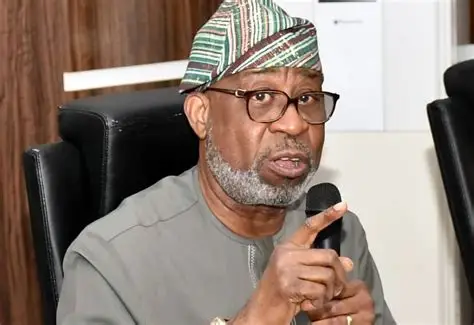
Nigeria’s Minister of Solid Minerals Development and Chairman of the Africa Minerals Strategy Group, AMSG, Dr Dele Alake, has taken the country’s mining reform campaign to the global stage, rallying African nations behind an ambitious plan to transform the continent from an exporter of raw minerals into a powerful hub for processing, manufacturing, and industrial wealth creation.
The push received the backing of President Bola Tinubu at the AMSG High-Level Roundtable on Critical Minerals Development in New York, held on the sidelines of the 81st Session of the United Nations General Assembly.
Tinubu, represented by Vice President Kashim Shettima, threw Nigeria’s weight behind the continental initiative, declaring that Africa’s vast mineral resources must henceforth translate into jobs, industries, infrastructure, technology, and prosperity for Africans.
The high-level meeting, convened under Nigeria’s leadership alongside Alake, brought African governments and stakeholders together under the theme, “From Resources to Wealth: Continental Cooperation for Mineral Value Addition, Data Sovereignty, Innovative Financing, and Critical Minerals Security.”
At the centre of the initiative is a Continental Integration and Economic Assurance Declaration being championed by the AMSG under Alake’s leadership to create a unified framework for Africa’s critical and solid mineral value chains.
Alake said the initiative was designed to bring African countries together around a common strategy for extracting greater economic value from their mineral resources instead of continuing the decades-old practice of exporting raw materials and importing finished products at considerably higher prices.
He urged African countries yet to join the AMSG to come on board, arguing that the continent would be better positioned to protect its interests and maximise its resources by pooling ideas, markets, and negotiating strength.
Alake also stressed that Africa’s mineral ambitions could not be realised through government policies alone, calling for partnerships capable of mobilising the huge financing, infrastructure, and industrial investment required to turn mineral deposits into sustainable prosperity.
Tinubu reinforced that message, warning that African countries risked weakening themselves if they competed against one another by offering lower royalties, weaker local-content requirements, and excessive concessions to secure foreign investment.
“Fragmentation leaves us exporting raw materials and buying finished goods at a premium. Cooperation gives our markets scale, our industries integration, our financing reach, and our negotiations authority,” the President said.
According to Tinubu, the global race for minerals needed for clean energy, artificial intelligence, and advanced manufacturing has created an historic opportunity for Africa, which possesses substantial deposits of cobalt, copper, lithium, rare earth elements, and other strategic resources.
But he insisted that merely possessing the minerals would not guarantee prosperity.
“For generations, Africa has furnished the materials of prosperity elsewhere. Our duty is to ensure that the future being fashioned from African minerals has room for African ambition,” Tinubu said.
He challenged the continent to build processing and refining capacity, manufacture batteries and components locally, acquire technology, and develop the skilled workforce needed to participate in the higher-value segments of global mineral supply chains.
“The worth of a mine must be counted in the lives it improves,” the President said, arguing that the true measure of Africa’s mineral success should be jobs created, industries established, infrastructure built, technology transferred, and prosperity retained on the continent.
Nigeria’s experience under the Tinubu administration was presented as an indication of what deliberate reforms could achieve.
Tinubu said mining-sector revenue rose from about N6 billion in 2023 to more than N38 billion in 2024 and between N68.1 billion and N70 billion in 2025, alongside growing foreign investment commitments.
The administration has also pursued greater local value addition, improved geological data, stronger regulation, the formalisation of artisanal miners into cooperatives, and measures against illegal mining.
Large-scale lithium processing capacity being developed in Nasarawa State was also highlighted as evidence of Nigeria’s determination to ensure that minerals extracted locally increasingly feed domestic processing and manufacturing rather than leave the country in raw form.
Tinubu urged other African countries to develop partnerships founded on mutual benefit, sovereign equality, fair market access, industrial investment, and technology transfer.
He also backed Alake’s drive for a stronger AMSG, calling on member countries to speak with one voice and turn the Continental Integration and Economic Assurance Declaration into an implementation programme with clear timelines, financing mechanisms, and public accountability.
Kenya’s Minister of Blue Economy and Maritime Affairs, Hassan Ali Joho, similarly called for stronger domestic resource mobilisation and greater transparency and competitiveness in Africa’s solid-minerals industry.
Discover more from Keeping Them Honest
Subscribe to get the latest posts sent to your email.