

By Peter Salami
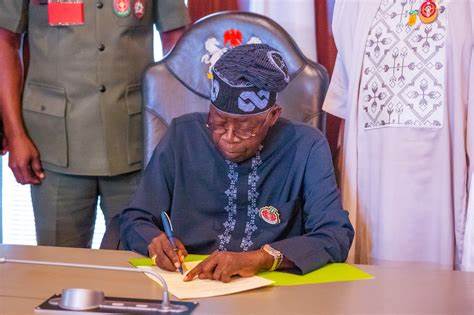
President Bola Tinubu has insisted that Nigeria’s newly enacted tax laws will be implemented as scheduled, despite growing opposition from opposition politicians, lawmakers, professional bodies, students, and civil society groups calling for their suspension.
In a statement issued yesterday, the President maintained that no substantial issue had been raised to justify halting or disrupting the tax reforms, some of which took effect on June 26, while others are slated to commence on January 1, 2026.
Tinubu described the tax reforms as a historic opportunity to rebuild Nigeria’s fiscal framework and strengthen governance.
“The reforms are a once-in-a-generation opportunity to build a fair, competitive, and robust fiscal foundation for our country,” the President said.
He clarified that the new tax laws were not intended to impose additional tax burdens on Nigerians but to overhaul the existing fiscal system, promote harmonization, and reinforce the social contract between citizens and the state.
“The tax laws are not designed to raise taxes but rather to support a structural reset, drive harmonization, and protect dignity while strengthening the social contract,” Tinubu stated.
The President urged all stakeholders to shift focus to implementation, noting that the reform process had entered what he described as the delivery stage.
“I urge all stakeholders to support the implementation phase, which is now firmly in the delivery stage,” he said.
Tinubu acknowledged the intense public debate surrounding alleged changes to some provisions of the tax laws but maintained that the concerns raised so far did not warrant a pause in implementation.
“No substantial issue has been established that warrants a disruption of the reform process,” he insisted.
He further emphasised his administration’s commitment to due process and respect for laws duly passed by the National Assembly and assented to by the President.
“Absolute trust is built over time through making the right decisions, not through premature, reactive measures,” Tinubu added.
Assuring Nigerians of continued engagement, the President said the Federal Government would work with the National Assembly to resolve any issues that may arise during implementation.
“I assure all Nigerians that the Federal Government will continue to act in the overriding public interest to ensure a tax system that supports prosperity and shared responsibility,” he said.
Despite the President’s position, opposition to the tax reforms has continued to mount.
Former Vice President Atiku Abubakar, the Minority Caucus of the House of Representatives, the Nigerian Bar Association (NBA), civil society groups, and student bodies have all called for the suspension of the laws scheduled to take effect from January 1, 2026.
In earlier statements, Atiku and the NBA have raised concerns over what they described as unconstitutional alterations to the Tax Reform Acts after passage by the National Assembly.
Atiku described the alleged modifications as “an act of treason against the Nigerian people,” accusing the executive arm of undermining legislative authority and due process.
He cited provisions granting tax authorities sweeping powers, including arrests, property seizures without court orders, and enforcement sales without judicial oversight.
“These provisions transform tax collectors into quasi-law enforcement agencies, stripping Nigerians of due process protections that the National Assembly deliberately included,” Atiku said.
He also criticised requirements such as mandatory 20 per cent security deposits for tax appeals, compound interest on tax liabilities, forced dollar-based computation for petroleum operations, and other measures he said would increase financial pressure on citizens.
Atiku called on the Federal Government to suspend implementation of the tax laws pending a full investigation, urged the National Assembly to reverse any illegal alterations, and asked the judiciary to strike down unconstitutional provisions. He also called on the Economic and Financial Crimes Commission (EFCC) to investigate those responsible.
NBA President, Mr. Afam Osigwe (SAN), echoed similar concerns, warning that the controversy surrounding the tax laws had eroded public confidence in the legislative process and created legal uncertainty capable of undermining economic stability.
The Minority Caucus of the House of Representatives also demanded a shift in the commencement date of the new tax regime, citing what it described as a “storm of controversy” over alleged unlawful alterations to the laws.
In a statement jointly signed by Minority Leader Rep. O.K. Chinda and other principal officers, the caucus called for an immediate suspension of implementation pending the outcome of ongoing investigations.
The lawmakers said Nigerians and the business community were entitled to access and verify authentic copies of the laws they were expected to obey, warning that circulating altered versions posed a serious threat to legislative integrity and democracy.
They disclosed that a House member had raised the matter during plenary, prompting the inauguration of a high-powered committee to probe claims that the tax laws were fraudulently altered after passage and assent.
The caucus urged Nigerians to disregard any versions of the tax laws not bearing the signatures of the Clerk to the National Assembly and the President.
The opposition escalated further on Monday as an Abuja High Court commenced hearing a suit seeking to halt implementation of the tax reforms.
The suit, filed by the Incorporated Trustees of the African Initiative Against Abuse of Public Trust, seeks an interim injunction restraining the Federal Government and relevant agencies from enforcing the new tax laws pending the determination of the substantive case.
Meanwhile, the National Association of Nigerian Students (NANS) had also accused the Federal Inland Revenue Service (FIRS) of fuelling confusion and mistrust around the new tax regime.
NANS President, Olushola Oladoja, said while tax reforms were necessary, the current approach was poorly communicated and constitutionally questionable, warning that implementation without proper public understanding could worsen economic hardship.
He criticised FIRS for relying on social media campaigns instead of grassroots engagement and called for nationwide sensitisation through town-hall meetings and structured civic organisations.
Discover more from Keeping Them Honest
Subscribe to get the latest posts sent to your email.