

…Says Shekarau, Ganduje, Incumbent Gov Yusuf Politically Finished
By Abu Adamu
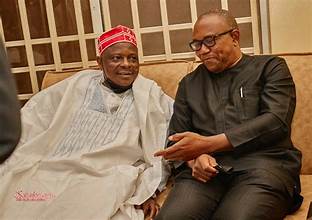
Former Kano State Governor and Vice-Presidential Candidate of the National Democratic Congress (NDC), Sen. Rabiu Kwankwaso, says he trusts the party’s presidential candidate, Peter Obi, to honour an agreement that he would serve only one term if elected president in 2027, after which power would return to the North.
Kwankwaso said the arrangement was part of the understanding between him and Obi to ensure political balance between the North and South, arguing that it would also respect the principle of rotational presidency.
The former governor made the disclosure while featuring on the News Agency of Nigeria (NAN) Personality Interview Series in Abuja on Sunday.
He described the proposed Obi-Kwankwaso ticket as “unbeatable” in terms of credibility and capacity, saying the combination of Obi’s political support in the South and his own influence in the North would provide a broad national platform capable of defeating other contenders in the 2027 presidential election.
“Nobody, no ticket, can beat our own in terms of credibility, capacity and of course, love for the country,” Kwankwaso said.
“Even in terms of empathy for the poor who are suffering across the country today, no other contender can match us,” he added.
Kwankwaso said his experience during the 2023 presidential election gave him a better understanding of Obi and contributed to the decision by both politicians and their supporters to work together ahead of the 2027 election.
According to him, the alliance is intended to bridge Nigeria’s regional and religious divisions by combining Obi’s support base in the South with his political influence in the North.
He said the arrangement also takes into account the need to maintain the North-South rotation of the presidency, noting that President Bola Tinubu, a southerner, assumed office in 2023.
“The bigger picture now is for us to allow the South to produce a president for one term, to make it balanced, considering the fact that the incumbent president from the South came into office in the year 2023,” he said.
Kwankwaso said the understanding was that Obi would serve for one term and subsequently hand over the presidency to a northerner.
He expressed confidence that Obi would honour the agreement, saying he had a high level of trust in the former Anambra State governor.
The former Kano governor said the arrangement would promote political balance and reassure supporters from both regions that neither side would be permanently excluded from national political leadership.
He also described the proposed ticket as a northern Muslim and southern Christian combination capable of addressing concerns over religious and regional representation.
According to him, the alliance is not merely about sharing political offices but about building confidence across the country and ensuring that no section of Nigeria feels marginalised.
Kwankwaso said an Obi-Kwankwaso administration would prioritise security, education, agriculture, and infrastructure, while addressing poverty and other socio-economic challenges confronting Nigerians.
He also criticised the Federal Government’s economic policies, arguing that the removal of the fuel subsidy had not translated into improved living conditions for Nigerians.
He said farmers were also facing difficulties, including competition from imported food.
Kwankwaso said the alliance involving the Kwankwasiyya Movement, the NDC and Obi’s supporters was aimed at producing what he described as democratic change similar to the political realignment that led to the defeat of the Peoples Democratic Party (PDP) in the 2015 presidential election.
He said the coalition was founded on the principles of fairness, justice and equity and was intended to provide Nigerians with an alternative political direction.
The former governor also spoke extensively about his political differences with former Kano Governors Ibrahim Shekarau and Abdullahi Ganduje, as well as incumbent Governor Abba Yusuf, declaring that the three were politically finished in the state.
Kwankwaso particularly criticised Ganduje, who served as his deputy for eight years before succeeding him as governor in 2015.
He attributed what he described as Ganduje’s declining political fortunes to the breakdown of their relationship, saying the former governor would have remained more influential had he stayed within the political structure they built together.
“If you can even see the issue of Ganduje, who we came together and supported, and became governor free of charge. The day when he started fighting was the beginning of his problem. If I may ask: where is he now? It is difficult to see him,” Kwankwaso said.
He said his experience of more than two decades in politics had convinced him that political betrayal could eventually lead to the loss of political relevance.
“You cannot succeed with treachery. I have not seen one. Now we have taken about two and a half decades,” he said.
Kwankwaso also criticised Governor Abba Yusuf, saying his political movement had deliberately backed Yusuf because it wanted a candidate who would not repeat what he described as Ganduje’s actions.
“Abba Yusuf: we went down, right down, to make sure that we picked the right person who would not go and repeat what Ganduje had done,” he said.
He recalled that members of his political group worked to secure Yusuf’s candidacy in the 2019 governorship election, which Yusuf won before the result was overturned through litigation.
According to Kwankwaso, the same political structure returned in 2023 and secured Yusuf’s election as governor.
He, however, alleged that Yusuf had subsequently distanced himself from the political camp that brought him to power.
“He left us, but he is not with Ganduje now. He is in between because I don’t think he is happy for anybody to call him Dan Gandujiyya,” he said.
Kwankwaso also alleged that Yusuf was seeking to establish himself as the dominant political figure in Kano despite Kwankwaso’s continued influence in the state.
He described political struggles over control and succession as a recurring feature of Nigerian politics rather than an issue peculiar to Kano.
It was against this backdrop that Kwankwaso recalled a conversation with President Tinubu in which, according to him, the President asked him to reconcile with Ganduje.
Kwankwaso said he responded by reminding Tinubu of former political associates who once occupied prominent positions within his political circle but had subsequently fallen out of the centre of power.
“I told him that when I come here, I don’t see Bucknor. When I come here, I don’t see Ambode. I started counting the people,” he said.
He was referring to Sen. Kofoworola Bucknor-Akerele, a former Lagos State deputy governor, and Akinwunmi Ambode, who served as Lagos State governor from 2015 to 2019.
Kwankwaso said the examples illustrated the transient nature of political relationships and explained why he did not assume that reconciliation between former allies necessarily guaranteed lasting political harmony.
“It’s not very peculiar to Kano, but I think the Kano experience is special out of the lot,” he said.
He nevertheless acknowledged that some political relationships could survive differences and singled out former Osun State Governor, Chief Bisi Akande, as one of the political associates he still regarded as a friend.
Kwankwaso compared enduring political relationships to friendships formed in school, saying people could maintain bonds despite taking different paths in their political careers.
His comments come against the backdrop of the long-running political rivalry between him and Ganduje. Ganduje succeeded Kwankwaso as Kano governor in 2015, but their relationship subsequently deteriorated, with the two men eventually leading rival political camps in the state.
Discover more from Keeping Them Honest
Subscribe to get the latest posts sent to your email.