

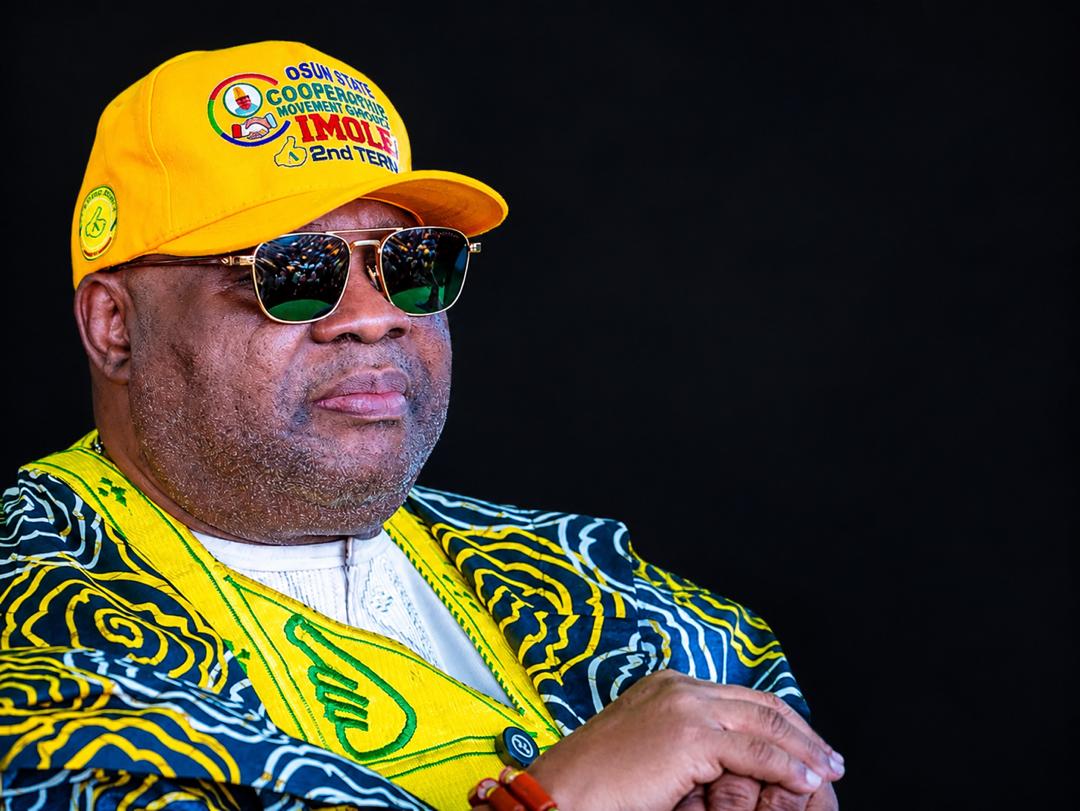
…Tinubu, Atiku, Obi Hail as Adeleke Dances Back to Power
By Orkula Shaagee
With additional reports from:
Emmanuel Olugua, Alhassan Kpaki and Samuel Aghulor
The outcome of the 2026 Osun State governorship election has thrown up important lessons for Nigeria’s emerging opposition platforms, with political observers warning that weak grassroots structures, inadequate funding and the power of incumbency could pose formidable challenges to the African Democratic Congress (ADC) and Nigeria Democratic Congress (NDC) ahead of the 2027 general elections.
The warning followed the decisive victory of incumbent Governor Ademola Adeleke of the Accord Party, who was declared winner of Saturday’s election by the Independent National Electoral Commission (INEC), polling 511,067 votes to defeat his closest challenger, Bola Oyebamiji of the All Progressives Congress (APC), who scored 444,815 votes.
The ADC candidate, Najeem Salaam, finished a distant third with 17,180 votes, while the NDC, whose presidential candidate Peter Obi has emerged as one of the leading figures of the opposition movement ahead of 2027, did not contest the Osun governorship election.
Adeleke won 19 of the state’s 30 local government areas, while Oyebamiji secured 11. The result, according to analysts who spoke across Lagos, Port Harcourt, Niger, and Abuja, highlighted the enormous gap between national political visibility and the painstaking grassroots organisation required to translate political momentum into votes.
For the ADC, the Osun result is particularly significant because the party is increasingly being positioned as a major platform for opposition forces seeking to challenge the established political order in 2027. But observers said the performance exposed the danger of assuming that the presence of high-profile, nationally recognised politicians can substitute for a functioning electoral machine at ward and local government levels.
A Lagos-based political analyst, Fidelis Oyeoma, said the ADC and NDC appeared to be “trying to find their feet” when confronted by parties with much deeper structures and stronger voter relationships.
“I think NDC and ADC have to go and prepare well before 2027. They have to be able to match the APC,” he said, stressing the need for the emerging platforms to take their messages directly to voters.
“They have to go from door to door and let people know what ADC has for them in the future and NDC as well,” he added.
The warning is coming at a particularly important moment for the opposition. While the ADC has attracted significant political attention through the alignment of prominent opposition figures, the Osun result suggests that national visibility must still be converted into local organisation before the 2027 contest.
In Port Harcourt, a Business Intelligence Analyst with the Port Harcourt Electricity Distribution Company, Benjamin Ndubueze, also identified grassroots organisation and candidate popularity as critical factors in the election.
He nevertheless said Accord’s victory should worry the APC ahead of 2027, arguing that the result demonstrated that presidential power does not automatically guarantee victory across the nation.
“Accord’s victory should be a fear factor for the APC ahead of 2027, whether incumbent power or not,” he said.
Another Port Harcourt respondent, Edith Owuala, cautioned against interpreting the election as a direct verdict on the NDC because the party did not field a candidate. She, however, identified Adeleke’s personal popularity, political movement, and incumbency as important components of his victory.
Chidiebere Favour Ochonma, a COREN-registered Process Engineer and PMP-certified Project Engineer, said the ADC performance should be treated as a warning about the organisational weaknesses of emerging opposition platforms.
According to him, inadequate grassroots structures, internal divisions, and insufficient funding contributed to the party’s poor showing. He also regarded the party’s inability to secure substantial support in the candidate’s home local government area as an indication of the depth of the organisational challenge.
For the opposition, he said, national coalitions and prominent political figures would only become electorally meaningful if backed by strong ward, state, and federal structures, adequate resources, and internal cohesion.
The same concern was expressed by a political observer in Niger State, Aliyu Suleiman Dada, who said the Osun result demonstrated that name recognition and elite endorsements could not by themselves guarantee electoral success.
He noted that Salaam’s 17,180 votes represented only a small fraction of the total valid votes, leaving the ADC a distant third in what effectively became a two-horse race.
“Structure and ground game matter far more than name recognition or elite endorsements,” he said.
Dada said the ADC was being taken more seriously in some parts of the country because of its growing association with the 2027 opposition project, but warned that the party remained far from having the organisational depth required to compete on equal terms with the established political machines.
He said the NDC faced an even steeper challenge because of its relatively limited electoral footprint.
According to him, the emerging parties could become serious contenders by 2027 if they establish effective ward-to-state structures, recruit credible candidates, and secure reliable financial resources.
He also warned that poor electoral performances could make prospective candidates, political financiers, and influential stakeholders more hesitant to invest in the platforms.
“Poor showings like this make politicians, donors, and ambitious candidates more cautious about investing time, money, or reputation,” he said.
The election, however, produced a wave of jubilation across Osun, particularly in Ede North, Ede South, and other communities, after INEC formally declared Adeleke the winner. Residents who spoke after the declaration described the exercise as generally orderly and transparent, although they called for electoral lapses recorded during the poll to be addressed ahead of the 2027 presidential election.
The INEC Returning Officer, Prof. Joshua Ogunwole, declared Adeleke the winner after the incumbent secured 511,067 votes from 985,079 valid votes cast. A total of 1,005,800 votes were recorded, with 20,721 rejected.
In his declaration, Ogunwole said: “I, Professor Joshua Ogunwole, hereby certify that I am the returning officer for the 2026 Osun governorship election held on Aug. 15, and declare that Ademola Jackson Adeleke of the Accord Party, having satisfied the requirements of the law, is hereby declared the winner.”
President Bola Tinubu subsequently congratulated Adeleke, saying he had personally called the governor to acknowledge his victory, describing the result as confirmation of the confidence placed in him by Osun voters.
Tinubu urged Adeleke to use his renewed mandate to unite the people of Osun and pursue growth, stability, and social and economic progress irrespective of how they voted.
The President also commended the other contestants for participating in the election and praised INEC and the security agencies for conducting what he described as a peaceful and transparent election.
Atiku Abubakar, the ADC presidential candidate for 2027, congratulated Adeleke and said his victory demonstrated the choice of Osun voters as expressed at the ballot box.
“I congratulate Governor Ademola Adeleke on his re-election as Governor of Osun State. His victory demonstrates the choice of the people of Osun as expressed at the ballot box,” Atiku said.
He commended Osun voters for their peaceful participation and wished Adeleke success in his second term.
Peter Obi, presidential candidate of the NDC, also congratulated Adeleke, describing the result as an important democratic achievement.
In a statement titled “Osun: When the People Stand, Democracy Wins,” Obi said the people of Osun had spoken with courage and clarity and argued that Adeleke’s renewed mandate reflected his commitment to the people, compassion for their needs, and achievements in office.
Obi particularly praised Osun youths for what he described as their peaceful defence of their democratic mandate. He urged Nigerians to remain informed, participate actively in the 2027 elections, and, most importantly, protect their votes at polling units.
He said the Osun experience showed that democracy was strongest when citizens were alert, conscious of their civic responsibilities, and determined to ensure that their votes counted. He also called on political actors to place the interests of Nigerians above partisan considerations and ensure that elections remained contests of ideas, competence, character, and service rather than violence.
The Inter-Party Advisory Council, IPAC, also congratulated Adeleke, describing his victory as a significant triumph for democracy and the rule of law.
IPAC National Chairman, Dr Yusuf Dantalle, commended Osun voters for what he described as their democratic resilience and praised INEC, security agencies, civil society organisations, domestic observers, and the international community for their roles in the conduct of the election.
He said the outcome demonstrated the people’s determination to exercise their constitutional rights and called for continued efforts to strengthen electoral integrity and public confidence in Nigeria’s democratic system.
Celebrations spread across Osun following the declaration, with Afrobeats star David Adeleke, popularly known as Davido, celebrating the victory of his uncle. Davido, who had campaigned for Adeleke, posted “WE DID IT UNC!!!” on his verified X account alongside a celebratory video.
The APC, meanwhile, adopted a more cautious position, saying it was studying the election results before deciding its next course of action.
The party’s Director of Media and Information, Kola Olabisi, said the APC would consult its lawyers and explore constitutional avenues available under the Electoral Act.
The party urged its members and supporters to remain calm, while insisting that the electoral process extended beyond the declaration of results and could proceed through the Election Petition Tribunal, Court of Appeal, and, ultimately, the Supreme Court.
The APC also alleged that some of its members and supporters had been molested and appealed to the police to protect them, while maintaining that it remained committed to the rule of law.
Discover more from Keeping Them Honest
Subscribe to get the latest posts sent to your email.