

…G100 pushes single opposition presidential candidate, four-year transition government
…Donald Duke offers to sacrifice ambition, back consensus choice
By Chike Ofili
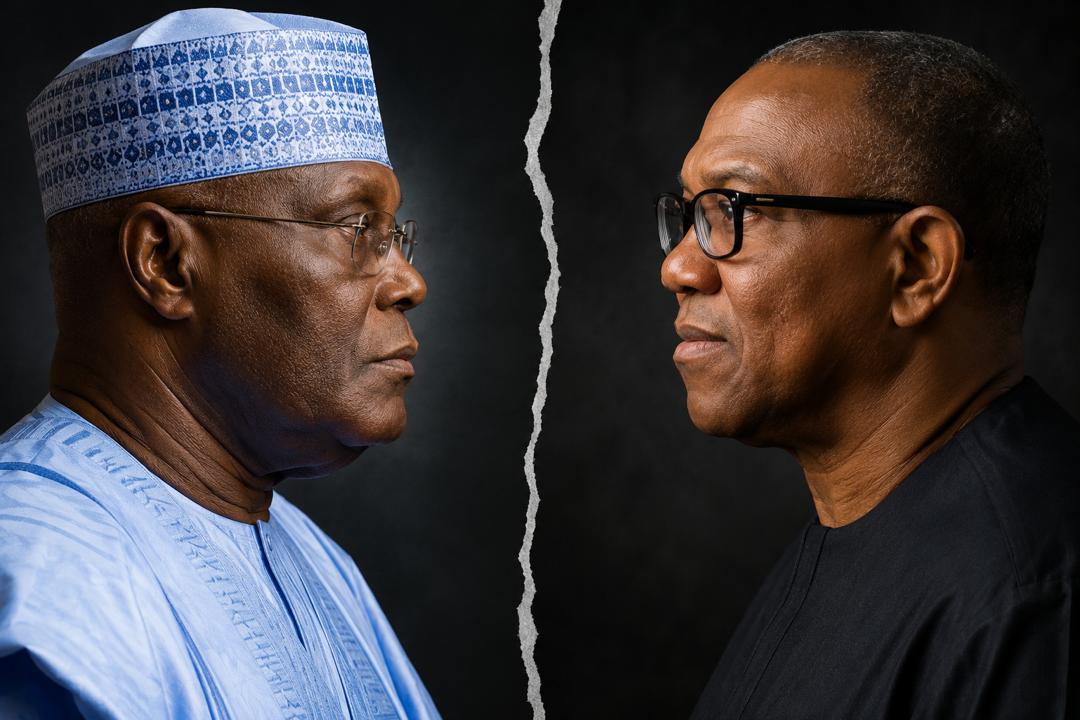
The push to forge a united opposition front against President Bola Ahmed Tinubu in the 2027 presidential election suffered an early setback on Monday as four of the most influential figures in the opposition—Atiku Abubakar, Peter Obi, Rabiu Musa Kwankwaso, and Rotimi Amaechi—stayed away from a major summit convened in Abuja to fashion a common electoral strategy.
The absence of the four political heavyweights cast a shadow over the much-anticipated Summit of Nigeria’s Opposition Political Parties, where organisers unveiled an ambitious plan for a single four-year transition government and a process that could ultimately produce one presidential candidate to confront the ruling All Progressives Congress (APC).
The summit, organised by the G100 in collaboration with the Minority Caucus of the House of Representatives, was held at the Shehu Musa Yar’Adua Centre under the theme, “A Framework for Opposition Cooperation and Coordination.”
Although six opposition parties were represented, the non-appearance of some of the politicians considered central to any viable anti-APC coalition immediately raised questions about the prospects of getting the major opposition forces behind one candidate.
Atiku, presidential candidate of the African Democratic Congress (ADC), and Obi, candidate of the Nigeria Democratic Congress (NDC), had been expected at the gathering but did not show up.
Their running mates, former Kano State governor Kwankwaso of NDC and former Transportation Minister Amaechi of ADC, were also absent. No official explanations were immediately given for their non-attendance.
Their absence was particularly significant because the central challenge confronting the proposed coalition is how to reconcile the presidential ambitions and political interests of the leading opposition blocs before the 2027 election.
Representatives of the ADC, NDC, Peoples Democratic Party (PDP), Social Democratic Party (SDP), Peoples Redemption Party (PRP), and Allied Peoples Movement (APM), however, participated in the deliberations.
Among prominent politicians present were PRP presidential candidate and former Cross River State governor, Donald Duke; SDP presidential candidate, Prince Adewole Adebayo; his running mate, Dr Usman Bugaje; former Niger State governor, Babangida Aliyu; APM vice-presidential candidate, Lawal Daura; PRP National Chairman, Hakeem Baba-Ahmed; House of Representatives Minority Leader, Fred Agbedi; and ADC National Publicity Secretary, Bolaji Abdullahi.
Despite the conspicuous absences, G100 Director-General and former Director-General of the Progressive Governors’ Forum, Salihu Mohammed Lukman, insisted that the summit represented the beginning of a serious attempt to prevent another fragmentation of opposition votes.
Lukman warned that unless opposition parties learnt to cooperate, their divisions could again hand the APC an advantage in 2027.
He argued that the opposition had repeatedly gone into presidential elections separately, allowing the ruling party to benefit from fragmented votes, and urged political leaders to agree first on the rules governing cooperation before negotiating candidates and offices.
“We are not asking any political party to dissolve. Let us agree that we must build the table before negotiating the seats,” Lukman said.
According to him, the summit was not convened to select a consensus presidential candidate immediately or compel any aspirant to abandon his ambition.
Instead, the parties were being asked to establish a framework through which they could cooperate, coordinate political activities, and ultimately develop an agreed process for producing a common presidential candidate.
Lukman drew attention to the 2023 presidential election, arguing that the opposition paid heavily for its inability to coordinate its strength.
President Tinubu won the election with just below nine million votes, while the two leading opposition candidates collectively polled about 13 million.
“Nobody stole thirteen million votes. We divided them ourselves, in public, and we did it knowing exactly what the consequence would be,” Lukman said.
He contrasted the 2023 experience with the opposition alliance that produced the APC ahead of the 2015 election, saying its success was founded less on personal relationships among its leaders than on an agreed political process.
“What they had was not affection. What they had was sequence. They agreed on the rules before they knew the outcome,” he said.
Central to the G100 proposal is the establishment of what it describes as a Government of National Competence, which would serve for a single four-year transition term.
Under the proposal, the government would be based on competence, integrity, national inclusion, and fair representation of every political party participating in the coalition.
It would implement a time-bound Four-Year National Reset Programme and be bound by an enforceable Transition Charter intended to guarantee adherence to the single-term commitment.
Lukman stressed that any agreement must go beyond the usual political promises.
“We want to underline the word ‘enforceable.’ This gathering does not need more sincerity. Nigerian politics has never suffered from a shortage of sincere promises. What it has suffered from is promises that nobody could enforce when the person who made them changed his/her mind,” he said.
Any agreement reached, he added, “must be written, it must be witnessed, and it must have consequences.”
The proposed structure would establish a Central Leadership Committee made up of national chairmen, national secretaries, and presidential and vice-presidential candidates of participating parties to provide overall political direction.
A Publicity and Communication Committee would coordinate the coalition’s messaging, while a Legal Committee would deal with legal strategy and issues arising from the alliance.
Five working groups are also proposed, with each participating party nominating a representative.
The groups would prepare proposals on a National Covenant for Democratic Renewal, a Single-Term Transition Charter, a National Reform Programme, a Framework for Opposition Unity, and a Roadmap to a Common Presidential Candidate.
They are expected to complete their assignments within four weeks and submit their recommendations to a second opposition summit for consideration and possible adoption.
But Lukman acknowledged that the real test would come when the discussions move from broad declarations about unity to decisions affecting individual ambitions.
“There is no version of this that costs nobody anything. Someone in this hall will have to accept an outcome he/she did not want. That is what unity is. It is not a communiqué. It is somebody’s disappointment, borne well,” he said.
He warned that participants must disclose their political red lines early rather than conceal them until negotiations reach a decisive stage.
“A hard line declared this morning is a problem that can be solved between now and the Second Summit. A hard line concealed this morning is a coalition that collapses in October, and that one will collapse in public too, only later, and at far greater cost to everybody in this room,” he said.
One presidential contender who publicly indicated his willingness to make the sacrifice was Duke.
The former Cross River governor declared that his presidential ambition would not stand in the way of a broader opposition agreement and pledged to support whatever candidate eventually emerges from a credible coalition process.
“We will support any political party that emerges in 2027. Whatever decision is arrived at today, I will not walk away but will strive all along because that’s what the people want to see,” Duke said.
His declaration offered the summit a significant boost, but the absence of Atiku, Obi, Kwankwaso and Amaechi underscored the much bigger hurdle facing the coalition builders.
Lukman maintained that neither the G100 nor the Minority Caucus was promoting any candidate or attempting to force participating parties into a merger.
“We are not promoting any candidate, no preference among the six parties in this hall, and nothing to gain from one of you rather than another,” he said.
He said the ultimate purpose was to give Nigerians a credible alternative government in 2027.
“Our only interest is the one stated in the Doctrine we published on August 2: that a democracy is sustained not merely by holding elections, but by the credible possibility of an alternative government,” Lukman said.
To many observers, Monday’s gathering exposed the gulf between opposition unity plans and the reality of persuading its biggest political actors to sit around the same table to possibly negotiate their ambitions away.
With a few months to the 2027 general elections, political analysts wonder if the proposed four-week negotiation process would be enough to produce a common challenger to the ruling APC, given the deep rooted, almost historical ambitions of the presidential candidates of the ADC and NDC.
Discover more from Keeping Them Honest
Subscribe to get the latest posts sent to your email.