

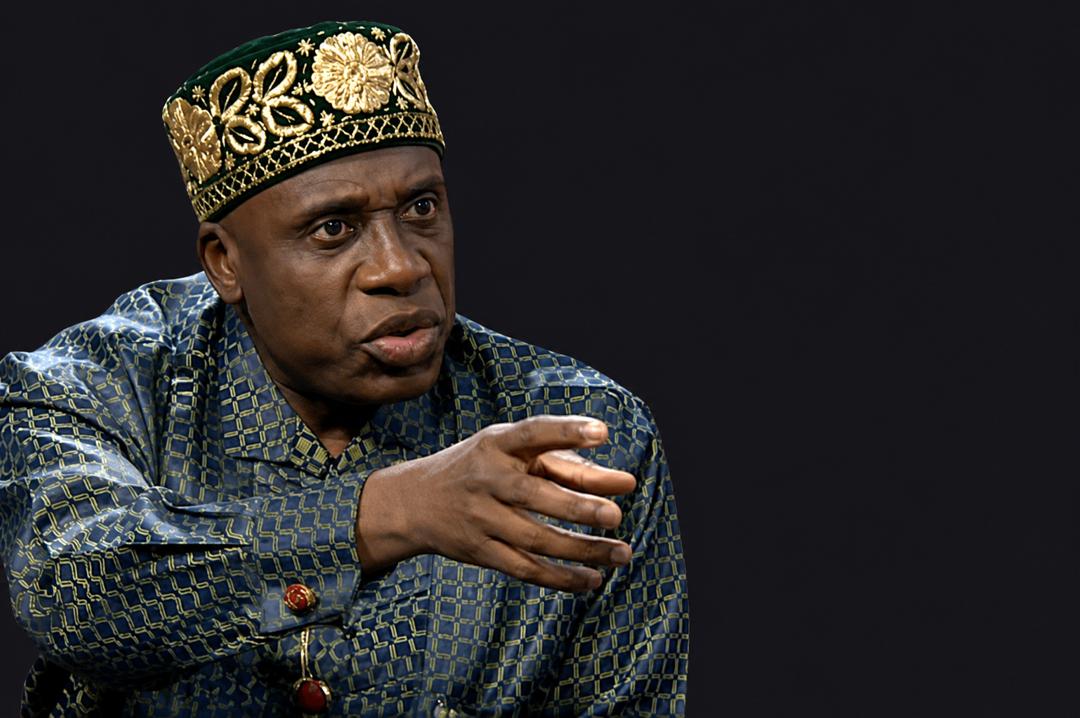
…Accuses Tinubu of favouring Yoruba ethnic group over others, as Gbajabiamila defends President’s record
By Peter Salami
Former Rivers State Governor and African Democratic Congress (ADC) vice-presidential candidate, Rotimi Amaechi, has said an ADC government would pursue inclusive governance and ensure that federal appointments reflect Nigeria’s diversity rather than being concentrated in one ethnic group.
Amaechi, who accused President Bola Tinubu’s administration of concentrating appointments in key federal agencies around people from his Yoruba ethnic base, said an Atiku Abubakar-Amaechi government would be detribalised and spread appointments across the country if elected in 2027.
The former Minister of Transportation spoke on Monday at the 2026 Nigerian Bar Association (NBA) Conference in Port Harcourt, Rivers State, where leading presidential candidates and political figures outlined competing positions on the economy, security, policing and fuel subsidy ahead of next year’s general election.
Amaechi said the ADC ticket would seek to build a government in which Nigerians from different parts of the country had a sense of belonging, contrasting that approach with what he described as the concentration of appointments under the Tinubu administration.
According to him, the Atiku-Amaechi ticket, if elected, would be “de-tribalised” in making political appointments and ensure that opportunities were spread across the federation.
He specifically alleged that Tinubu had concentrated appointments in important federal agencies around Yoruba appointees.
Amaechi also painted a bleak picture of the economy, saying Nigeria needed to create jobs, strengthen local content, and increase the amount of money circulating in the hands of ordinary citizens.
He argued that employment creation and greater domestic participation in economic activities would be crucial to stabilising the economy and improving household purchasing power.
Drawing attention to his record as Rivers governor, Amaechi said his administration built more than 500 primary schools, over 300 health centres, and more than 200 roads.
He also claimed that crime was drastically reduced during his tenure through intelligence gathering and sustained security interventions.
On the contentious debate over state police, Amaechi said he would rather support community policing, arguing that security structures rooted in communities would be better equipped to detect threats and understand local security challenges.
His position differed from that of several other participants who backed state police and came as President Tinubu’s Chief of Staff, Femi Gbajabiamila, strongly defended the administration’s move to decentralise Nigeria’s policing structure.
In a keynote address titled “Policing in Transition,” Gbajabiamila said Tinubu had chosen to confront a longstanding weakness in Nigeria’s security architecture by proceeding with plans for state police.
He said the proposed reform must, however, be accompanied by safeguards to prevent abuse by political authorities.
Gbajabiamila argued that Nigerians must enjoy equal protection in every part of the federation regardless of ethnicity, religion, or other considerations.
“Nigerians must receive equal protection in every state, regardless of ethnicity, religion, or others,” he said.
He said Nigeria also needed to clearly identify the deficiencies the reforms were intended to address, pointing particularly to the shortage and poor deployment of police personnel.
According to him, Nigeria currently has one police officer to about 650 people, compared with an international benchmark of one officer to 450 people.
He said the situation was compounded by the deployment of large numbers of police officers to administrative and escort duties.
Gbajabiamila also stressed the importance of improved training and professionalism, saying officers must be properly prepared to enforce the law and policing transformed into a respected career.
But he acknowledged fears that state police could be weaponised by governors against their political opponents.
“Who polices the police?” Gbajabiamila asked, arguing that while governors required sufficient authority to perform their constitutional responsibilities, such powers must have clear limits.
“A governor shouldn’t be allowed to order the arrest of a political opponent,” he said.
He added that police officers who refused unlawful instructions must be protected by strong institutions rather than relying merely on assurances from political officeholders.
“An officer who refuses an unlawful command must be protected as well,” Gbajabiamila said.
The NBA conference also featured Nigerian Democratic Congress (NDC) presidential candidate Peter Obi, African Action Congress (AAC) candidate Omoyele Sowore, former Cross River State governor Donald Duke of the Peoples Redemption Party (PRP), and Social Democratic Party (SDP) presidential candidate Adewole Adebayo.
The politicians used the gathering to present sharply different prescriptions for Nigeria’s security and economic challenges.
While most participants favoured decentralising the police, Adebayo proposed a three-tier policing arrangement at federal, state and local government levels, while Amaechi maintained that community policing would provide a more effective grassroots security structure.
Sowore and Adebayo argued that a change of leadership was necessary to tackle insecurity, with Sowore also strongly criticising the impact and management of fuel subsidy removal.
Sowore argued that state governments had been among the biggest beneficiaries of the increased revenues following subsidy removal while ordinary Nigerians continued to bear higher transportation and living costs.
“The poor people of this country only benefit from subsidy on petrol, gasoline,” he said, stressing that any sustainable subsidy policy must be accompanied by an effective transportation policy.
Obi, meanwhile, identified poverty reduction and increased production as essential components of the fight against insecurity.
“Nigeria must move from a consumption country to a production country. We must invest heavily in agriculture,” Obi said.
Duke said Nigeria’s wider problems ultimately revolved around leadership, arguing that getting the country’s leadership recruitment right would make other challenges easier to resolve.
“If we get the leadership right, everything else will fall into place,” the former Cross River governor said, while also warning against the continued influence of ethnicity in national politics.
Discover more from Keeping Them Honest
Subscribe to get the latest posts sent to your email.