

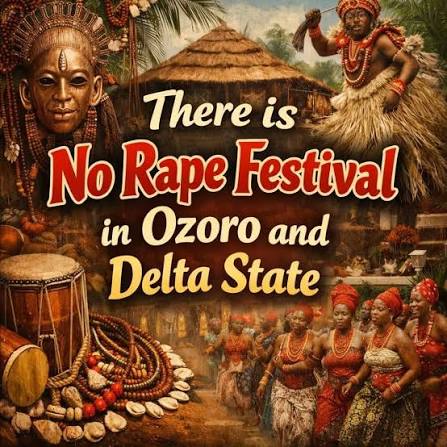
…Niboro, Igelige: No Urhobo or Isoko Festival Promotes Sexual Violence
By Emmanuel Olugua
Former Delta State Governor, James Ibori, has strongly condemned reports linking an alleged sexual assault incident in Ozoro to a so-called “rape festival,” describing the claim as false, dangerous, and a gross misrepresentation of Urhobo and Isoko culture.
Ibori, reacting to viral social media reports suggesting that a local festival in Ozoro sanctioned acts of sexual violence against women, said he was shocked by the allegation, noting that in all his years living in Urhobo land, including his eight-year tenure as governor, he had never heard of such a practice.
The incident, which reportedly involved the assault of young women in Ozoro, a university town in Isoko North Local Government Area of Delta State, has sparked outrage nationwide, with many calling for justice and clarity over the circumstances. However, attempts by some commentators to label the occurrence as part of a cultural festival have drawn widespread criticism.
“I must confess that this is the first time I am hearing of a festival of this nature,” Ibori said, adding that he immediately sought to verify the claims upon being alerted. According to him, preliminary findings indicate that even the traditional authorities in Ozoro, whose approval is essential for any recognised cultural festival, were not consulted.
He stressed that it was both unfair and misleading to attribute the actions of a few criminal elements to the entire Isoko ethnic group, warning further against dragging the Urhobo people into what he described as a baseless narrative.
Ibori also dismissed claims linking the Ekene festival to any form of sexual misconduct, insisting that festivals across Urhobo and Isoko communities are deeply rooted in history, spirituality, and moral values.
“Festivals among our people are celebratory and symbolic. They memorialise past events, reinforce belief systems, and are anchored in strong moral codes. There is nothing in our tradition that condones violence, let alone sexual violence against women,” he said.
While condemning the reported assault in the strongest terms, the former governor commended security agencies for stepping in to investigate the matter, expressing hope that their findings would put to rest what he called “a dangerous distortion of cultural identity.”
He further pledged to work with local institutions, which include the traditional council and the university community in Ozoro, to engage young people and reinforce respect for societal values, particularly the dignity and protection of women.
Adding his voice to the controversy, former presidential spokesman and publisher of Keeping Them Honest Daily, Ima Niboro, categorically rejected the notion that any festival in Urhobo or Isoko land promotes rape or gender-based violence.
Niboro, who is maternally Isoko and paternally Urhobo, strongly condemned the violence against women, but said the group narrative being pushed in some quarters was false and deeply offensive to the cultural heritage of the people.
“There is no festival in Isoko or Urhobo land that is about rape or sexual violence. Our cultural festivals are no different from those across Africa—they are meant to reconnect people with their traditions, values, and the moral codes that sustain society,” he said.
He emphasised that traditional institutions in the region have historically upheld the dignity of women, noting that motherhood occupies a central and revered place in Urhobo and Isoko cosmology.
“Our cultures hold women in very high esteem, particularly because of the profound significance of mothers and motherhood. Any act that demeans women is a violation of our values, not an expression of them,” Niboro added, while calling for an unfettered investigation into the criminality that occurred in Ozoro.
Also weighing in, prominent entertainment lawyer, Rockson Igelige, an indigene of Isoko, described the “rape festival” narrative as a reckless distortion that maligns an entire people.
Igelige insisted that no known cultural practice in Isoko land permits or encourages sexual violence, stressing that what occurred in Ozoro, if proven, should be treated strictly as a criminal act.
He emphasised the need to separate criminality from culture, warning against the dangers of amplifying unverified claims that could stigmatise communities and erode cultural identity.
He called for a thorough, transparent investigation noting that justice for the victims must remain the primary focus.
The intervention by Ibori, as well as Niboro and Igelige, comes amid growing concern that misinformation surrounding the Ozoro incident could inflame ethnic tensions and unjustly stigmatise entire communities.
Observers say the focus must now shift to ensuring justice for the victims while condemning attempts to weaponise culture as a cover for criminal acts in Ozoro.
Discover more from Keeping Them Honest
Subscribe to get the latest posts sent to your email.