

…Obi, Salihu Urge Tinubu to Rethink Fiscal Priorities
…Say Unsustainable Borrowing Won’t Lift Nigeria Out of Poverty
By Peter Salami
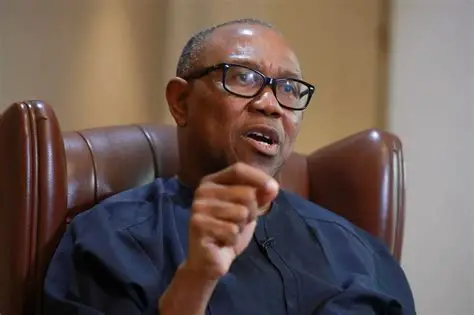
The 2023 Labour Party presidential candidate, Mr. Peter Obi, and former Director-General of the Federal Radio Corporation of Nigeria (FRCN), Dr. Ladan Salihu, have urged the Bola Tinubu administration to recalibrate its economic strategy, warning that unsustainable borrowing and fiscal indiscipline are aggravating Nigeria’s economic woes.
Obi, who voiced his concerns via his official X (formerly Twitter) handle, described Nigeria’s growing external debt as alarming, with no corresponding improvement in critical sectors like education, healthcare, infrastructure, and security. Dr. Salihu echoed similar sentiments in a live interview on ARISE News, calling for a total rethink of the government’s financial priorities.
Their interventions come on the heels of the National Assembly’s recent approval of new external loans amounting to $21 billion, €2.2 billion, and ¥15 billion for the 2025–2026 fiscal cycle, in addition to domestic bond issuances and grants. This is despite Nigeria’s existing public debt, which Obi estimates at about N187 trillion, likely to surpass N200 trillion by year-end.
“The debt-to-GDP ratio is spiraling out of control,” Obi cautioned. “Even after the latest GDP rebasing, the government has borrowed over 50% of the nation’s entire economic output. This is the highest debt burden in Nigeria’s history, and it’s simply unsustainable.”
He lamented that despite the scale of borrowings, poverty, unemployment, and human development indicators continue to worsen. Citing statistics, Obi pointed out that over 133 million Nigerians live in multidimensional poverty, healthcare remains inaccessible to the masses, and infrastructure—especially roads and electricity—is in a state of decay.
“Borrowing itself is not inherently bad,” Obi clarified. “But when debts are not tied to productive investments with measurable impact, and there’s no transparency or accountability, we are simply mortgaging the future of young and unborn Nigerians.”
The former Anambra State governor called on the Tinubu administration to drastically cut the cost of governance, plug leakages, and refocus public spending on human capital development and economic productivity. “We need a disciplined, people-centered approach that ensures every borrowed kobo delivers tangible benefits,” he stated.
On his part, Dr. Ladan Salihu criticized what he termed the government’s “reckless” borrowing attitude, arguing that the frequency and scale of loans are out of sync with Nigeria’s pressing needs. “Citizens are groaning under the weight of economic hardship, yet the government’s response has been to double down on borrowing,” Salihu said.
Speaking on ARISE News, Salihu said Nigeria’s debt ballooned from about N138 trillion in 2023 to nearly N187 trillion within a year. He questioned whether the borrowing spree is addressing priority areas like infrastructure, education, and youth employment.
“What we’re witnessing is a financial culture that prioritizes elite-driven projects—like bloated constituency allocations—over genuine national development,” Salihu alleged. “We are spending heavily, yet the results are not adding up.”
He expressed dismay over reports of constituency projects allocated billions per legislator, describing them as patronage tools for political elites rather than instruments for economic transformation. “These projects, while not necessarily white elephants, do not create the scale of impact needed to lift the country.”
On Nigeria’s persistent power crisis, Salihu questioned why the government would need fresh loans to settle outstanding payments to power generation companies (GenCos). “With strategic financial discipline, we can resolve these issues without always resorting to borrowing,” he said.
Salihu, however, acknowledged that borrowing could be justified if driven by transparent processes and geared towards the public interest. “Nigerians are not averse to borrowing per se,” he noted. “But they want clarity, transparency, and evidence that borrowed funds are being used to solve real problems.”
Both Obi and Salihu urged the Tinubu administration to reflect on its fiscal choices and embrace financial prudence. “The economy must be managed with a sense of urgency, responsibility, and empathy,” Salihu concluded. “Nigeria needs a budgetary culture where every naira spent is felt positively by the ordinary citizen.”
Discover more from Keeping Them Honest
Subscribe to get the latest posts sent to your email.