

- As Confidence Rises on Local Production Targets
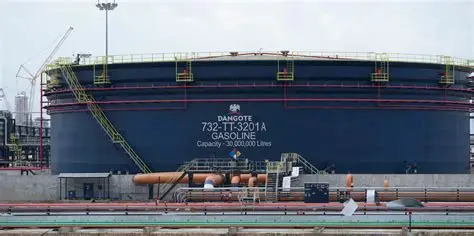
The Dangote Refinery, Africa’s largest and most ambitious refining project, is expected to run entirely on Nigerian crude oil by the end of 2025, according to Dangote Industries Ltd. This shift marks a significant milestone in the plant’s long-term plan to cut Nigeria’s dependence on imported refined products and fully integrate local crude supply into its operations.
Situated on the outskirts of Lagos, the 650,000-barrel-per-day facility was designed not only to refine Nigeria’s high-quality light crude but also to blend it with heavier or sour grades of foreign crude to optimize production of petrol, diesel, aviation fuel, and other petroleum products. This blending capability is a core part of the refinery’s flexible configuration, allowing it to meet different product specifications and maximize output.
Bloomberg reports Devakumar Edwin, vice president at Dangote Industries and overseer of the refinery, as saying in an interview last week that the facility received 53% of its crude supply from domestic producers in June, while the remaining 47% was sourced from countries like the United States, Brazil, Angola, Ghana, and Equatorial Guinea. He noted that reliance on foreign grades was necessary during the initial ramp-up phase, as local producers were unable to meet demand due to existing export commitments and domestic supply constraints.
“We expect some of the long-term contracts will expire,” Edwin said, referring to deals that currently tie local crude to international buyers. “Personally, and as a company, we expect that before the end of the year we can transition 100% to local crude.”
The refinery’s design to process a mix of foreign and Nigerian crude was driven by both technical and economic factors. While Nigeria produces some of the highest-quality crude oil in the world, its limited variety and inconsistent supply—due to pipeline vandalism, theft, and underinvestment—meant that supplementing it with other crude types was essential to meet operational targets during the early stages.
The plant is currently processing 550,000 barrels of crude per day, inching closer to its nameplate capacity. In July and August, it is scheduled to receive five cargoes each from the Nigerian National Petroleum Company (NNPC), with each shipment holding nearly one million barrels. This growing allocation of local crude indicates stronger cooperation between the refinery, NNPC, and indigenous oil producers.
The Dangote Refinery was sold to Nigerians and the international community as a game-changing solution to Nigeria’s paradox: Africa’s largest oil producer that still imports most of its fuel. For decades, crude extracted in Nigeria was shipped to Europe for refining, only to return as high-cost imports—a system plagued by inefficiencies and corruption. Dangote promised to end this cycle by refining domestically and exporting finished products, positioning Nigeria as a net exporter of fuels.
Experts say that the vision is gradually taking shape. Though local oil production has been hampered by the withdrawal of international oil companies from onshore and shallow-water assets, improved engagement with local producers and the federal government is helping to stabilize domestic supply. Edwin said the company’s evolving relationships with indigenous oil firms will help bridge the gap as Nigeria strives to meet the refinery’s full needs locally.
With an estimated net worth of $27.7 billion, according to Bloomberg’s Billionaire Index, Aliko Dangote remains Africa’s richest man. His refinery—widely considered his legacy project—is not only a statement of industrial ambition but also a critical piece of Nigeria’s economic puzzle, aiming to save billions in foreign exchange, stabilize fuel prices, and restore national energy security.
Observers maintain that if by year’s end, the refinery achieves its goal of running fully on Nigerian crude, it will mark a pivotal moment in the country’s journey to reclaim its place in the global oil value chain—not just as an exporter of raw crude, but as a producer of finished petroleum products for Africa and beyond.
Discover more from Keeping Them Honest
Subscribe to get the latest posts sent to your email.