

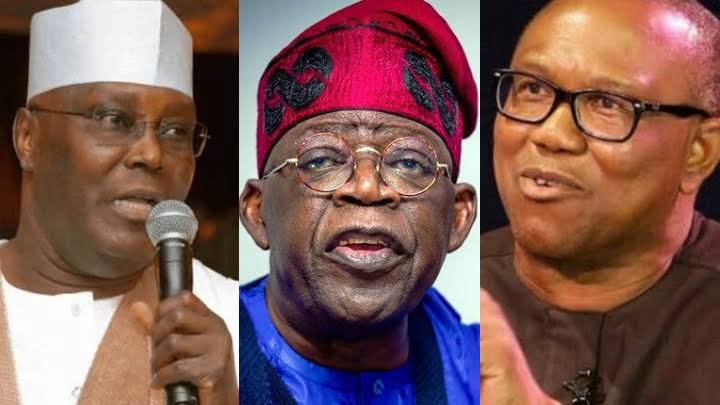
Atiku, Obi blame Tinubu; Tinubu blames Gov. Alia; Gov. Alia blames Abuja politicians and Fulani herdsmen.
By Orkula Shaagee
As Benue State in North Central Nigeria limps from one horrendous massacre to another, the latest being last weekend’s bloodbath at Yelewata, the political class , rather than offering concrete, workable solutions, continue to tear at one another in an inelegant ding-dong leading to nowhere.
While President Bola Tinubu has announced plans to visit the blood-soaked state on Wednesday, opposition politicians, former Vice President Atiku Abubakar, and Labour Party’s Peter Obi have ripped into his administration with a variety of colourful epithets that say he is incompetent and unfeeling and therefore incapable of governing Nigeria.
Bayo Onanuga, Tinubu’s spokesman, said in a statement yesterday that the president will travel to Benue State on Wednesday, June 18, in a renewed effort to foster peace and address the persistent conflict affecting communities there.
“During his stay, President Tinubu will meet with all stakeholders—including traditional rulers, political, religious, community leaders, and youth groups—to seek lasting solutions to the hostilities.
“In preparation for the visit, President Tinubu has already dispatched the Secretary to the Government of the Federation, SGF, the Inspector General of Police, heads of intelligence agencies, the National Security Adviser, and the Chairmen of the Senate and House Defence Committees to Benue State.
“The President is expected to hold a town hall meeting with all stakeholders during the visit,” said the statement.
President Tinubu had previously condemned the ongoing violence in Benue and called on all leaders and residents to embrace peace, love, and mutual understanding.
He extended his heartfelt condolences to the families of the victims and to all those who have suffered losses as a result of the crisis.
According to the statement, the President has rescheduled his planned visit to Kaduna on Wednesday, to commission various projects, to June 19.
But earlier yesterday, the presidential candidate of the Labour Party (LP) in the 2023 election, Peter Obi, criticised President Tinubu for not visiting Benue State after the incessant killings in the state.
In a post on his X handle, Obi said Tinubu does not value human lives.
He pointed to incidents in India and South Africa, as examples of what good leaders do when tragedies happen.
Obi wrote: “Sadly, the evidence is right before our eyes. Recently, we witnessed severe flooding in Niger State that claimed nearly 200 lives, with many still missing. Yet, not even a single presidential visit, this, in a nation where the scene of the tragedy is less than an hour away by helicopter.
“Just days ago, over 200 Nigerians, innocent men, women, children, and even soldiers were massacred in Benue State.
“Again, no presidential visit. No physical presence at the scenes of pain. No genuine national mourning. No leadership face to comfort the grieving or give hope to the people.
“Yet, we have seen what true leadership looks like elsewhere:
“In India, after a plane crash killed nearly 200 people, the Prime Minister was physically at the scene within hours.
“In South Africa, when floods claimed 78 lives, the president went personally to the affected communities, stood with them, and took responsibility.
“That is leadership with compassion. That is leadership that understands the value of human life. But here in Nigeria, we have normalised leadership without empathy, without accountability, and without a human face.
“That is why I insist: Nigeria does not just need another president; Nigeria needs a leader, a leader with competence, capacity, character, and compassion. Until we choose leaders on these principles, the cycle of pain will only continue.”
Former Vice President Atiku was equally graphic in his statement, which he personally signed.
He said: “The bloodshed in Benue State has reached a devastating crescendo – a brutal and heart-wrenching reality that can no longer be ignored. For years, families have buried their loved ones in silence, villages have been ravaged, and communities shattered, while those in power watch from a distance, offering nothing but hollow assurances.
“How much more must the people of Benue endure before their humanity is acknowledged? Their demand is simple: to live in peace, to sleep without fear, to farm without being slaughtered, and to raise their children without the constant shadow of violence.
“The silence, the indifference, the lack of urgency, it is all damning. It speaks to a deeper rot in the conscience of leadership, a frightening normalisation of violence against the very people they swore to protect.
“This is a call to conscience to every leader at both the federal and state levels: stop turning a blind eye while Benue drowns in blood. Stop offering condolences and start offering solutions. Work with security agencies, deploy resources, and craft a security architecture that prioritizes human lives over political optics.
“Benue is not alone. From Plateau to Zamfara, Kaduna to Taraba; the cries are the same. Nigerians are bleeding and begging to be heard.
We urge the people not to be silenced. Raise your voices. Demand accountability. Demand justice.
“Demand a government that sees you, hears you, and protects you.
History will not be kind to those who chose power over people. The time to act is now.”
While Benue governor, Hyacinth Alia, has not laid the blame for the latest attacks on any specific quarters beyond vague statements on long-standing clashes between local farmers and itinerant Fulani herdsmen, he was unequivocal last year when he blamed the bloodshed in the state on “Abuja politicians,” bent on regime change.
He had said of the bloodshed in Ukum: “Unfortunately, when the political wing of it comes into the fray, it kind of complicates what had been there. For many years, there had been skirmishes of instability in the Ukum area.
“And what pains me most is that the instability is never created by the invaders; it is not from the outsiders. It is the homegrown bandits who come out there to kill their fathers and mothers and their brothers and sisters, stopping them from going to farm.
“In other climes, if you are talking of insecurity, you are fighting those who have come from outside trying to grab land and to destabilize the lives of the people in those areas. But in Ukum LGA and Sankera axis, this is a different story, which is strange.
“But we cannot stop talking to them. I extended numerous olive branches to them to come out. I offered that those who would want to go to school, the state is willing to sponsor them to recreate their lives, and for those of them who are trade-inclined, we will help them acquire better skills to earn them good living.”
But in his statement on Sunday, President Tinubu lashed at Governor Alia, demanding greater statesmanship from him. The president, through Onanuga, had said, “ This is the time for Alia to act as a statesman and immediately lead the process of dialogue and reconciliation that will bring peace to Benue.
“Our people must live in peace, and it is possible when leaders across the divides work together in harmony, and differences are identified and addressed with fairness, openness, and justice,” the President said.
Meanwhile, in adherence to President Tinubu’s directive to security chiefs on Sunday night, Inspector General of Police, Kayode Egbetokun, and Chief of Defence Staff (CDS), Gen. Christopher Musa, arrived the state yesterday.
The Nigeria Police Force in a statement on its official Facebook page yesterday said the IGP has “ordered for additional deployment of tactical teams” to tackle the security crisis.
Suspected Fulani herdsmen had attacked the Yelewata community, Guma Local Government Area , near Makurdi, the state capital. They reportedly burnt 250 unsuspecting citizens alive during the carnage.
Following the incident, hundreds of Benue youths staged a protest in Makurdi on Sunday to draw global attention to the incessant and deadly attacks by killers in the state.
Benue’s Governor Alia, yesterday refuted claims that the Federal Government has not come to the aid of the people of Benue State to defend them against vicious, bloodthirsty marauders.
“If he (President Bola Tinubu) didn’t have an understanding of what is going on, he wouldn’t be giving us full support,” the governor said on Channels Television’s The Morning Brief programme yesterday.
“Seventeen local governments out of 23 were under siege and then we fought it down to nine local governments. We fought it down to six and now to three. It came down because of the full support we got from the Federal Government.
“The last time we had some severe attacks, three security units were assigned to us from the Federal Government. They came in and there was a huge shift. Those who had occupied the spaces in the local governments had to leave,” he stated.
Killings in Benue, called the food basket of Nigeria, have lingered for years, with some linking it to inter-communal conflicts as well as the quest for land dominance between the autochthonous agrarian dwellers and nomadic cattle rearers.
However, the killings in the last few weeks have been without let. Among those killed in Yelewata were military and civil defense personnel who fought to defend the community during the night raid.
Two months earlier, suspected herdsmen slayed about 60 residents in Ukum and Logo local government areas of the state. Unfortunately, the killing spree continued in May 2025 with at least 42 people confirmed killed by suspected herders in the Gwer West LGA of the state.
Said Governor Alia, “Before now, we were talking about the farmer-herder crisis. And now, it graduates from there and becomes the case where the herders came in but the armed men were amongst them and we tagged them: ‘the armed herders’.
“Now, what we experience generally is that the herds are not being brought, but those who are in the frontline carry AK-47 and AK-49. What are their aims? They don’t even come with cows. They attack, they kill, and after one or two weeks, a number of people now come back to occupy.”
The cleric turned politician said the suspicion of collusion between the aggressors or invaders and residents of the troubled local governments was not impossible.
“It is very possible that members of the state may have been recruited into the external militia. We can’t deny that because one or two names have been mentioned, but traditionally, there are some bandits within the territories.
“A thief will not just come into a community unless there is someone within the community who lives nearby,” he said.
The governor also blamed the continuous killings on the delicate geography of the state. “We share borders with Cameroon, with Taraba, and with Nasarawa,” he said, adding that those who frequently attacked the state come in from the borders.
“They were not necessarily Nigerians speaking the Hausa we know or the Fulanis.
“When you come to the axis of Nasarawa. This is where we have a lot of challenges. There are a number of happenings within Nasarawa State, and there were routes where these people come in at any time they are (pushed) out of Benue. What we see now if anyone describes it as a reprisal, we wouldn’t say no to that.”
Alia said he spoke with his Nasarawa counterpart, Abdullahi Sule, and he said he got some intelligence that “the terrorists were coming into his state through Benue”.
“When I told him that the havoc had already been caused at Yelewata in Benue, then he said probably, they came and made a touchdown in Yelewata in Benue and were going back because he said one person was macheted in Nasarawa State.”
Discover more from Keeping Them Honest
Subscribe to get the latest posts sent to your email.