

….Says, for now, the odds favour Tinubu’s reelection
By Peter Salami, with agency reports
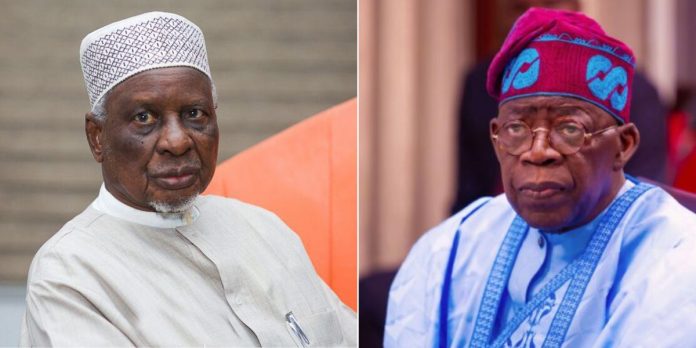
Renowned politician and elder statesman, Alhaji Tanko Yakassai, yesterday said the north is yet to take a stand on the 2027 presidential election, stressing that what many Northerners have said in recent times was their personal opinion.
Yakassai also said at the moment, no one has a strong chance of defeating President Bola Tinubu in the 2027 presidential election.
Yakassai stated this in an interview yesterday in Abuja.
According to the elder statesman, as a key member of Arewa Consultative Forum, he was not aware of any forum where a position was taken by the north supporting a candidate from the zone for the 2027 presidential election.
“I haven’t heard anybody making any proposition about the 2027 presidential election from Arewa Consultative Forum. What is tagged the Arewa Consultative Forum or Northern Elders Forum’s position is mere individual opinions, because all sections of the north have not taken a stand on this,” he said.
Yakassai said that Nigerians should wait until the Northerners meet and officially take a position.
“In Nigeria today, Bola Tinubu is the president. He has his ministers and governors who are backing him.
“Who else has all what it takes to move into the contest with the kind of stamina and strength to be more successful comparatively with Tinubu?,” he asked.
Yakassai said that aside from the ruling All Progressives Congress (APC) controlling the majority of states, there are some other governors from the opposition parties still supporting Tinubu.
“We should all wait and see if the picture will change drastically; otherwise, for now, the odds are in his (Tinubu’s) favour because I have not seen anything that will prevent him from winning the next election.
“He hasn’t done anything against the north in my understanding, and the north alone cannot decide who becomes the president of the country,” he said.
According to him, the crisis rocking some of the major opposition parties has further softened the grounds for Tinubu to win in 2027.
In terms of assessment of the administration in the last two years, Yakassai said that he would not do so for now. He, however, advised Nigerian politicians to always have the interest of the masses at the centre of their actions and plans.
“Our politicians should see politics as a dynamic game, and what I will advise is for them to play the game on the basis of ideology and programmes.
“Let them envision the way they want the country to be and not target being ministers, governors, and president. After becoming all these and nothing is done in the interest of the country, we will not get better.
“They should eschew politics of ethnicity and religion because not making our country the focal point of our politics has held us down for so long,” he said.
On the factors he could attribute his longevity to, Yakassai, who would turn 100 years in December, said it was a gift from God. He said that his father died at the age of 107 years and that his mother died at almost 100 years, adding that the combined effects of the two might have equally contributed to his longevity.
“My children, grandchildren, and great-grandchildren are more than 80 and still expanding. I give glory to God for these,” he said.
Speaking further, Yakassai stressed the need for politicians and political officeholders to be guided by ideologies rather than personal interests in deciding which political party to pitch tent with.
“The way political parties emerge in this country, especially when you look at the events that followed this democratic dispensation, is not ideal. People were not sure of where to go initially. It is only now that things are beginning to take some shape.
“This is a country where we have a federation with East, West, and North, yet many politicians don’t consider what should be the interest of their people and the nation at large; rather, all they think is personal gains, as politicians,” he said.
Yakassai, who was the late President Shehu Shagari’s Liaison Officer at the then National Assembly, attributed frequent defections by politicians from one political party to another to a dearth of ideologies. He, however, said that the gale of defections currently taking place cannot result in Nigeria becoming a one-party state.
“Given the size of the country and the multi-party system being practised, it will be difficult for the country to melt into a one-party state,” he said. According to him, it will be hard to satisfy the yearnings of Nigerians under a one-party arrangement.
“In a democracy, the minority can have their say, but the majority will have their way. There is always going to be a place for the opposition, but it all depends on the magnitude of the opposition.
“Those who are defecting are doing so for so many reasons. Some are thinking that their former parties are no longer popular in their localities and need a more viable platform to ensure they win the next election,” he said.
On what the regional bodies, such as Arewa Consultative Forum, Ohaneze Ndigbo, and Afenifere, have done to advance the unity of the country, he said that they haven’t done much in that regard.
Yakassai, who described himself as a proponent of rotational presidency, said that the idea was the brainchild of the defunct National Party of Nigeria (NPN).
While stating that no group had opposed the principle of zoning, he said that it was a valid proposition for the country’s unity.
“This is a country where we originally had three regions and later 36 states. In the long run, letting key political offices, such as the president, go round will promote unity,” he said.
On the agitation for return to regional government, Yakassai said that it is no longer possible for Nigeria to return to regional government as practised in the First Republic.
“I am almost 100 years old. I was born in December 1925. I know what is possible and what is not possible. I can’t venture into what is not possible. I don’t think regional government is possible again in Nigeria,” he said.
According to him, not many Nigerians are favourably disposed to the idea of going back to regional government, which gained ground during the First Republic.
“Read the newspapers; how many people are supporting the call for a return to regional government? Where are those people from the North, West, or South?,” he queried.
The elder statesman said that in a democracy, everyone has the right to express his/her opinion, stating that this might not constitute majority opinion unless otherwise tested.
“That you have few people who are talking about regional government doesn’t translate into the fact that the majority of the country are craving for what is being talked about.
“What the few are talking about could be regarded as their wishful thinking. If the government scales their calls and uncovers that it is not what the majority want, they will keep quiet,” he said.
Discover more from Keeping Them Honest
Subscribe to get the latest posts sent to your email.