

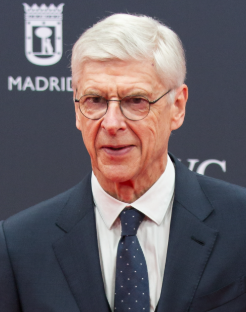
Former Arsenal manager Arsene Wenger has proposed a change to the offside rule that would mean attackers are onside if any part of their body is in line with the last outfield defender.
Wenger, head of global development at world governing body FIFA, said it would restore an advantage to the attacker that many feel was eroded by the introduction of the video assistant referee (VAR).
Players are currently ruled offside if any part of the body, apart from hands and arms, is beyond the last defender.
Wenger compared the suggested change to a similar move taken after the 1990 World Cup.
Before and during that tournament, a player was considered offside if he was level with the last defender before the goalkeeper.
There were an average of 2.21 goals per match in 1990, the lowest in World Cup history.
“It was in 1990 after the World Cup in Italy when there were no goals scored,” Wenger told Bein Sports, recalling the rule change.
“We decided that there is no offside any more when you are on the same line of the defender.
“In case of doubt, the doubt benefits the striker. That means when there’s a fraction, the striker did get the advantage.
“With VAR this advantage disappeared and for many people it’s frustrating.”
Trials of the system have taken place in Italian youth football, and Wenger said further trials will happen before a final decision, which could come in 2026.
Any change to the offside rule rests with the sport’s law-makers, the International Football Association Board (Ifab).
Ifab agreed to further trials, conducted by Fifa, at its annual general meeting in March.
It said the aim of the trials is to see whether they “foster attacking football and encouraging goalscoring opportunities while maintaining the game’s attractiveness”.
Any potential rule change would only come after consultation with football stakeholders and advice from Ifab’s football and technical advisory panels.
Those panels include experienced members from the football world such as former players and referees.
The Premier League, Champions League and other major European leagues currently use semi-automated technology when a tight offside decision goes to a VAR review.
Swiatek defends coach, psychologist despite disappointing results
Iga Swiatek has failed to win a tournament in almost a year, but the Polish world No 2 has defended her coach and psychologist despite the poor run of results and losing her place at the top of the world rankings in a difficult period.
Swiatek parted ways with her coach Tomasz Wiktorowski in October after three years, adding Belgian Wim Fissette to her team and in November accepted a one-month suspension after testing positive for banned substance trimetazidine.
The five-time Grand Slam winner has drawn a blank since winning last year’s French Open, and her latest result saw Swiatek lose her Madrid Open title in a crushing 6-1 6-1 semifinal defeat to Coco Gauff last week.
“Sometimes I’m not happy with the way I play. It’s natural, especially with my perfectionism. This can be seen on the court,” Swiatek told Polish media outlet SportoweFakty in an interview.
“However, when I come off it, I can look at the season from a broader perspective.
“Then I find a lot of positives. Reaching the quarterfinals or semifinals is a good result. Again, I am the most even player of the whole season.”
Swiatek was asked if new coach Fissette was responsible for the lack of success.
“No, this is a very harsh and unfair statement,” Swiatek said.
“I can only look at the coach from my own perspective, which is the only right one for me, that is, what our work looks like every day.
“The worse results coincided with many other challenges in recent months, also in family life. I found myself at a stage of my career where I had to reformulate my thinking about myself.
Swiatek believes others have improved rather than her regressing.
“The level of tennis in the world is getting higher and higher. The girls got to know my game, they developed themselves,” Swiatek said.
“Coco Gauff, who has always been a great talent, is older today and has more experience. Aryna (Sabalenka) managed to make it through the semifinals and began to win titles.”
The 23-year old has been working with sports psychologist Daria Abramowicz for the last six years and Swiatek was asked if there was a moment when she thought their cooperation had run its course.
“No. People don’t know it, but practically every year there are different challenges,” Swiatek replied.
“When I was suspended, I didn’t want to go out on the court at all for a few weeks. It was the most difficult experience of my career. Daria is a constant support for me, a person I trust. This is my team, I decide who is in it.
“I am irritated by headlines talking about falling apart or a mental crisis. Of course, sometimes I get annoyed on the court. Sometimes I’m not as focused as I’d like.
“But I work, day in and day out, week in and week out, to be better. So there is no reason to make strange judgements or look for fatigue or burnout.”
Discover more from Keeping Them Honest
Subscribe to get the latest posts sent to your email.