

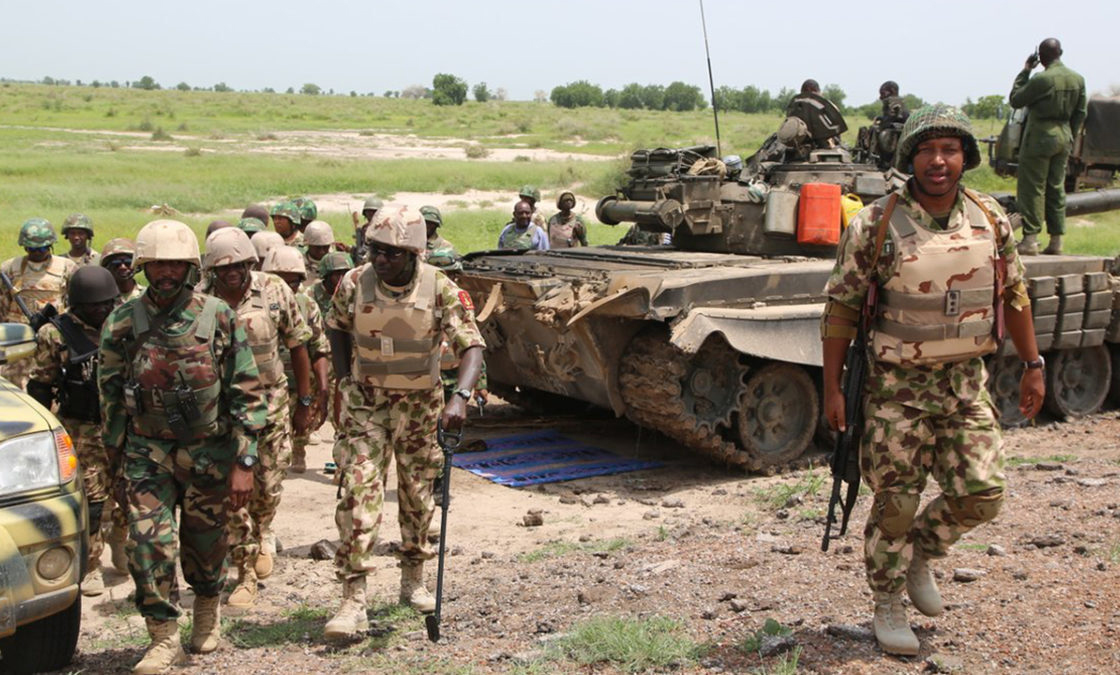
In its avowed commitment to rid the country of terrorism and banditry, Nigerian troops neutralised no fewer than 13,543 terrorists within the last two years.
This was disclosed by the Defence Minister, Mohammed Badaru Abubakar during the ministerial press briefing being hosted by the Minister of Information and National Orientation, Mohammed Idris.
The Minister said between May 2023 and May 2025, a total of 17,469 suspects were also arrested.
He added that while 9,821 hostages were rescued, 124,408 Boko Haram/ISWAP terrorists surrendered.
Abubakar further announced recovery of 11,118 weapons and 252,596 assorted ammunition.
He said the Armed Forces had recorded tremendous success, including liberating several areas hitherto under the control of terrorists, as well as restoring sanity on several highways.
The Minister, while disputing claims that the terrorists had more sophisticated arms, declared that, “it is not true; we have much more sophisticated weapons.
“The issue is this war is not a conventional war; it’s like a guerilla war; they watch us, they have informants around us, around the people that we try to protect and they give them information, and they jump to us when we don’t expect, and when they know that our surveillance mechanism is watching some direction, because we cannot cover all the areas.
“That is it but they don’t have more equipment than us, we have much more, we have more sophisticated equipment and that is why we have recorded the successes that I have just mentioned.”
FG pledges to priotise made-in-Nigeria products using Nigeria First Policy
The Federal Government has expressed its readiness to prioritise made-in-Nigeria products, to boost the nation’s self-reliance using the Renewed Hope Nigeria First Policy.
The Secretary to the Government of the Federation (SGF), Sen. George Akume, disclosed this yesterday when he visited Gov. Alex Otti of Abia in Nvosi, Isiala Ngwa South Local Government Area.
Akume said: “Yesterday, the government approved a new economic policy, called the Renewed Hope Nigeria First Policy.
“It’s going to be an executive order to ensure that we place Nigeria first.
“So, we’re going to give emphasis to products that are manufactured locally.”
According to the SGF, the move would benefit Nigeria’s industrious communities such as the people of Abia, who “will soon be laughing to the bank”.
Akume also praised the performance of the Nigeria Extractive Industries Transparency Initiative (NEITI).
He described NEITI as a “sensitive and strategic agency” monitored not just domestically but also internationally, including from its global headquarters in Oslo, Norway.
On economic reforms, Akume said the removal of fuel subsidy was a necessary step to end a “massive scam” that had become “uncontrollable, like a wounded lion”.
He said: “A few weeks ago, Prof. Benedict Oramah, President of the African Export-Import Bank, applauded what the government had done.
“Oramah was quoted as saying that this is the best decision taken by the Federal Government in the oil and gas industry.
“Oramah said indeed it is bad business for Nigeria to be selling crude and at the same time, lacking money to pay for imported petroleum products into the country.”
Akume said that before subsidy removal Nigeria had reached its borrowing limit with traditional banks, prompting the African Export-Import Bank to step in with credit support.
The SGF also noted that subsidy removal freed up more funds for state and local governments to carry out development initiatives.
He assured Nigerians of the federal government’s commitment to infrastructure development.
Akume said that the Calabar–Lagos Superhighway Project would not be limited to the coastal areas but would extend inland to benefit more states.
He added that similar projects, such as the Sokoto–Badagry Superhighway, formed part of the federal government’s broader strategy to open up the country and boost economic growth.
Responding, Gov. Otti urged public officials to remain focused on governance, in spite of rising criticisms from opposition voices less than two years after the 2023 elections.
“Well, in politics, you expect things like that. My approach is to just ignore the noise, and continue to focus on delivering the goods,” he said.
Otti emphasised the difficulty of certain policy decisions, urging leaders to prioritise long-term benefits over short-term popularity.
“Sometimes, the immediate outcomes may be difficult, but I’ve never seen anywhere where omelettes are made without breaking eggs,” he said.
On fuel subsidy removal, Otti reiterated his longstanding position, dating back to his writings in ThisDay Newspaper’s ‘Outside the Box’ column.
“I have written extensively about subsidy removal, as far back as 2016, 2017, and we should have done it,” he said.
He said that the unique opportunity to remove subsidy presented during COVID-19, when global oil prices collapsed and countries were practically giving oil away.
“Countries who had oil were begging people to come and evacuate it, even without paying for it,” Otti said.
He maintained that subsidies must be properly directed to avoid long-term economic harm.
“Subsidies are good, but then, it depends on where the subsidy is going.
“If you are subsidising production, that is very good but whenever you start subsidising consumption, you are distorting your economy,” the governor warned.
He cautioned against avoiding difficult decisions, because of the severe consequences it could have on the system.
“If you don’t think you need to take the pain of taking difficult decisions, then what you may see is an economic crisis, but we don’t pray for that,” Otti said.
Otti also commended NEITI’s commitment to transparency and accountability in governance, describing it as vital to democratic health. (NAN)
Discover more from Keeping Them Honest
Subscribe to get the latest posts sent to your email.