

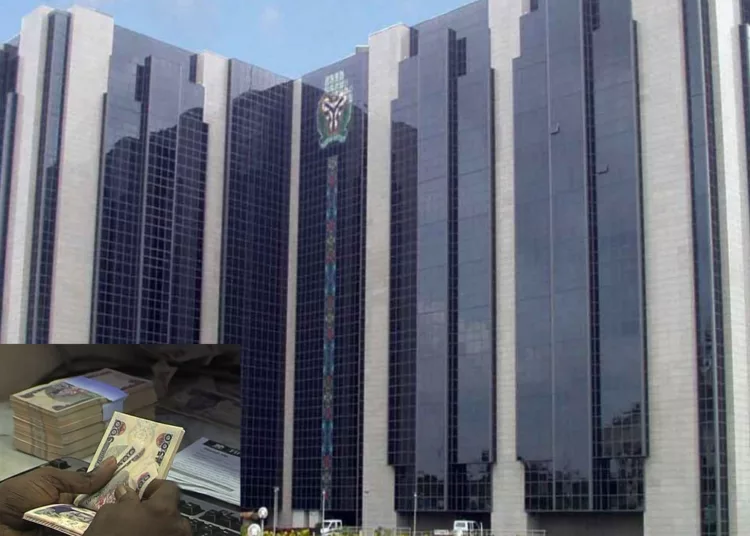
Amid excess liquidity in the financial sector, banks’ borrowing from the Central Bank of Nigeria (CBN) dropped by 28.2 per cent Year-on-Year (YoY) to N2.9 trillion in August 2025 from the N4.04 trillion recorded in August 2024.
The sustained increase in the Federation Accounts Allocation Committee (FAAC) disbursements to the federal, states, and local governments, and broad money supply (M2), were some of the factors that contributed to excess liquidity in the financial sector.
Banks access credit from the apex bank using the Standing Lending Facility (SLF) window and deposit excess cash using the Standing Deposit Facility window (SDF).
The CBN lends money to banks and merchant banks through the SLF at an interest rate of 500 basis points (bpts) above the Monetary Policy Rate (MPR).
Similarly, the apex bank accepts deposits from the banks through its SDF, and pays an interest rate of MPR minus 100 basis points.
According to the apex bank’s financial data, between January-August 2025, the banks accessed an estimated N68.43 trillion, representing a decline of 13.6 per cent from the N79.22 trillion they accessed between January-August 2024.
Data from the money and credit statistics of the CBN showed that the country’s M2 surged by 15.8 per cent year-on-year to N117.5trillion as of June 2025, as against N101.45 trillion in June 2024.
M2 includes cash, demand deposits, savings deposits, money market deposits, and time deposits, and these provide a comprehensive measure of liquidity in the economy.
While the rising liquidity supports economic activities, it also stresses the need for balanced fiscal and monetary policies to sustain economic growth without exacerbating inflation.
In terms of deposits, in August 2025, the banks deposited N15.62 trillion, representing an increase of 92.3 per cent from N8.12 trillion reported in August 2024.
Meanwhile, between January and August, bank deposits with CBN stood at N95.5 trillion, a significant increase of 417 per cent from the N18.5 trillion recorded between January-August 2024.
The Monetary Policy Committee (MPC) of CBN, since November 2024, hiked MPR to 27.50 per cent from 27.25 per cent in a bid the tackle inflation and stabilise Naira at the foreign exchange market.
However, the MPR has remained at 27.50 per cent since the beginning of 2025.
In 2024, the CBN shifted to a single-tier remuneration structure for the SDF. Previously, deposits up to a certain threshold, for example, N3 billion, earned a higher interest rate, while amounts exceeding that threshold earned a lower rate.
The CBN governor, Mr. Olayemi Cardoso, had disclosed that the apex bank removed the cap on the remunerable SDF to increase activity in the SDF window and manage liquidity.
Investment Banker and Stockbroker, Tajudeen Olayinka, attributed the surge in banks’ deposits with CBN to uncertainty in the business environment over rising insecurity, among others.
According to him, “The most significant factor is the increasing level of threat in the environment of business in Nigeria, arising from: insecurity, supply chain problems, rising inflation and poor purchasing power, low level of productivity, rising unemployment, liquidity overhang and paucity of risk-free financial instruments.”
He added that, “As a result, most banks prefer to be debited by CBN for running short of LDR limit, as against extending credit to businesses that are finding it difficult to survive. It is all about managing risk.”
Discover more from Keeping Them Honest
Subscribe to get the latest posts sent to your email.