

…Leader of Tinubu Support Group Markets President in Critical Heartland of the Northwest, as Top Politicians, 136,000 Others Defect to APC in Kano in Weekend Political Haul
By Abu Adamu
For a politician who rarely seeks the spotlight, Rt. Hon. James Abiodun Faleke is increasingly emerging as one of the more important figures quietly building the political machinery behind President Bola Ahmed Tinubu’s 2027 re-election campaign. And that machinery roared into public view in Kano at the weekend.
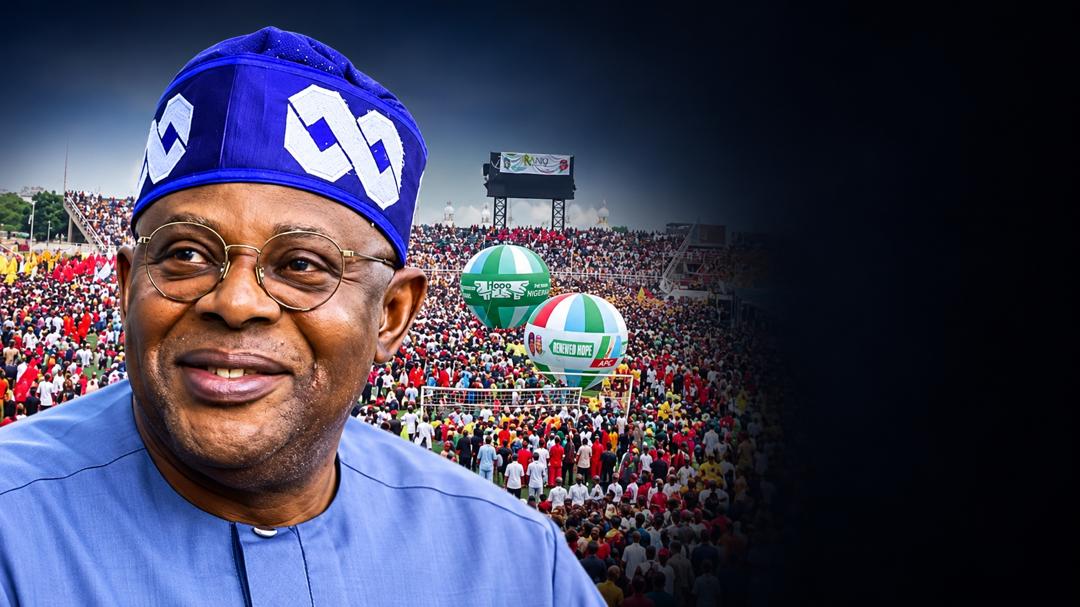
At the Sani Abacha Stadium, Kofar Mata, on Saturday, Faleke, founder and convener of the Tinubu Support Group (TSG), presided over a massive political gathering that brought together party leaders and supporters from across the country, inaugurated a new nationwide grassroots structure and received more than 136,000 defectors into the ruling All Progressives Congress (APC).
The scale of the gathering, coming in Kano, one of Nigeria’s biggest electoral prizes and the political heartland of the North-West, offered perhaps the clearest indication yet of the strategy taking shape around Faleke: rebuild and deepen Tinubu’s support from the grassroots, broaden the APC coalition and make the President’s economic record the central argument for a second term.
Faleke made clear that the Kano spectacle was not intended to be an end in itself.
Inaugurating the TSG 2.0 National Structure and State Chapters Executive Committees, the ranking federal lawmaker ordered the organisation’s new officials to immediately move beyond rallies and take the Tinubu re-election message directly into communities across Nigeria.
He described Tinubu as a “marketable product” and challenged members to sell the achievements of the Renewed Hope administration to voters rather than assume that Nigerians already understood the reasoning behind some of its difficult reforms.
Central to that assignment, Faleke said, would be explaining the removal of petrol subsidy and countering opposition promises to restore it.
He argued that subsidy removal was necessary to reset an economy that had become increasingly difficult to sustain and urged TSG campaigners to explain both the policy and its implications in terms ordinary Nigerians could understand.
For Faleke, the assignment is familiar territory. His political relationship with Tinubu stretches back more than two decades, from his years in Lagos local government administration through his emergence as a ranking member of the House of Representatives and eventually as one of the principal organisers of the nationwide political infrastructure that promoted Tinubu’s presidential ambition.
Faleke recalled in Kano that the TSG began organising for Tinubu as far back as 2020, long before the former Lagos governor had secured the APC presidential ticket and at a time when his eventual emergence as President was far from certain.
Six years later, the organisation is being retooled for another national contest; and Kano provided a dramatic launchpad.
The Sani Abacha Stadium was filled with supporters several hours before proceedings began, while the crowds spilled onto adjoining roads around Kofar Mata, Kanti Kwari, Kurmi Market and IBB Way, creating severe traffic congestion and disrupting commercial activities in parts of the ancient city.
The rally also delivered a major political prize to the APC, with the party announcing the reception of more than 136,000 defectors from opposition parties, including established political figures with grassroots structures across Kano.
Among them were Senators Rufa’i Sani Hanga and Kabiru Ibrahim Gaya, as well as Mas’ud El-Jibrin Doguwa.
Other opposition figures who received into the ruling party included Ali Datti Yako; Badaru Umar; former Ungogo Local Government Chairman Isyaku Ali Danja; former Speaker of the Kano State House of Assembly Yusuf Bello Danbatta; former PDP deputy governorship candidate Baraka Sani; Abdulmajid Dauda Dandawaki; and former Presidential Adviser Abdullahi Zubairu Abiya, among others.
Many arrived with large contingents of supporters dressed in APC colours, turning the stadium and surrounding areas into a sprawling political carnival.
Speaking for the defectors, Hanga pledged their commitment to the APC and promised to mobilise for Tinubu and Kano State Governor Abba Kabir Yusuf in the 2027 elections.
The political significance of the defections was amplified by the presence of Yusuf, APC National Chairman Prof. Nentawe Yilwatda, former Kano governor and former APC National Chairman Abdullahi Umar Ganduje, and other senior party figures.
Yusuf said the turnout demonstrated what he described as the rapidly growing acceptability of Tinubu in Kano and argued that the President deserved another term to consolidate his programmes and policies.
Welcoming the 136,000 new members, the governor described the APC as a broad political platform and urged both old and new members to work together for the peace, unity, and development of Kano and Nigeria.
“The APC remains a broad platform for all members to contribute meaningfully to the development of Kano State and Nigeria,” Yusuf said.
He urged the new entrants to join existing stakeholders in strengthening unity and stability within the party as preparations intensify for the 2027 elections.
Yilwatda was similarly upbeat, declaring that the scale of the gathering had strengthened the party leadership’s confidence about Tinubu’s prospects.
“We are very happy with this unprecedented crowd. With this, we are very sure the coast is clear for President Tinubu to secure his second-term bid,” the APC national chairman said.
But beneath the spectacle of defections and the sea of party colours was a more deliberate political strategy: an attempt to build a structured national mobilisation operation extending from the national level through the states and ultimately into local communities.
The Director-General of the Tinubu Support Groups, Dr Umar Tanko-Yakasai, sought to provide the economic argument that the new structures would be expected to take to voters.
He said Tinubu inherited what he described as a “shattered and battered economy” but had taken difficult decisions that were now stabilising key economic indicators.
Tanko-Yakasai cited Nigeria’s foreign reserves, easing inflation, and second-quarter 2026 GDP growth of 4.43 per cent as evidence that the reforms were beginning to yield results.
He also pointed to increased Federation Account allocations to states, the establishment of the Nigerian Education Loan Fund, financial autonomy for local governments, and the establishment of additional regional development commissions as evidence of the administration’s broader reform agenda.
For Kano specifically, he said more than 50 indigenes had been appointed to federal positions, while drawing attention to federal road infrastructure, including the Kano-Kaduna Expressway and other projects.
“Mr President has done a lot for Kano and is still doing more,” Tanko-Yakasai said.
Ganduje also defended the Renewed Hope Agenda, describing it as a framework developed by the APC administration to tackle poverty, insecurity, and sluggish economic growth and put Nigeria on a more sustainable development path.
But Faleke’s message to the political machinery was that statistics and government programmes would not sell themselves. The task, he insisted, was to take the administration’s case directly to the electorate, and it is a strategy consistent with Faleke’s political trajectory.
Born in Ekinrin-Adde in Ijumu Local Government Area of Kogi State, North Central Nigeria, Faleke built much of his political career in Lagos, where he served as the pioneer Executive Secretary and later two-term chairman of Ojodu Local Council Development Area before moving to the National Assembly in 2011 to represent Ikeja Federal Constituency.
He subsequently emerged as one of the more influential ranking lawmakers in the House of Representatives and has occupied important positions in the legislature.
His political reach was tested beyond Lagos in 2015 when he became the running mate to the late Prince Abubakar Audu on the APC governorship ticket in Kogi State.
But it is his role as a political organiser and Tinubu loyalist that has increasingly placed Faleke right in the engine room of the President’s electoral machinery.
Rather than operate principally as a public face of campaigns, his strength has been in building structures, cultivating networks, and connecting disparate political interests to a central organisation — attributes that were evident in the TSG’s pre-2023 mobilisation.
The Kano operation went beyond the inauguration of executives. It included the formal unveiling of the Tinubu Support Campaign Council, commissioning of the TSG Kano State Head Office, and presentation of operational vehicles intended to support grassroots mobilisation.
The TSG North-West Coordinator, Dr Baffa Babba-Dan’agundi, credited Faleke’s mentorship and organisational support with strengthening the group’s political network in Kano.
“I want to sincerely thank Hon. James Abiodun Faleke for recommending me for this appointment. The appointment has further strengthened my political base in Kano and enhanced my capacity to mobilise support for Mr President, Bola Ahmed Tinubu, ahead of the 2027 elections,” he said.
For the APC, Kano carries importance far beyond Saturday’s crowd. The state remains one of the country’s largest reservoirs of votes and an essential battleground for any presidential candidate seeking a commanding showing across northern Nigeria.
For Faleke, the emerging TSG strategy therefore appears to be to convert enthusiasm at large gatherings into durable ward, local government, and community structures capable of persuading voters and defending the administration’s record.
He warned his newly inaugurated lieutenants against mistaking the mammoth Kano turnout for the completion of their assignment.
The real work, he said, begins after the rally. And his instruction was straightforward: go into the communities, explain Tinubu’s policies, defend the difficult reforms, expand the coalition, and mobilise relentlessly until election day.
It was vintage Faleke: little theatre, much organisation.
For if Kano is an indication of what the quiet strategist and the political machinery he has spent years building intend to roll out across the North, the contest for the region’s massive 2027 vote may already be gathering steam.
Discover more from Keeping Them Honest
Subscribe to get the latest posts sent to your email.