

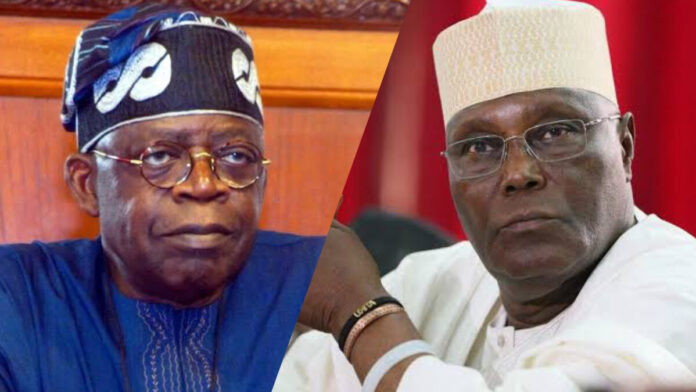
• Says border security, not reopening, should dominate debate as Sahel terror threats persist
• Challenges ADC candidate to spell out controls he plans to relax; proposed safeguards against arms trafficking, smuggling
By Our Reporter
The Presidency has challenged former Vice President Atiku Abubakar to clarify his pledge to immediately “open the borders” if elected President, insisting that Nigeria’s land borders are already open and that the real policy question should be how to secure them while facilitating legitimate trade and movement.
In a statement issued by the Special Adviser to the President on Media and Public Communication, Sunday Dare, the Presidency said the Federal Government announced the reopening of most of Nigeria’s land borders on March 14, 2024, and had not reversed the decision.
It also cited the reopening of the Kamba border in Kebbi State by President Bola Tinubu on February 14, 2026, saying the move had generated economic and diplomatic benefits.
The Presidency was reacting to a recent declaration by Atiku, the presidential candidate of the African Democratic Congress (ADC), that he would “open the borders” immediately upon assuming office.
According to the Presidency, Atiku’s statement requires greater clarification because opening a border is different from removing or relaxing security and regulatory controls at entry points.
“If he means he would relax existing border controls, then Nigerians deserve to know precisely which controls he intends to remove, why he considers their removal necessary, and what safeguards his administration would deploy against terrorism, arms trafficking, smuggling, human trafficking, and other forms of transnational organised crime,” the statement said.
It argued that the distinction was particularly important because Nigeria’s security challenges were increasingly interconnected with developments across the Sahel and Lake Chad Basin.
The Presidency stressed that an open border should not be confused with an uncontrolled border, noting that modern border management seeks to encourage legitimate movement, commerce, and economic interaction while preventing terrorists and criminal organisations from exploiting international boundaries.
It said effective border governance therefore required immigration and customs controls, intelligence-sharing, surveillance technology, and coordinated security operations.
According to the statement, Nigeria’s geographical position makes such measures especially important, given its extensive land borders and proximity to countries confronting terrorism, violent extremism, and transnational organised crime.
The Presidency noted that Atiku himself had acknowledged Nigeria’s shared borders with Niger, Chad, and Cameroon, arguing that insecurity within the wider region could easily spill across national boundaries where border controls were weak.
Citing the Global Terrorism Index 2026, the Presidency said about 41 per cent of terrorist attacks occurred within 50 kilometres of an international border, while approximately 64 per cent occurred within 100 kilometres.
It said difficult terrain, limited government presence, and weak cross-border coordination could make border communities particularly vulnerable to terrorist and criminal networks.
The Presidency maintained that the deployment of the Armed Forces and other security agencies along strategic corridors in the Northeast and Northwest should therefore not be interpreted as evidence that Nigeria’s borders remained closed.
Rather, it said, such deployments represented efforts to keep the borders secure while allowing lawful movement and trade.
“As domestic insurgencies evolve into increasingly networked and transnational terrorist threats, effective border management becomes an indispensable component of national security,” the statement said.
It added that terrorist and criminal organisations frequently exploit international boundaries because security agencies cannot pursue suspects across sovereign borders without cooperation, agreements, and appropriate legal frameworks.
The Presidency said Atiku’s experience as a former Vice President meant Nigerians were entitled to expect a more detailed border-management policy from him as the country moves towards another presidential election.
While acknowledging that political disagreement and criticism were legitimate parts of democracy, it said debates touching on national security and the economy should be based on verifiable facts and clearly defined policy alternatives.
It consequently challenged Atiku to explain how a government headed by him would improve border surveillance, strengthen intelligence-sharing with neighbouring countries, modernise customs and immigration operations, deploy technology, protect border communities, and deepen regional cooperation against terrorism and organised crime.
The Presidency said such proposals would provide Nigerians with a clearer basis for comparing competing approaches to border management rather than reducing the issue to whether borders should simply be “opened” or “closed.”
It also defended the Tinubu administration’s approach, saying the government remained open to scrutiny over its performance in security, economic recovery, border management, and citizens’ welfare.
According to the statement, Nigeria needs borders that are open to legitimate commerce and movement but sufficiently secured against terrorism, arms trafficking, smuggling, and other criminal activities.
“They must be monitored with technology, led by intelligence, and integrated into the country’s broader national-security and economic strategy,” the Presidency said.
It further urged Atiku and other opposition figures to present detailed alternatives to existing government policies, arguing that the 2027 political debate would better serve Nigerians if it centred on competing ideas and measurable programmes.
The Presidency maintained that Nigerians should be given a clear choice between policy alternatives, particularly on issues as consequential as national security, regional trade, and the management of the country’s international borders.
Discover more from Keeping Them Honest
Subscribe to get the latest posts sent to your email.