

By Chike Ofili
The worsening condition of major highways across the Niger Delta has triggered fresh criticism of the Federal Government, with Chairman of the Pan Niger Delta Forum (PANDEF), Ambassador Godknows Igali, describing the situation as an injustice to a region that contributes significantly to the nation’s revenue.
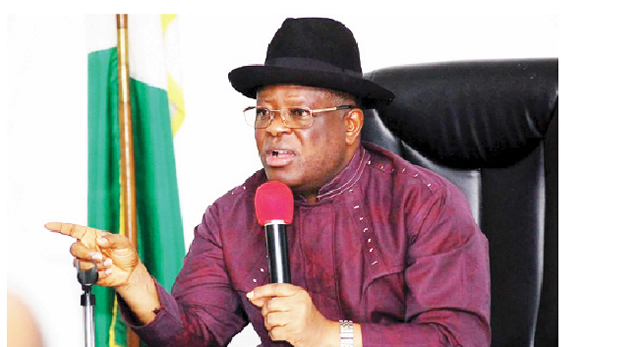
Igali’s criticism comes as Minister of Works, David Umahi, moved to terminate the concession agreement for the troubled Benin-Asaba Expressway, accusing the concessionaire of failing to deliver the project to acceptable standards and, in some sections, worsening the condition of the highway.
The former Nigerian ambassador to Norway, Sweden, and Denmark said the reality confronting motorists on major roads in the Niger Delta was difficult to reconcile with government claims about progress on road infrastructure.
Speaking in a television interview on Thursday, Igali singled out the East-West Road and Benin-Asaba corridor, saying his frequent journeys across the region had given him firsthand experience of the hardship faced by motorists.
“When I listen to the Minister of Works sometimes, I feel like breaking my television. Because I move around every time. I had to come in from Port Harcourt to be able to have this conversation with you. And the roads are not there,” Igali said.
He said travelling on sections of the East-West Road that previously took less than an hour could now consume several hours because of their deteriorating condition.
“Even the so-called East-West Road is not in order. You can’t go from Sapele to Warri. It used to take us 40, 45 minutes. Today it takes about three hours from Sapele to Benin. One hour now takes about three or four hours,” he said.
Igali also pointed to recent protests over the Benin-Asaba Expressway as evidence that public frustration over the state of federal highways in the region was reaching a breaking point.
“And the other day, just last week, we saw people demonstrating that the road from Asaba to Benin is so bad. And people came out demonstrating,” he said.
The PANDEF chairman argued that the condition of the roads was particularly troubling because of the Niger Delta’s contribution to Nigeria’s economy.
“So the roads, and this is where the money comes from, it is the height of injustice,” he said.
According to him, the people of the Niger Delta are not demanding preferential treatment but equitable distribution of infrastructure and federal resources.
“We are not asking for more than we should have. We are just saying be fair, be equitable, be just, be fair to all such people,” he said.
The controversy over the region’s road infrastructure has been particularly intense on the Benin-Asaba Expressway, where severe deterioration and gridlock recently prompted protests by youths, residents, and commuters.
Umahi, who inspected the troubled highway, subsequently turned his anger on the Benin-Asaba Expressway Concession Company (BAECC), accusing the concessionaire of failing to execute the project to the standard expected by the Federal Government.
At a stakeholders’ meeting at the Edo State Government House in Benin on Wednesday, the minister said the government was no longer satisfied with the company’s performance and indicated that it wanted the concession arrangement terminated.
Umahi asked the concessionaire to formally communicate its consent to the Ministry of Works to facilitate the termination process.
“We are therefore pleading with you to give us written approval to proceed in this manner,” the minister said.
He said the company should be removed from the project within the limits of the government’s legal rights, arguing that it had “added no value” and lacked the capacity to properly rehabilitate affected sections of the highway.
The minister was particularly critical of the removal of asphalt from sections of the road without adequate replacement.
He directed the ministry to engage the project’s independent engineer to assess and document work carried out by the concessionaire and determine the extent of any damage.
“When you remove asphalt contrary to the contract and contrary to the specifications, that is negative work,” Umahi said.
He maintained that such work would not be recognised as progress on the project and directed that the cost of repairing any resulting damage be established.
The Federal Government’s immediate concern, according to the minister, is to restore movement on the highway and reduce the hardship motorists have endured.
Umahi ordered the clearing of obstructions, restoration of damaged asphalt and diversion of water flowing onto the carriageway.
The concessionaire was also directed to produce a technical design for proper stormwater drainage to prevent further damage to the highway.
Umahi warned that failure to quickly address the situation could deepen public frustration and potentially create security concerns along the corridor.
The Head of Legal and Compliance of BAECC, Peterson Fabian, however, appealed for more time to allow the parties explore alternative solutions.
Fabian argued that issues raised during the meeting were not yet conclusive and expressed optimism that further discussions could produce a mutually acceptable resolution.
But Edo State Governor Monday Okpebholo backed tougher action, expressing disappointment that after about 16 months, motorists were still confronted with the poor condition of the highway.
Okpebholo said the situation had inflicted unnecessary hardship on road users, particularly residents of Edo State, arguing that resources committed to the project would amount to waste if the road remained unfinished.
“If they are competent, by now we should have seen some part of this road completed,” the governor said.
He urged Umahi to act decisively, noting that the Benin-Asaba Expressway is a strategic interstate artery whose deterioration affects travellers and businesses far beyond Edo State.
Senator Allwell Onyesoh, a member of the Senate Committee on Works, also questioned the concession arrangement, saying the experience demonstrated that not every private concessionaire possesses the financial and technical capacity to handle major national infrastructure.
He said the troubled project should serve as a lesson for government in assessing companies seeking concessions for critical highways.
The Federal Government has since indicated that the Benin-Asaba highway would undergo complete reconstruction following intervention by President Bola Tinubu.
For Igali, however, the controversy extends beyond one highway. He maintained that the state of the East-West Road and other strategic routes across the Niger Delta raises broader questions about fairness in the allocation and delivery of infrastructure.
He also warned political leaders that Nigerians were becoming increasingly conscious of their rights and more prepared to hold public officials accountable.
“Our people are watching. Our people are watching,” Igali said.
“People are now wiser. They are reasoning, they are wiser. The political bandwidth is now wider for people to reason and participate.”
Discover more from Keeping Them Honest
Subscribe to get the latest posts sent to your email.