

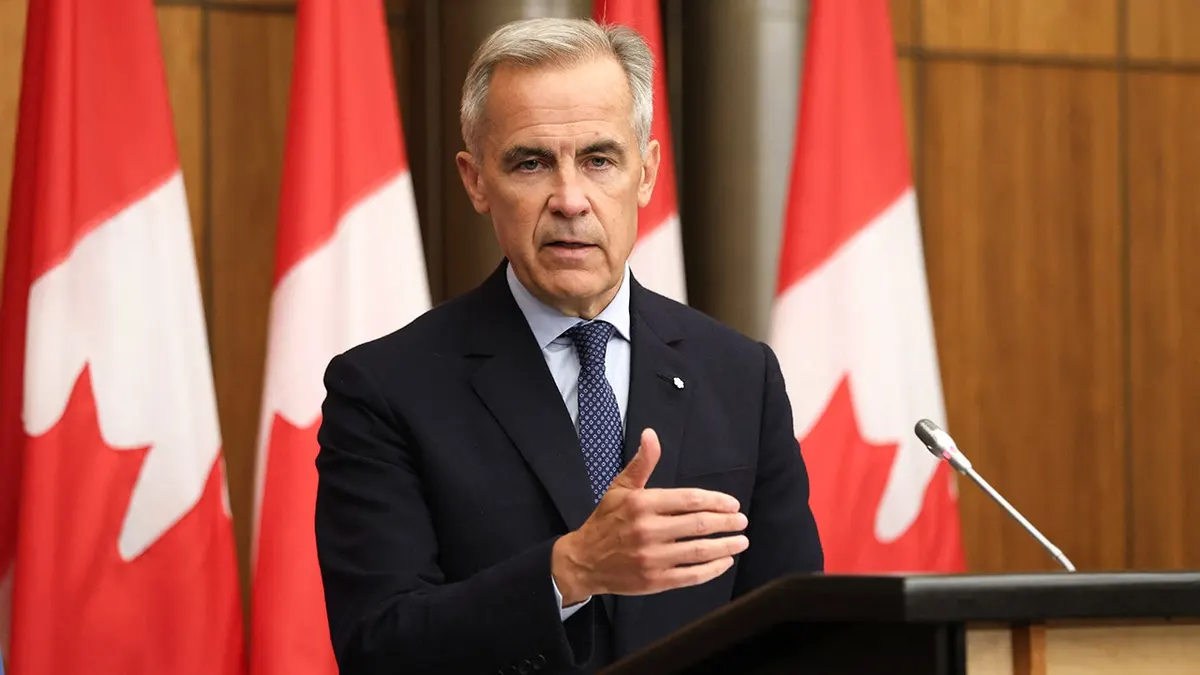
Canadian Prime Minister Mark Carney has firmly rejected United States President Donald Trump’s attempt to rename Lake Ontario as “Lake America,” declaring that Canada will continue to recognise the historic name regardless of Washington’s decision.
Carney, leading a growing chorus of Canadian officials dismissing the move, said the name Lake Ontario predates both the Canadian Confederation and the United States itself and cannot simply be erased by an executive order from Washington.
In a social media post on Thursday, the Canadian leader noted that the name could be traced back more than 400 years.
“We know that the United States is changing. Their trade relations, their foreign policy, their national monuments, their hydronyms,” Carney wrote.
“Canadian women and men also know that things must be called by their name, and this lake is called Lake Ontario — today and forever.”
Other Canadian political leaders were equally dismissive.
Nova Scotia Premier Tim Houston described the controversy as “real foolishness,” insisting Canadians would not be persuaded to adopt Trump’s preferred name.
“It’s Lake Ontario, buddy,” Houston said.
Canada’s Industry Minister Melanie Joly also rejected the proposed change, saying simply: “We’ll always call it Lake Ontario.”
The Canadian response followed Trump’s signing of an executive order directing the US Department of the Interior to update the Geographic Names Information System, Washington’s official repository of domestic geographic names, to reflect “Lake America.”
The decision echoes Trump’s controversial move shortly after returning to the White House in 2025 to rename the Gulf of Mexico the “Gulf of America.”
Mexico rejected that decision, maintaining that the United States could not unilaterally rename a body of water shared with other countries.
The controversy subsequently spread to Google Maps, where users in the United States were shown “Gulf of America,” while users in Mexico continued to see “Gulf of Mexico.” Users elsewhere were presented with both names.
The White House also became embroiled in a legal dispute with the Associated Press after restricting the news organisation’s access to some presidential events because it declined to adopt “Gulf of America” in its reporting.
Trump’s latest decision could provoke a similar dispute because Lake Ontario is shared by Canada and the United States.
The lake, the smallest of North America’s five Great Lakes, borders the Canadian province of Ontario and the US state of New York.
Four of the Great Lakes — Ontario, Huron, Michigan, and Erie — have names derived from Indigenous languages, while Lake Superior takes its name from an anglicised version of a French term.
There is no universally recognised international authority with the power to impose names on international bodies of water. Although a US president has broad powers to determine how geographic landmarks are officially identified by American federal agencies, that authority does not compel neighbouring countries to adopt the same terminology.
Canada therefore remains free to recognise the body of water as Lake Ontario irrespective of changes made to American government records.
Trump insisted while signing the order in the Oval Office that the decision was not intended as a direct provocation against Canada, although he immediately renewed criticism of America’s northern neighbour.
Canada, he said, “has been ripping us off for a long time on trade.”
The US president said he had been considering changing the lake’s name “for a long time” and jokingly raised the possibility of eventually turning his attention to the Atlantic and Pacific oceans.
“So if you think about it, we have a gulf and we have a lake,” Trump said.
“Now, all we need is an ocean. So maybe we’ll have to change the name of the Atlantic and or the Pacific. Maybe we’ll change them both.”
The remarks come at a particularly sensitive moment in US-Canada relations, already strained by a bitter trade dispute and increasingly sharp exchanges between officials of the two countries.
Negotiations aimed at resolving their differences collapsed late last Friday after both governments accused the other of introducing last-minute demands into what had appeared to be an emerging agreement.
There were, however, signs on Thursday that the two neighbours could eventually return to negotiations.
Canada’s minister responsible for US trade, Dominic LeBlanc, said Washington had withdrawn some of its demands relating to French-language labelling requirements and had indicated that Canadian measures designed to protect the French language and Canadian culture would not become targets of future American trade actions.
LeBlanc welcomed the development while stressing that any future agreement must respect Canada’s sovereignty.
“We look forward to further constructive US clarifications on their other positions, which would create the possibility of a mutually beneficial trade agreement that respects Canadian sovereignty,” he said.
For Carney and other Canadian leaders, however, the identity of one of North America’s Great Lakes appears non-negotiable.
Whatever name Washington chooses to enter into its own official records, Ottawa’s message is unequivocal: for Canada, it was Lake Ontario before either modern country existed, and it will remain Lake Ontario.
Discover more from Keeping Them Honest
Subscribe to get the latest posts sent to your email.