

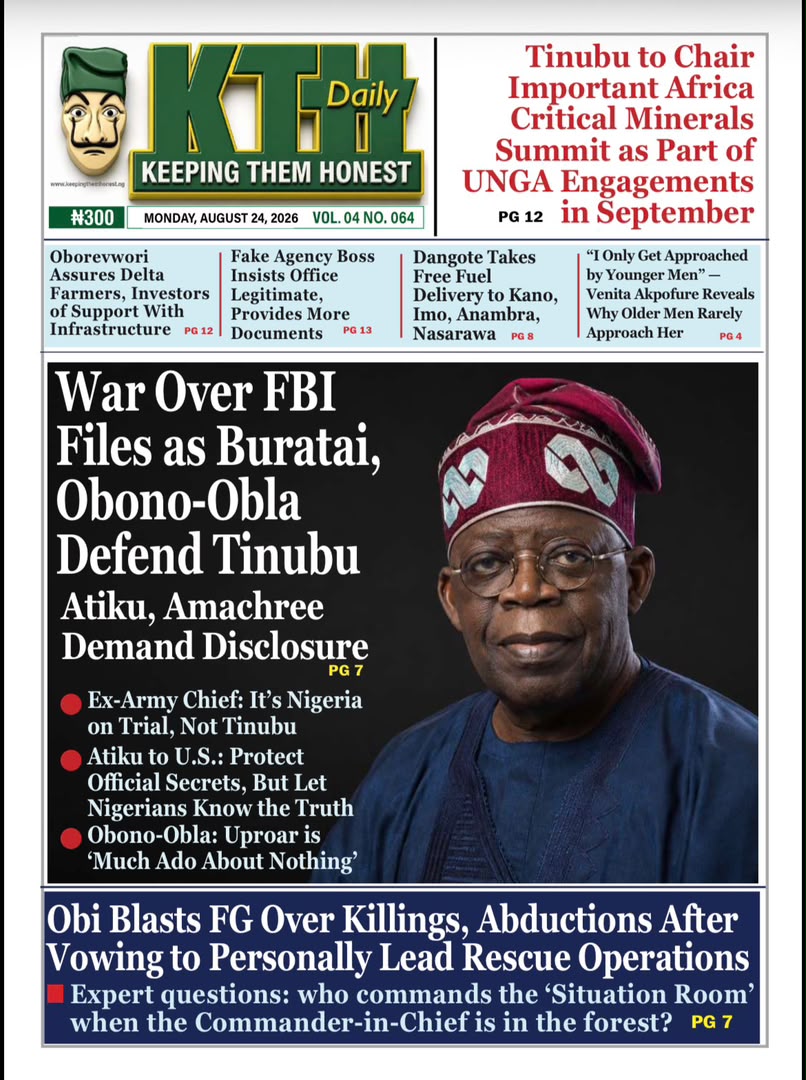
Atiku, Amachree Demand Disclosure
…Ex-Army Chief: It’s Nigeria on Trial, Not Tinubu
…Atiku to U.S.: Protect Official Secrets, But Let Nigerians Know the Truth
…Obono-Obla: Uproar is ‘Much Ado About Nothing’
By Jeremy Fregene
A major political and legal battle has erupted over the United States Federal Bureau of Investigation files relating to President Bola Tinubu, splitting prominent Nigerians into two opposing camps over whether decades-old records linked to investigations in Chicago should be released.
Former Chief of Army Staff, Lt.-Gen. Tukur Buratai (retd.), and former presidential adviser Okoi Obono-Obla yesterday mounted separate defences of Tinubu, warning about the implications for Nigeria and what they consider an exaggeration of the legal significance of the records.
On the other side, former Vice President and African Democratic Congress presidential candidate Atiku Abubakar and Worldview International founder Kio Amachree are demanding disclosure, arguing that Nigerians have a right to know what is contained in the files before the 2027 presidential election.
Their sharply divergent interventions have turned the Freedom of Information Act litigation pending before the United States District Court for the District of Columbia into an increasingly heated Nigerian political issue.
At the heart of the controversy is a FOIA suit filed by American transparency advocate Aaron Greenspan, who between 2022 and 2023 submitted requests to six US agencies—the FBI, Drug Enforcement Administration, Central Intelligence Agency, Internal Revenue Service, Executive Office for US Attorneys, and Department of State—for records relating to Tinubu and others.
Among the documents sought are FBI and DEA records concerning investigations dating to the late 1980s and early 1990s and the 1993 civil forfeiture proceeding in which $460,000 linked to Tinubu was forfeited to the US government.
Tinubu was never criminally charged or convicted in that matter, a distinction that has become central to the argument of those who say the significance of the current FOIA litigation has been overstated.
In April 2025, US District Judge Beryl Howell rejected attempts by the FBI and DEA to neither confirm nor deny the existence of relevant records—known as Glomar responses—after finding that the agencies had previously officially acknowledged investigations involving Tinubu.
The ruling required the agencies to process responsive records and release reasonably segregable, non-exempt information. It did not, however, order the unrestricted release of every document. US agencies remain entitled to invoke applicable FOIA exemptions covering matters including personal privacy, confidential sources, law-enforcement techniques, and threats to individuals.
The controversy intensified after the FBI moved on 20 August 2026 to explain privately to Howell why certain information should remain withheld. The Bureau sought permission to make an ex parte, in-camera submission, effectively allowing the judge to examine its arguments outside public view.
The FBI has maintained that fuller public disclosure of its reasons could itself expose sensitive information, potentially endanger individuals, and reveal protected law-enforcement methods.
But the secrecy surrounding the material has triggered demands in Nigeria for the release of everything that can lawfully be made public.
Leading that charge, Atiku said the FBI should protect genuine secrets and sensitive operational information but must not use those protections as a shield around Tinubu.
“Protect your agents. Protect your sources. Protect legitimate investigative methods. Redact whatever American law genuinely requires you to redact. But do not stretch those protections until they become a bulletproof vest for Tinubu,” Atiku said in a statement issued through his Senior Special Assistant on Public Communication, Phrank Shaibu.
The former Vice President insisted that his demand did not amount to seeking American intervention in Nigerian politics, arguing instead that information available for disclosure under American law should not be concealed from Nigerians.
“Our message is simple: Protect your investigators. Protect your sources. Protect your methods. But do not protect the truth from Nigerians,” Atiku said.
Amachree, writing directly to FBI Director Kash Patel from Stockholm, went considerably further, questioning why the Bureau appeared determined to prevent the public from seeing records generated more than three decades ago.
“Why is Bola Tinubu’s file more sacred to your Bureau than the Epstein files?” Amachree asked in an open letter.
The founder and president of Worldview International questioned the FBI’s argument that disclosure could reveal law-enforcement techniques, pointing to the age of the underlying investigation.
He also speculated about whether Tinubu could have been a source, asset, or cooperator for American law enforcement, asking the FBI to clarify its position. Amachree, however, presented no evidence that Tinubu occupied any of those roles, and no US court has made such a finding.
“What service has Bola Tinubu rendered the United States that earns him protection your own citizens cannot obtain about their own government? Was he a source? An asset? A cooperator? If so, say it. If not, release the file,” he wrote.
Amachree argued that the records could be relevant to questions Nigerians are debating ahead of the 2027 election and maintained that voters should be allowed to examine whatever information American law permits to be disclosed before casting their ballots.
Buratai, however, warned Nigerians against viewing the controversy purely through the prism of partisan politics, arguing that the consequences of disclosure could extend far beyond Tinubu.
Writing under the title, “Nigeria First: A Case for Protecting National Sovereignty and Dignity — A Patriotic and Non-Partisan Perspective,” the former army chief said Nigeria itself could suffer reputational and economic damage from sensational international coverage of allegations involving a sitting President.
“This is not merely about Bola Tinubu — it is about 250 million Nigerians whose national pride, economic prospects, and global standing hang in the balance,” Buratai wrote.
“We are not protecting Tinubu; we are protecting ourselves.”
Buratai argued that international audiences might not distinguish neatly between allegations concerning the President and perceptions of Nigeria, potentially affecting foreign investment, international business, tourism, and opportunities available to Nigerians overseas.
He said events dating back about 33 years should also be weighed against Tinubu’s subsequent public career, including his eight years as Lagos State governor and eventual election as President.
While acknowledging that political leaders must remain accountable, Buratai argued that accountability should be pursued without damaging the dignity of Nigeria or subordinating its democratic choices to a foreign process.
“We did not elect an American court to vet our leaders. We did not ask the FBI to determine the character of our president,” he said.
“We have our own processes, our own institutions, and our own standards. If Nigerians have concerns about their leader, those concerns should be addressed through Nigerian institutions — not through foreign courts acting on behalf of foreign interests.”
The former army chief also raised concerns about the timing of any disclosure ahead of the 2027 presidential election, warning that damaging revelations could influence the political contest.
Buratai described such an outcome as potentially constituting foreign interference, although he provided no evidence that the US court, the FBI, or Greenspan had coordinated the timing of the litigation with any Nigerian political actor.
He urged the Federal Government to engage Washington diplomatically, challenging Tinubu’s lawyers to exhaust available legal remedies and Nigerian political leaders to consider what he described as the wider national interest.
Obono-Obla, a lawyer, took a more technical route in defending Tinubu, arguing that the controversy is being invested with a legal significance it does not possess.
According to the former presidential adviser, the fundamental point is that Greenspan’s case is a freedom-of-information dispute seeking historical government records — not a criminal prosecution of Tinubu.
He noted that US FOIA law contains nine categories of exemptions and allows agencies to withhold or redact information where disclosure would harm recognised interests, including privacy, confidential sources, law-enforcement operations and personal safety.
Obono-Obla stressed that Howell’s April 2025 decision did not find Tinubu guilty of any offence. It instead rejected the FBI and DEA’s blanket Glomar position and required them to process the requested records while retaining the right to withhold legitimately exempt material.
“The FOIA production consists of historical investigative files, not a new indictment, prosecution or conviction,” Obono-Obla argued.
He also pointed to the distinction between the 1993 civil forfeiture and a criminal conviction, saying no criminal charges were filed against Tinubu in that matter.
According to him, even the eventual release of additional FBI or DEA documents would not, on its own, amount to an indictment or conviction capable of automatically disqualifying Tinubu from political office in Nigeria.
Obono-Obla consequently dismissed predictions that the files would necessarily produce an earth-shaking legal revelation as political hype.
He described the controversy as a “shadow chase,” concluding that after years of litigation, the central historical issue underpinning the dispute has already been publicly known for decades.
Discover more from Keeping Them Honest
Subscribe to get the latest posts sent to your email.