

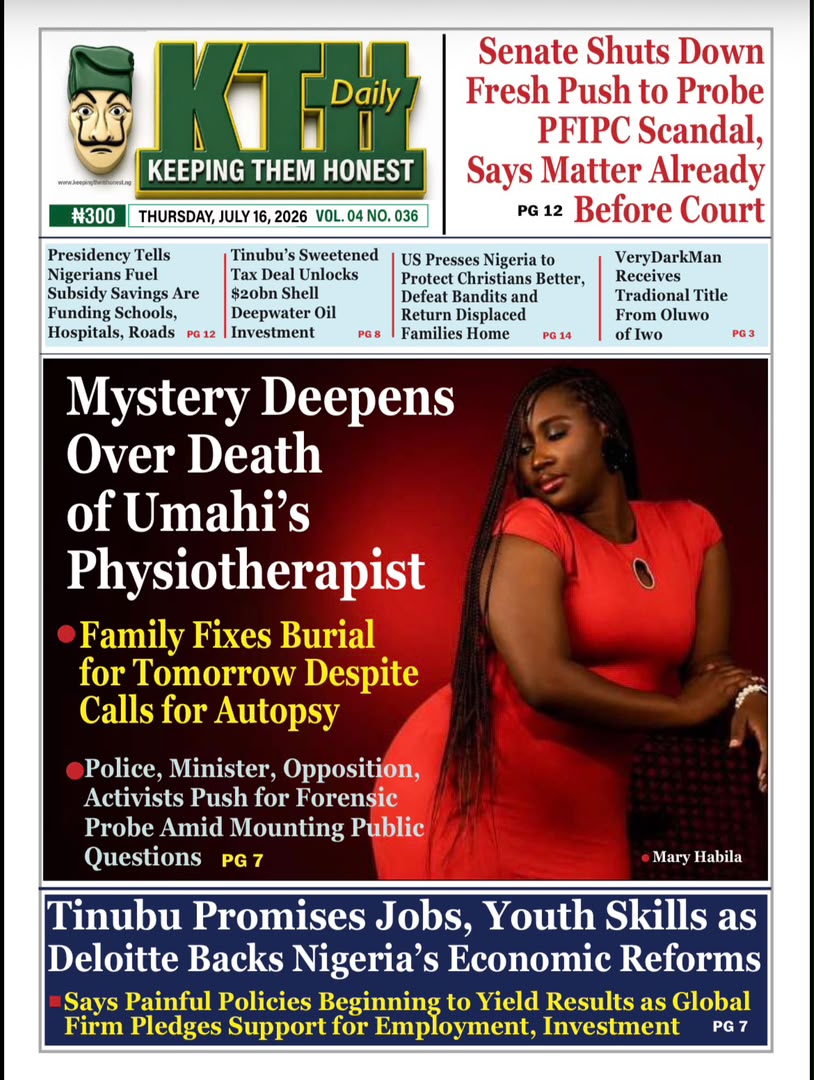
…Police, Minister, Opposition, Activists Push for Forensic Probe Amid Mounting Public Questions
…Family Fixes Burial for Tomorrow Despite Calls for Autopsy
By Chike Ofili
Controversy surrounding the death of 26-year-old physiotherapist Mary Habila has intensified after her family announced plans to proceed with funeral arrangements beginning tomorrow, Friday, July 17, despite an ongoing police investigation and mounting calls for an autopsy to establish the exact cause of her death.
The development has raised fresh questions because both the Nigeria Police and the Minister of Works, Senator David Umahi, in whose Ebonyi residence Habila died, have publicly insisted that a forensic autopsy is necessary before the circumstances surrounding her death can be conclusively determined.
With no indication that such an autopsy has been carried out, the family’s decision to proceed with burial has left many Nigerians puzzled and has intensified public curiosity over a case that has rapidly evolved into one of the country’s most controversial deaths involving a serving cabinet minister.
Habila, popularly known as Mara, reportedly died on June 27 at Umahi’s residence in Uburu, Ebonyi State, where she had been working after being seconded from the David Umahi Federal University of Health Sciences to the Federal Ministry of Works.
Her funeral programme, released by the family, indicates that funeral rites will commence tomorrow with a service at the Deeper Life Bible Church, Nok, in Jaba Local Government Area of Kaduna State, where relatives, friends, colleagues, and sympathisers are expected to pay their final respects.
Ordinarily, the announcement might have marked the end of a family tragedy. Instead, it has become another source of controversy.
Many observers say the timing of the burial has become difficult to reconcile with repeated official assurances that an autopsy would determine what caused the young physiotherapist’s death.
Equally intriguing, they note, is the continued silence of Habila’s family. Although Umahi had earlier disclosed that her parents, who travelled to Ebonyi after the incident, would address journalists and explain the circumstances surrounding their daughter’s death, no such briefing has taken place.
The family has also not publicly explained why it has chosen to proceed with burial while investigations remain incomplete.
That silence has only deepened public suspicion and intensified speculation on social media and across the country.
The controversy first erupted after reports emerged that Habila died inside the private residence of the Minister of Works under circumstances that remain unclear.
Since then, questions have continued to multiply.
What exactly was her assignment at the minister’s residence? Why was she living there? What happened in the hours before her death? Who was present? And why has the cause of death still not been established publicly nearly three weeks after the incident?
Umahi has repeatedly denied any attempt to conceal what happened.
Responding to the allegations during an inspection of the Calabar-Ebonyi-Benue-Nasarawa-Abuja Super Highway project, the minister insisted the incident was immediately reported to the police.
According to him, it was members of Habila’s own family who became alarmed after she failed to respond, forced open her room, and summoned doctors from the David Umahi Federal University Teaching Hospital.
He said the doctors rushed her to hospital, where every effort was made to revive her without success.
“The family broke the girl’s door, called doctors from DUFUTH, who took her to hospital and did everything to revive her, but failed,” Umahi said.
“The family reported the matter to the police, so where is the secrecy?”
Rejecting allegations of a cover-up, Umahi disclosed that he had directed that a comprehensive autopsy be carried out with the consent of Habila’s parents to determine the exact cause of death.
He also instructed his lawyers to institute legal proceedings against individuals spreading what he described as false and misleading reports concerning the incident.
The minister’s insistence on an autopsy now appears to stand in contrast with the family’s decision to proceed with funeral arrangements before any forensic findings have been publicly disclosed.
Police sources have maintained that detectives are still reconstructing events leading to Habila’s death, including determining who was inside the residence, the sequence of events after she was discovered unresponsive, and when emergency medical assistance was requested.
The African Democratic Congress (ADC) has meanwhile escalated the political dimension of the controversy by demanding an independent investigation outside the control of the Executive.
In a statement signed by its National Publicity Secretary, Mallam Bolaji Abdullahi, the party argued that the death of a young woman inside the residence of a serving cabinet minister had become a matter of national accountability rather than a private affair.
The party called for a full autopsy, an independent inquiry, and the public release of investigative findings.
It also questioned the exact nature of Habila’s assignment, why she was residing in Umahi’s private residence and what circumstances led to her death.
ADC further urged President Bola Tinubu to direct Umahi to step aside while investigations continue, arguing that anything less would reinforce public perceptions that the administration protects senior officials from scrutiny.
Adding to the pressure, the Nigerian Women International Alliance (NWIA) appealed directly to President Tinubu to guarantee an independent, transparent and credible investigation.
In an open letter signed by its President, Mrs Omolara Abike, Vice President Mrs Ogonna Chiedum and Secretary Dr Mariam Adeosun, the organisation stressed that it was not accusing anyone of wrongdoing but insisted that the seriousness of the incident required an investigation capable of inspiring public confidence.
The group noted that every Nigerian enjoys the constitutional presumption of innocence but argued that holders of high public office equally have a duty to submit themselves to transparent scrutiny whenever grave questions arise.
Human rights activist and former presidential candidate Omoyele Sowore also renewed his call for a coroner’s inquest.
He argued that all investigative and forensic procedures, including an autopsy where required by law, should be completed before Habila is buried.
According to him, the unresolved circumstances surrounding her death make it imperative for every legal and scientific process to be exhausted before funeral rites proceed.
Journalist and rights advocate Fejiro Oliver has also joined the growing chorus demanding answers.
Oliver questioned the circumstances under which the young physiotherapist came to be at the minister’s residence and called for a transparent, comprehensive police investigation capable of establishing the truth through evidence rather than speculation.
Meanwhile, police have continued to emphasise that only scientific examination and ongoing investigations can establish the true cause of Habila’s death.
Despite the competing narratives now dominating public discourse, no official investigative authority has announced any conclusions regarding the circumstances of her death.
As funeral rites are set to commence tomorrow, many Nigerians believe the central questions remain unanswered.
Rather than calming public anxiety, the family’s decision to proceed with burial before any publicly acknowledged autopsy, its continued silence, the minister’s own insistence on forensic examination, the police investigation, opposition demands for an independent inquiry and growing pressure from civil society have combined to deepen one of the most closely watched controversies involving a senior government official in recent years.
Discover more from Keeping Them Honest
Subscribe to get the latest posts sent to your email.