

…Links Surge in Terror Attacks to 2027 Politics
…Killings of Soldiers, Recent US Evacuation Stoke Fear Nationwide
By Abu Adamu
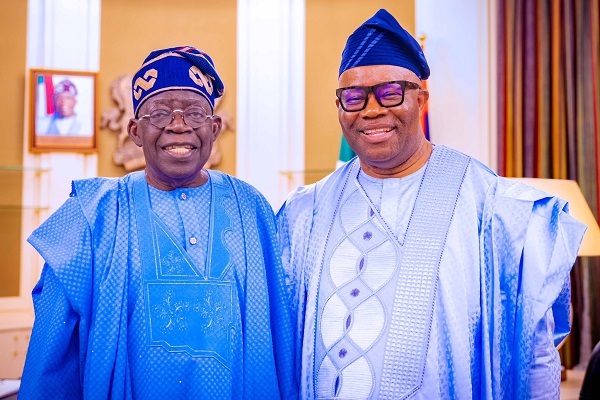
Senate President Godswill Akpabio on Tuesday stirred the hornets’ nest over Nigeria’s worsening security situation, declaring that the recent spike in terrorist attacks is politically motivated and would abruptly end shortly after President Bola Tinubu secures re-election in 2027.
Akpabio made the assertion in Abuja during the commissioning of the Nigeria Revenue Service Headquarters, suggesting that the wave of violence across the country is part of a calculated attempt to undermine the administration.
“Believe me, Mr President, two weeks after you win the elections, the bomb blasts will stop. People are sponsoring it to distract you from your work,” he said, adding that the President was performing well “despite the gang-up” against his government.
His comments come against the backdrop of escalating terrorist attacks, mounting military casualties, and growing international concern over Nigeria’s security trajectory.
Just a day earlier, President Tinubu convened a high-level security meeting at the Presidential Villa with the Chief of Defence Staff, Olufemi Oluyede, the National Security Adviser, service chiefs, and heads of intelligence agencies, including the Department of State Services and the National Intelligence Agency.
The emergency meeting followed confirmation by the Nigerian Army that a Commanding Officer and six soldiers were killed in a terrorist attack in Monguno, Borno State. According to the military, troops under Operation HADIN KAI had successfully repelled an attempted infiltration at their position in the Charlie 13 area on April 12 after a fierce gun battle.
Tragedy, however, struck shortly after the encounter when the Commanding Officer, who had advanced to assess the situation, ran into an Improvised Explosive Device (IED), which destroyed his vehicle and killed him alongside six other personnel.
The Army described the fallen officer as a courageous and selfless leader who died in active service, even as it maintained that troops remained firmly in control of the area and had successfully foiled the terrorist incursion.
The Monguno incident came on the heels of another deadly assault in Benisheikh, also in Borno State, where insurgents launched a brazen night attack on the 29 Task Force Brigade Headquarters.
Military sources confirmed that the attack claimed the life of Brigade Commander, Brigadier-General Oseni Omoh Braimah, alongside several officers, including the Brigade Imam. The attackers, believed to be affiliated with the Islamic State West Africa Province (ISWAP), reportedly engaged troops in hours of intense fighting before being repelled.
The Defence Headquarters said troops responded with “exceptional courage and superior firepower,” forcing the insurgents to retreat and preventing the base from being overrun. It described the attack as a desperate move by weakened terrorist elements under sustained military pressure.
Reacting, President Tinubu expressed deep sorrow over the loss of the soldiers, describing them as “unforgettable and irreplaceable heroes,” and urged the military not to be discouraged, insisting that ongoing offensives have significantly degraded insurgent capabilities.
“Because of the courage and dedication of our troops, our resolve to defeat terrorism is stronger than ever,” the President said, while cautioning against narratives that could undermine military morale.
Despite these assurances, insecurity has continued to intensify across multiple fronts, reinforcing both domestic anxiety and international concern.
The United States Department of State recently authorised the voluntary departure of non-essential embassy staff and their families from Abuja, citing heightened risks. In an updated travel advisory, Washington designated several states, including Plateau, Jigawa, Kwara, Niger, and Taraba, as “Do Not Travel” zones over threats of terrorism, kidnapping, and violent crime.
The advisory followed a series of deadly incidents, including attacks in Plateau and Niger states that left dozens dead, as well as broader troubling indicators such as Nigeria’s ranking among the most terrorism-affected countries globally, with insurgent groups like Boko Haram and ISWAP responsible for the majority of fatalities.
Nigeria’s Minister of Information, Mohammed Idris, however, dismissed the US move as a routine precaution that does not reflect the overall security reality.
“While we acknowledge isolated security challenges in some areas, there is no general breakdown of law and order, and the vast majority of the country remains stable,” he said, pointing to what he described as measurable gains from sustained military operations and improved inter-agency collaboration.
He also urged international partners to adopt a more balanced assessment, even as the government reiterated that Nigeria remains open for business.
Akpabio’s politically charged remarks, coming amid these developments, are likely to further inflame debate over the true drivers of Nigeria’s worsening insecurity—whether rooted in evolving terrorist threats or, as he suggests, in the high-stakes calculations ahead of the 2027 general elections.
Nigeria continues to grapple with a complex web of security challenges, including a protracted insurgency in the North-East, banditry in the North-West and North-Central, and separatist-linked violence in parts of the South-East, raising urgent questions about the country’s stability and the path forward.
Discover more from Keeping Them Honest
Subscribe to get the latest posts sent to your email.