

..£746m Lagos Port Upgrade
…Visa Expansion
…Border Security Pact
…Deepening Alliance
BY Yinka Giwa
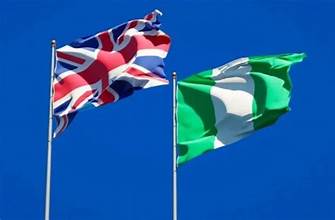
Nigeria and the United Kingdom have entered into a sweeping new phase of bilateral cooperation, signing multiple agreements spanning migration management, border security, and a landmark £746 million infrastructure financing deal to modernise key seaports in Lagos.
At the heart of the partnership is a trio of Memoranda of Understanding (MoUs) covering migration partnership, organised immigration crime, and border security, alongside a separate agreement to expand business visa access for UK companies operating in Nigeria.
The Minister of Interior, Olubunmi Tunji-Ojo, signed two of the MoUs on Wednesday and a third the following day in the UK, describing the agreements as a reflection of Nigeria’s commitment to a transparent and structured migration system aligned with national interests and international obligations.
He said both countries share a common vision to build a migration framework that is safe, orderly, and mutually beneficial, adding that the focus would be on measurable outcomes and effective implementation.
“This relationship with the UK means a lot to us, and you can see the level of commitment that Bola Ahmed Tinubu has put in,” Tunji-Ojo said, reiterating Nigeria’s resolve to protect legitimate migrants while cracking down on abuse of legal pathways and transnational criminal networks.
Under the agreements, a structured migration framework will promote regulated movement of people while respecting national laws and human rights, while a three-year strategy between the UK Home Office and Nigeria’s Ministry of Interior will target organised immigration crime and strengthen border control systems.
A key component of the pact is the expansion of the Business Visa Scheme, designed to ease mobility for credible UK-based firms with verified investment interests in Nigeria, mirroring existing UK concessions for trusted Nigerian companies.
Tunji-Ojo described the visa deal as critical to Nigeria’s economic ambitions, noting that reducing barriers linked to irregular migration would help unlock trade and support the country’s drive towards a trillion-dollar economy.
UK Home Secretary, Shabana Mahmood, described Nigeria as the UK’s foremost bilateral partner in such arrangements, commending the depth of cooperation and shared strategic vision between both countries.
Similarly, UK Trade Envoy, Florence Eshalomi, said the visa expansion agreement offers clear economic benefits and represents a bold step towards strengthening commercial ties with Africa’s largest economy.
In a parallel development, both countries also sealed a landmark £746 million financing agreement aimed at overhauling the Lagos Port Complex and Tin Can Island Port Complex—two of Nigeria’s busiest maritime gateways handling a significant share of international cargo traffic.
The project, backed by UK Export Finance through its Buyer Credit Facility and arranged by Citibank London, will fund the comprehensive rehabilitation and modernisation of the ports in partnership with the Nigerian Ports Authority and the Federal Ministry of Finance.
Officials said the upgrade will introduce modern infrastructure, digital cargo handling systems, and automated operations to significantly cut cargo clearance time, ease congestion, and improve efficiency across Nigeria’s maritime supply chain.
Minister of Marine and Blue Economy, Adegboyega Oyetola, described the initiative as a major milestone in unlocking the country’s marine and blue economy потенциал, noting that it would transform port operations and reduce long-standing logistical bottlenecks.
He said the reforms would shorten vessel turnaround time, lower demurrage and logistics costs, boost transparency and ultimately increase government revenue.
The modernisation is also expected to strengthen Nigeria’s position as a leading maritime hub in West and Central Africa by expanding port capacity and enhancing operational efficiency.
Beyond domestic gains, the agreement opens up significant commercial opportunities for British firms, with at least £236 million in supply contracts projected for UK-based companies. British Steel is expected to supply 120,000 tonnes of steel billets for the project, marking one of its largest export deals supported by UK Export Finance.
UK Secretary of State for Business and Trade, Peter Kyle, said the deal underscores the strength of UK–Nigeria economic relations and growing global demand for British industrial expertise.
Chief Executive of UK Export Finance, Tim Reid, added that the agreement demonstrates the agency’s capacity to unlock large-scale infrastructure projects that deliver mutual benefits for both countries.
Analysts say the combined agreements signal a strategic reset in Nigeria–UK relations, positioning both nations for deeper collaboration in trade, migration governance and infrastructure development, while sending a strong signal to global investors about Nigeria’s commitment to reform and economic modernisation.
Discover more from Keeping Them Honest
Subscribe to get the latest posts sent to your email.