

…“In a country that cannot accurately count itself, how do you count the dead?” observers ask U.S. newspaper
By Our Reporter
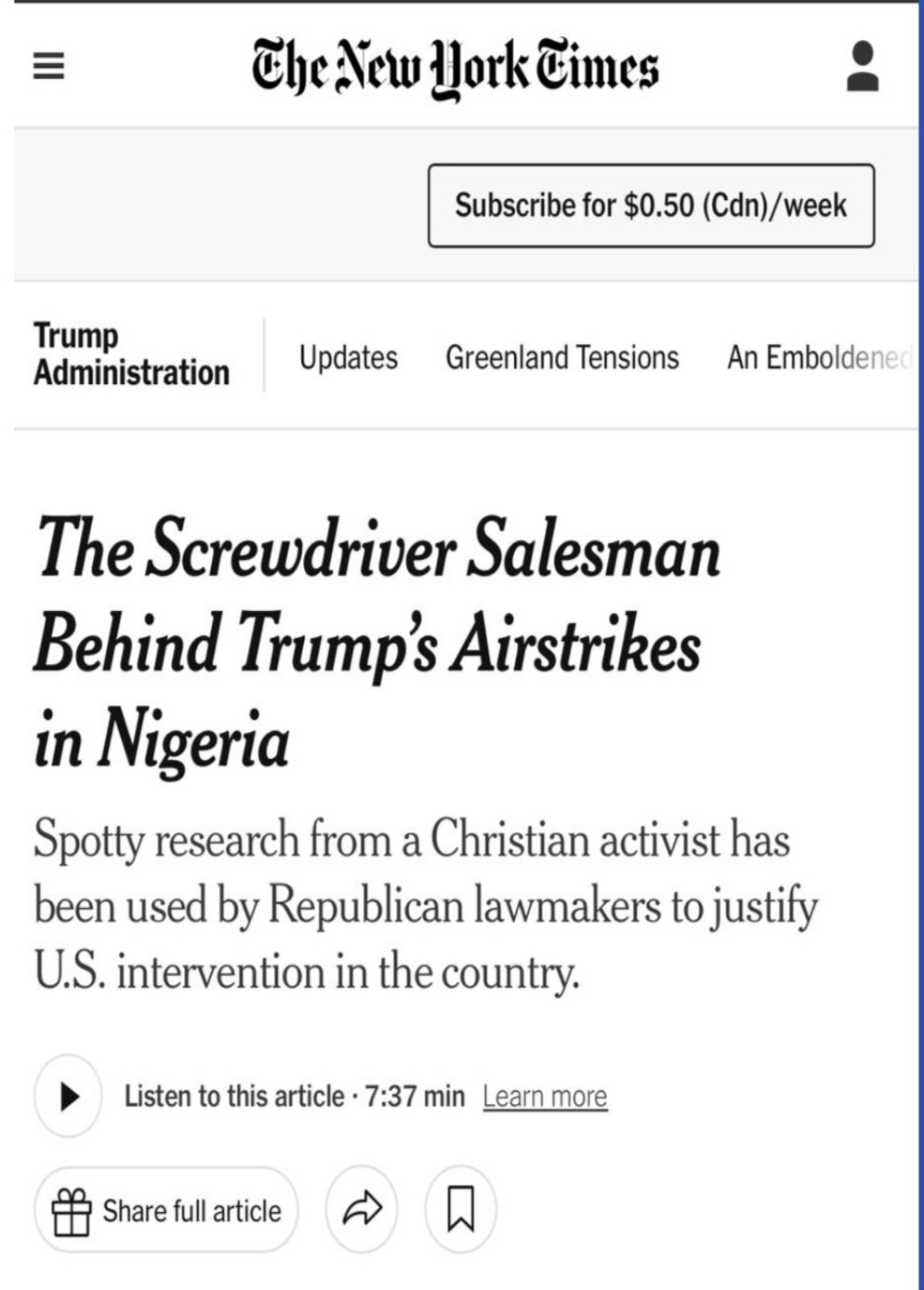
Analysts and informed observers have faulted Sunday’s New York Times report, to be published in print today, on violence against Christians in Nigeria, describing it as a continuation of the newspaper’s well-known adversarial posture toward policies associated with President Donald Trump, rather than a balanced engagement with Nigeria’s long-running security crisis.
While acknowledging that the statistics cited by Nigerian activist Emeka Umeagbalasi may be methodologically weak, sources insist that large-scale killings of Christians in northern and Middle Belt Nigeria are real, persistent and ongoing, regardless of debates over exact casualty figures. They argue that the New York Times appears more invested in discrediting narratives that have informed Trump administration rhetoric than in confronting the substance of Nigeria’s violence.
The New York Times investigation focused heavily on questioning the credibility of Umeagbalasi’s data, which has been cited by U.S. lawmakers and referenced in policy debates under President Trump. However, analysts say the report downplayed the lived realities of affected communities, where churches have been destroyed, villages emptied and thousands displaced by attacks linked to bandits, extremist groups, violent herdsmen and their collaborators.
According to security observers, the absence of a comprehensive national database documenting killings, abductions and missing persons in Nigeria has contributed directly to the persistence of atrocities. “Perpetrators are emboldened because there is no official record that counts their crimes,” a civil society source said. “If nobody is counting the dead, killing becomes easier.”
Analysts further argue that in a country that has struggled for decades to conduct an accurate population census, demanding forensic precision in casualty figures from non-state actors amounts to a form of denial. “In situations of widespread atrocities in a country that cannot even count itself, how is it possible to have perfectly accurate figures of those killed, abducted or missing?” one observer asked. “The lack of exact numbers does not negate the existence of targeted violence.”
Sources stressed that even if Umeagbalasi’s figures are not accurate “to the tee,” they nonetheless point to an undeniable pattern of sustained killings, particularly of Christian communities in vulnerable regions. “You can argue over whether the number is 3,000 or 7,000 in a year,” a security analyst said, “but you cannot argue away mass graves, deserted communities and a cycle of impunity.”
Observers warned that an excessive fixation on statistical imperfections risks shifting attention away from the deeper crisis of state failure and weak enforcement. “The real scandal is not imperfect data,” one analyst noted. “It is the lived experience of a state historically unable to protect its citizens, let alone account accurately for the dead and those forever missing.”
Critics of the New York Times report caution that global audiences may wrongly conclude that because casualty figures are disputed, the crisis itself is exaggerated. “Violence in northern Nigeria did not begin with President Bola Tinubu, and it has not ended under his watch,” an observer said. “It continues today, counted or not.”
For many analysts, the central question remains unresolved: not whether all the numbers add up, but why, after years of terror, it takes intervention from Washington to galvanise political will and moral urgency to stop the killings and properly account for Nigeria’s victims.
Discover more from Keeping Them Honest
Subscribe to get the latest posts sent to your email.