

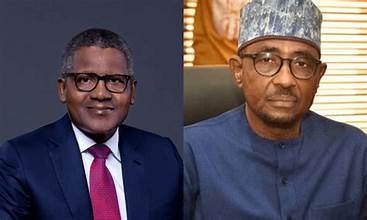
…Says Won’t Back Down From War Against ‘ Monopolists’, as ICPC Confirms Receipt of Dangote Petition
By Yinka Giwa
The Chief Executive Officer of the Nigerian Midstream and Downstream Petroleum Regulatory Authority (NMDPRA), Engr. Farouk Ahmed, who has been engulfed in a major corruption storm following allegations that he spent about $5 million on his children’s foreign education, has openly invited the Economic and Financial Crimes Commission (EFCC), the Code of Conduct Bureau (CCB), and the National Assembly to investigate his finances and conduct in office.
This is as the Independent Corrupt Practices and Other Related Offences Commission (ICPC) confirmed that it had received a formal petition from Africa’s richest businessman, Alhaji Aliko Dangote, and owner of the Dangote Refinery, against the NMDPRA boss.
In a statement issued in Abuja, ICPC spokesperson, Mr. John Okor Odey, disclosed that the petition was submitted on December 16, 2025, through Dangote’s legal representatives and is already being processed in line with the Commission’s statutory mandate.
“The Independent Corrupt Practices and Other Related Offences Commission confirms that it received a formal petition today, Tuesday, December 16, 2025, from Alhaji Aliko Dangote through his lawyer against the CEO of the NMDPRA, Alhaji Farouk Ahmed,” Odey said, adding that the petition “will be duly investigated.”
Yesterday, Ahmed issued a detailed public statement denying any wrongdoing and insisting that the claims were a deliberate attempt by powerful commercial interests to intimidate the regulator and weaken ongoing reforms in the downstream petroleum sector.
The NMDPRA chief disclosed that his annual remuneration is about ₦48 million, inclusive of allowances, and said the narrative that he personally spent $5 million on school fees was false and misleading. According to him, three of his four children benefitted from merit-based scholarships covering between 40 and 65 per cent of tuition, while additional support came from an education trust established by his late father, who died in 2018.
“When scholarships, family contributions and my own savings accumulated over more than three decades of public service are properly accounted for, my personal financial obligation was entirely within legitimate means,” Ahmed said.
He stressed that he has consistently filed asset declarations with the Code of Conduct Bureau since 1991, noting that all his income sources, investments and major expenditures are fully documented and available for scrutiny.
Ahmed publicly called on the EFCC, the CCB and the National Assembly to conduct a comprehensive probe of his assets, financial transactions and regulatory decisions since assuming office.
“I will cooperate fully, provide all documentation and answer all questions under oath if required,” he said, adding that he has nothing to hide.
The NMDPRA boss linked the timing of the allegations to recent regulatory actions that, according to him, have disrupted entrenched interests and exposed substandard petroleum products in the market. He accused unnamed “monopolists” of orchestrating a smear campaign in retaliation for policies aimed at ensuring supply security, enforcing quality standards and ending opaque practices in the sector.
“These allegations have emerged precisely at a time when NMDPRA has insisted on transparent pricing, stricter licensing, and the rejection of a single-source supply model that endangers national energy security,” Ahmed stated.
He maintained that granting import licences when domestic supply falls short is a statutory duty under the Petroleum Industry Act, not economic sabotage, warning that no responsible regulator would allow Nigeria’s fuel supply to be held hostage by any single operator, regardless of economic influence.
Ahmed said he would not be intimidated into abandoning regulatory independence or granting preferential treatment to any company, insisting that the reforms being implemented may create “winners and losers” but ultimately serve Nigeria’s long-term interests.
Observers maintain that Dangote’s petition (and Ahmed’s response) is shaping up as a high-stakes test of accountability, regulatory autonomy, and power dynamics in Nigeria’s oil and gas sector, with far-reaching implications for official oversight and Dangote’s 600,000 barrels per day refinery.
Discover more from Keeping Them Honest
Subscribe to get the latest posts sent to your email.