

By Our Reporter
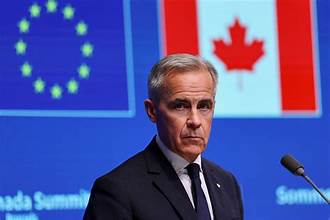
Canada has taken a decisive step in redefining its defence posture by joining the European Union’s multibillion-dollar Security Action for Europe (SAFE) initiative, becoming the first non-European nation to do so, in what analysts see as a clear pivot away from its long-standing dependence on the United States.
Prime Minister Mark Carney announced the move on Monday, framing Canada’s entry into the EU’s rearmament programme as both strategic and symbolic. Participation in SAFE, he said, will grant Canadian defence firms “tremendous opportunities” through greatly expanded access to Europe’s defence market at a time Carney described as “dangerous and divided.”
“Canada’s participation in SAFE will fill key capability gaps, expand markets for Canadian suppliers, and attract European defence investment into Canada,” he said. In a joint statement with European Commission President Ursula von der Leyen, Carney added that the partnership marks a deepening of Canada-EU cooperation and underscores “shared priorities” between Ottawa and Brussels.
SAFE, a 150-billion-euro ($170bn) fund unveiled earlier this year, was crafted amid mounting fears of Russian aggression and growing unease within Europe about the reliability of U.S. military protection. The initiative is central to the EU’s plan to “speed up defence readiness” and achieve the capacity to defend itself from external threats by 2030.
Canada’s decision to join the programme aligns with Carney’s broader policy goal of diversifying Canada’s defence procurement and trade relationships. He has previously signalled that more than 70 cents of every dollar in Canadian military capital spending would be redirected away from the United States—a remarkable shift for a country long integrated with U.S. defence supply chains.
The move comes in the wake of escalating tensions with Washington. Earlier this year, U.S. President Donald Trump angered Canadians by sparking a trade war and suggesting Canada should consider becoming the 51st state. The SAFE partnership further underscores Canada’s intent to insulate itself from American unpredictability and re-anchor its strategic ties with Europe.
Under the SAFE rules, joint arms projects must source at least 65 percent of their components from within the EU’s 27 member states, though exemptions may be available for trusted partners such as Canada. Priority funding will go to missiles, ammunition, artillery, ground combat systems, drones and counter-drone technologies, cyber capabilities, air and missile defence, naval forces, electronic warfare, and the protection of space assets.
Meanwhile, the United Kingdom’s bid to join the SAFE fund stalled last week after talks with Brussels collapsed. Negotiations broke down over financial commitments, with EU officials demanding a higher contribution than London was willing to offer.
Canada’s entry into SAFE thus marks a historic realignment—one that further distances Ottawa from Washington while embedding it more deeply in Europe’s fast-evolving defence architecture.
Discover more from KTH Daily
Subscribe to get the latest posts sent to your email.