

…Bloody Revelations Trigger Major Washington Probe
By Yinka Giwa
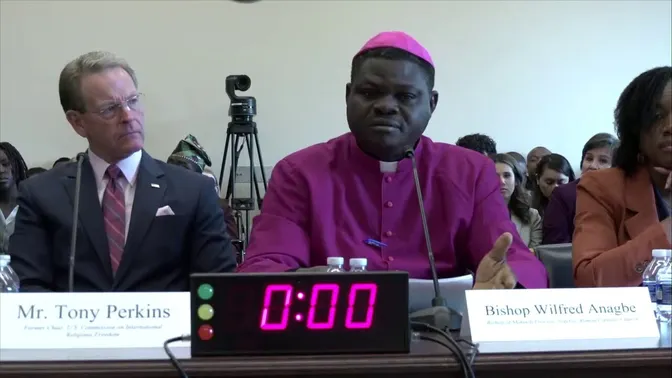
Former Nigerian Army Chaplain and Catholic Bishop of Makurdi, Wilfred Chikpa Anagbe, whose stark testimonies about mass killings and alleged persecution of Christians in Nigeria have reverberated across international policy circles, is set to appear before the U.S. Congress on Thursday, November 20. Bishop Anagbe, now one of the most prominent global voices calling attention to violence in Nigeria’s Middle Belt, will testify at a crucial hearing of the U.S. House Subcommittee on Africa, where his evidence is expected to shape Washington’s response to President Donald Trump’s redesignation of Nigeria as a Country of Particular Concern (CPC).
According to the official notification to members of the House Foreign Affairs Committee, the hearing will take place at 11:00 a.m. in Room 2172 of the Rayburn House Office Building and will be streamed live. Two panels will testify. Senior officials Jonathan Pratt, representing the Bureau of African Affairs, and Jacob McGee, Deputy Assistant Secretary in the Bureau of Democracy, Human Rights, and Labour, are slated to appear first. They will be followed by Nina Shea, Director of the Center for Religious Freedom; Ms. Oge Onubogu of the Center for Strategic & International Studies; and Bishop Anagbe, whose documentation of attacks on Christian communities has been shared widely with policymakers across Europe and North America.
Bishop Anagbe has previously spoken on the issue at the UK Parliament, where in March 2025 he described what he called a coordinated campaign of violence by Islamist extremists and militant Fulani herdsmen. He told British lawmakers that Christian villages in Benue had been burned, families displaced, and clergy murdered, stressing that even internally displaced persons’ camps were not spared. His testimony, delivered as a guest of the Catholic charity Aid to the Church in Need, contributed to a renewed international focus on Nigeria’s spiraling insecurity and what many advocacy groups describe as genocide-level attacks on Christian populations.
That global pressure intensified after President Trump’s October 31 decision to redesignate Nigeria as a CPC. Citing what he termed “severe violations of religious freedom,” Trump claimed Christianity faced an “existential threat” in Nigeria and threatened sweeping consequences, including the withdrawal of U.S. aid and potential military intervention. “If the Nigerian Government continues to allow the killing of Christians, the USA will immediately stop all aid and assistance to Nigeria, and may very well go into that now-disgraced country, ‘guns-a-blazing,’” he declared, adding that he had instructed his “Department of War” to prepare for possible action.
President Bola Ahmed Tinubu swiftly rejected the allegations, insisting that Nigeria’s constitutional commitment to religious liberty remains intact. Through a statement on his official X handle, he said the depiction of Nigeria as religiously intolerant was inaccurate and ignored the country’s democratic safeguards. Yet several U.S. lawmakers remain unconvinced. Representative Riley Moore (R-WV), speaking on Fox News, dismissed Tinubu’s comments as “completely false,” claiming that Christians are being killed at a ratio of five to one compared to Muslims and pointing to cases of Nigerians facing the death penalty for alleged blasphemy. He accused Nigerian authorities of complicity “to one degree or the other” by failing to fully confront the violence.
Thursday’s hearing comes amid a broader legislative push. Senator Ted Cruz’s “Nigeria Religious Freedom Accountability Act of 2025”, already before the U.S. Senate, proposes sanctions: including visa bans and asset freezes—on Nigerian officials accused of enabling persecution. Representative Chris Smith has introduced a House resolution urging the State Department to impose conditions on U.S. aid and intensify pressure on the Nigerian government to protect vulnerable communities. The U.S. Commission on International Religious Freedom has welcomed the CPC redesignation, citing years of documented attacks by Boko Haram, Islamic State affiliates, and armed Fulani groups.
Against this backdrop, Bishop Anagbe’s testimony is expected to play a pivotal role in shaping Washington’s next steps. His detailed accounts of devastated farming communities, torched churches, murdered clergy, and displaced families are likely to influence deliberations on sanctions, humanitarian assistance, and broader U.S.–Nigeria relations. As he prepares to testify, international scrutiny of Nigeria’s security failures has reached a new peak, and the outcome of Thursday’s hearing may well determine how the world responds to one of Africa’s most contested and politically volatile human rights crises.
Discover more from Keeping Them Honest
Subscribe to get the latest posts sent to your email.