

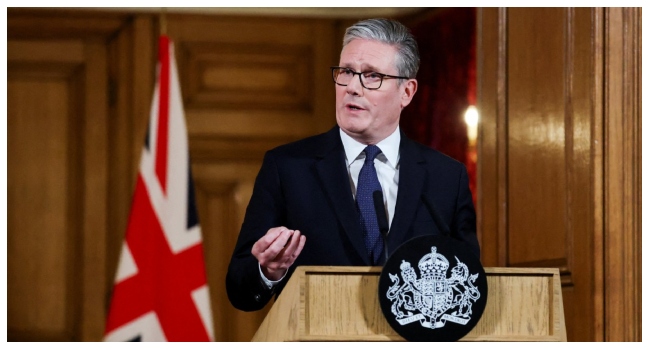
Sir Keir Starmer is expected to announce the UK’s recognition of a Palestinian state in a statement on Sunday afternoon.
The prime minister said in July the UK would shift its position unless Israel met several conditions, including agreeing to a ceasefire in the Gaza Strip and committing to a long-term peace process leading to a Palestinian state co-existing alongside Israel.
The Israeli leadership has ruled this out since the start of the war following Hamas’s attack in southern Israel on 7 October 2023 in which 1,200 people were killed and 251 taken hostage.
The PM’s move has drawn fierce criticism from the Israeli government, families of hostages held in Gaza and some Conservatives.
Israeli Prime Minister Benjamin Netanyahu previously said recognition of a Palestinian state “rewards terror”.
It represents a major change in UK foreign policy, after successive governments said recognition should come as part of a peace process and at a time of maximum impact.
However, ministers argue there was a moral responsibility to keep hopes of a long-term peace alive.
Efforts to secure a ceasefire in Gaza – let alone a long-term solution to the Israel-Palestine conflict – have faltered. Israel sparked international outrage when it recently carried out an air strike on a Hamas negotiating team in Qatar.
Government sources said the situation on the ground had also worsened significantly in the last few weeks, citing images showing starvation and violence in Gaza that Sir Keir previously described as “intolerable”.
On Sunday, the Hamas-run Gaza health ministry said 71 people were killed and 304 injured in Israeli attacks in the past 24 hours.
It is the latest Israeli offensive in the nearly two-year war which has seen much of the Palestinian territory’s population displaced, its infrastructure destroyed, and at least 65,208 people killed, according to the Gaza health ministry.
Earlier this week, a UN commission of inquiry concluded Israel had committed genocide against Palestinians in Gaza, which Israel denounced as “distorted and false”.
UK ministers have also highlighted the continued expansion of Israeli settlements in the occupied West Bank, which are illegal under international law, as a key factor in the decision to recognise Palestinian statehood.
Mohammed Jarrar, mayor of the West Bank city of Jenin, told the BBC that “this Israeli government wants to annex the West Bank” – but stressed that the decision to recognise a Palestinian state was an important move.
“It confirms the fact that the Palestinian people possess a state, even if it is under occupation,” he said.
UK Deputy Prime Minister David Lammy said “now is the time to stand up for” a two-state solution.
He told BBC One’s Sunday with Laura Kuenssberg programme: “Will this feed children? No, it won’t. That’s down to humanitarian aid. Will it free hostages? That must be down to a ceasefire.
“But does this mean that you get, or hold out for, that two-state solution and stand by the Palestinian cause being a just cause? That was the determination that I and the prime minister made at the end of July.”
Lammy cited the controversial E1 settlement project, which critics warn would put an end to hopes of a viable, contiguous Palestinian state.
Palestinian Authority President Mahmoud Abbas welcomed the UK’s recognition pledge when he visited Sir Keir earlier this month, with Downing Street saying both agreed Hamas should play no role in the future governance of Palestine.
Husam Zomlot, its UK representative, told the BBC that recognition was an “inalienable right” that would mean “ending the denial of our existence” and that “the British people should celebrate today, when history is being corrected”.
“The question is never why should the UK recognise the state of Palestine,” he said, “the question is why didn’t the UK recognise the state of Palestine all along?”
Conservative shadow chancellor Mel Stride said he agreed with a two-state solution, but said recognising Palestine now was “not applying any leverage or getting anything in return”.
“It’s more to do with the internal politics of [the prime minister’s] own cabinet and his backbenchers and the pressure he is receiving, and that is not a good basis on which to conduct foreign policy.”
But Liberal Democrat leader Sir Ed Davey welcomed the decision, which he said had “needed to be done for years”.
Discover more from Keeping Them Honest
Subscribe to get the latest posts sent to your email.