

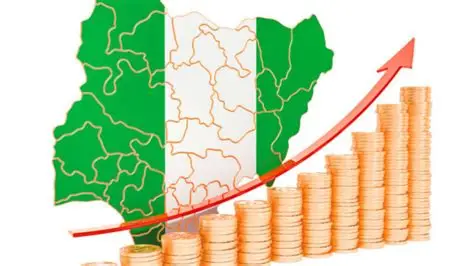
…FG Targets More Expansion Through Investment, Reforms
… What it All Means for Nigerians
By Jeremy Fregene
In what will appear to be some good news on Nigeria’s economic front, the country’s economy grew by 3.13% in the first three months of 2025 — a notable improvement compared to 2.27% growth during the same period last year.
The National Bureau of Statistics (NBS) released this data on Monday, showing that sectors like services, industry, and agriculture helped push the economy upward. This growth comes after a rebasing of Nigeria’s Gross Domestic Product (GDP), which is a routine update that gives a clearer picture of how the economy is doing based on more current data.
Thanks to the rebasing, Nigeria’s economy is now officially valued at ₦205 trillion using 2019 as the base year, showing a 41% increase compared to earlier estimates. In today’s terms, the GDP stands at ₦372.8 trillion, or about $243 billion.
According to Adeyemi Adeniran, the Statistician General of the Federation, this new valuation reflects stronger performance in areas like farming (especially crop production), trade, real estate, telecoms, and oil and gas.
One interesting takeaway: real estate has now overtaken oil and gas as one of the top five contributors to the economy. That’s partly because the government is now tracking informal property transactions that weren’t captured before.
The data also shows that the services sector, everything from banking and telecoms to entertainment, now makes up more than half of Nigeria’s economic activity, while agriculture accounts for about 26%, and industry (like manufacturing and oil) about 21%.
The informal sector, which includes small-scale and non-registered businesses, plays a huge role too. It now contributes ₦86.85 trillion to GDP—more than double previous estimates. This means that even street vendors and roadside mechanics are a big part of Nigeria’s economy.
…Government Eyes a $1 Trillion Economy
Building on this positive outlook, the Federal Government says it is working toward a much bigger goal: growing Nigeria’s economy to $1 trillion by 2030.
Speaking at the Domestic Investment Summit in Abuja on Monday, Minister of Industry, Trade and Investment, Dr Jumoke Oduwole, said this ambitious target is part of President Tinubu’s Renewed Hope Agenda.
“The President has made it clear: we want to grow this economy, not just for the sake of numbers, but to create jobs, reduce poverty, and make Nigeria a strong player in Africa and beyond,” she said.
According to her, Nigeria is already making progress. Non-oil exports, for example, rose by nearly 25% in the first quarter of 2025, hitting $1.79 billion. Local manufacturing is also getting a boost, with new textile parks, car assembly plants, and food hubs emerging in special economic zones.
“These facilities are helping us save foreign exchange, create thousands of jobs, and reduce our reliance on imports,” the minister added.
She said the government is also targeting $6 billion in foreign and portfolio investment, $6.5 billion in non-oil exports, and 200,000 new jobs tied to exports by the end of 2025.
So far, the government claims it has secured $50 billion in investment commitments through outreach to both local and international investors.
Permanent Secretary at the ministry, Amb. Nura Rimi, said the government’s “Nigeria First Policy” is more than just a slogan—it’s about giving local businesses priority, supporting homegrown industries, and building economic strength from within.
Also speaking at the event, a Central Bank of Nigeria representative said the summit was helping to build an environment where Nigerian businesses can thrive and compete not just locally, but across Africa.
…What It All Means
In simple terms, Nigeria’s economy is growing a bit faster than before. The new numbers give a clearer picture of how various sectors are performing, and the government says it’s laying the groundwork for a much bigger and stronger economy.
If the plans work as intended, Nigerians could see more jobs, stronger local industries, and a reduced reliance on oil, which has been the country’s economic backbone for decades.
But observers say that whether or not these statistics will turn into real improvements in people’s daily lives is something only time will tell.
Discover more from Keeping Them Honest
Subscribe to get the latest posts sent to your email.