

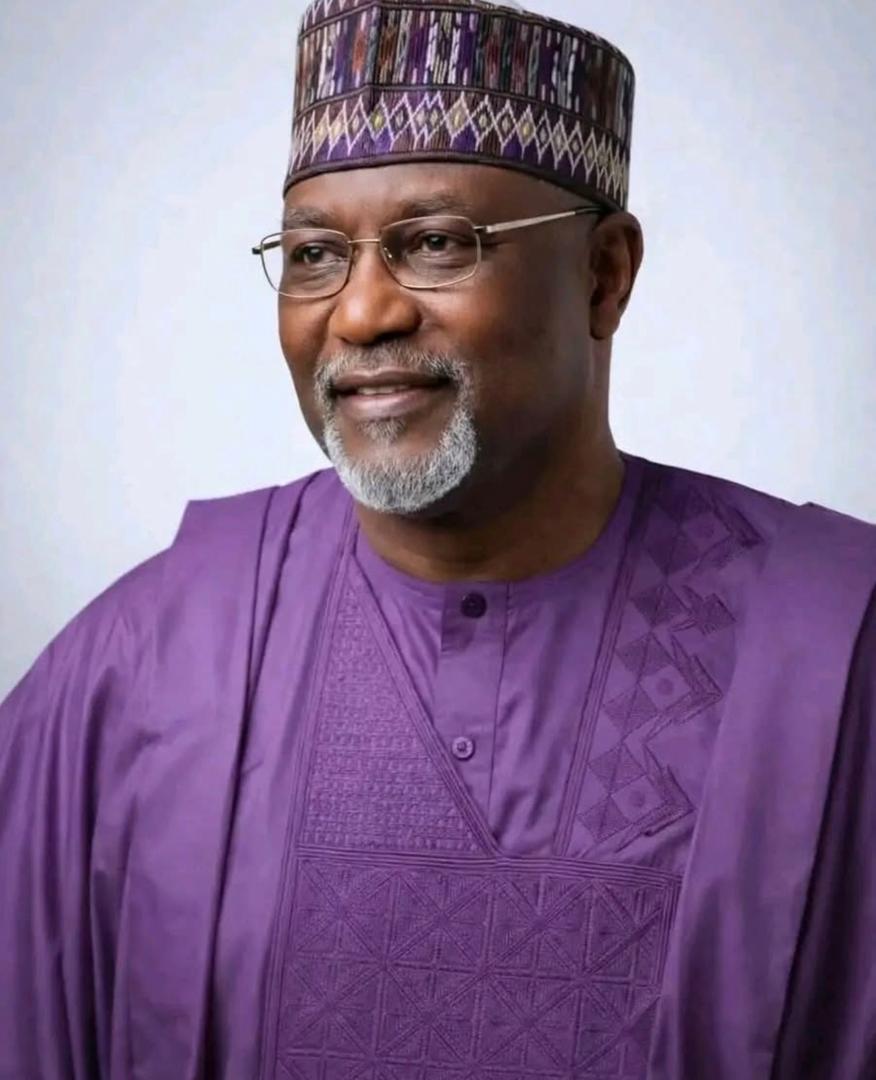
• Ex-DSS Henchman who raided judges’ homes at midnight, arrested Supreme Court judge in pyjamas, got fired over National Assembly siege says sycophants hijacked Buhari govt after his 2018 exit
By Abu Adamu
Lawal Daura, the powerful former Director-General of the Department of State Services whose controversial tenure was marked by midnight raids on judges’ homes and ended abruptly when then-Acting President Yemi Osinbajo fired him following the 2018 siege on the National Assembly, has declared that the administration of the late President Muhammadu Buhari began to lose direction after his exit from government.
Daura, now the vice-presidential candidate of the Allied Peoples Movement (APM), said Buhari was eventually surrounded by sycophants who betrayed the former President’s trust and took advantage of his administration, arguing that things began to unravel after he was removed as Nigeria’s domestic intelligence chief in August 2018.
Speaking on Channels Television’s Politics Today on Monday, Daura pushed back against assessments that Buhari presided over one of the worst governments in Nigeria’s history, effectively drawing a line between the period when he served as DSS Director-General and the remaining years of the administration.
“Everything started to give way after 2018 since I left office,” Daura generally pontificated.
His intervention is particularly striking given the extraordinary power he wielded during Buhari’s first term and the controversies that eventually consumed his tenure.
Appointed DSS Director-General shortly after Buhari assumed office in 2015, Daura became one of the administration’s most influential security officials and was frequently portrayed by critics as a member of the powerful inner circle around the President.
But Daura rejected suggestions that he belonged to any so-called cabal, arguing that his constant proximity to Buhari was dictated by his responsibilities as the country’s domestic intelligence chief.
“No, there is no cabal,” he said.
“Even if there was a cabal, the intelligence chief of a country can never be part of a cabal because the schedule I handled made it necessary for me to be close to the President at all times.”
According to him, rather than a cabal, Buhari’s problem was the presence of sycophants who enjoyed the former President’s confidence but ultimately betrayed it.
Daura said he knew some of the people involved and was familiar with details of their conduct, although he did not publicly identify them during the interview.
He also challenged Nigerians who describe the Buhari years as exceptionally poor to undertake a broader assessment of the country’s political history.
“Yes, they can say it, but I also want them, the real students of history, to go back from 1995 to 2023, when he exited, and find out which were the worst years,” Daura said.
“I wasn’t part of the government then (when things started to go wrong). And that will show you that I stood by him and I protected that government.”
Daura’s claim that Buhari’s government began to unravel after his departure is likely to reopen debate about his own role in an administration whose first term witnessed some of the most contentious security operations against institutions and individuals perceived as hostile to the government.
Perhaps the defining episode of his tenure came in October 2016, when armed DSS operatives carried out coordinated overnight raids on the residences of senior judicial officers in Abuja and other parts of the country.
Among those targeted were Supreme Court Justices Sylvester Ngwuta and John Okoro and Justice Adeniyi Ademola of the Federal High Court.
The dramatic operations, during which judges were confronted in their homes in the middle of the night, caused an uproar within the legal community and triggered accusations that Buhari’s security establishment was attempting to intimidate the judiciary under the banner of fighting corruption.
The raids became emblematic of Daura’s almost harebrained leadership of the DSS, with accounts of judicial officers being arrested in their night clothes adding to public outrage over the methods deployed by the secret police.
The Nigerian Bar Association, senior lawyers, civil society organisations and rights advocates strongly criticised the operation, arguing that allegations of misconduct involving serving judicial officers should have been handled through constitutionally recognised legal and disciplinary procedures, including the National Judicial Council.
The DSS and the Buhari administration defended the raids at the time as legitimate anti-corruption operations and said large amounts of money had been recovered from some of the locations searched.
Several of the affected judges challenged the operations in court, while Daura, Buhari and then-Attorney-General of the Federation Abubakar Malami were named in legal actions arising from the raids.
But Daura’s grip on the security establishment came to a dramatic end less than two years later.
On August 7, 2018, masked DSS operatives barricaded the National Assembly complex in Abuja, preventing some lawmakers, parliamentary workers and journalists from entering.
The operation plunged the country into a political crisis and generated widespread condemnation amid intense tensions between the Buhari administration and the leadership of the Senate under Bukola Saraki.
Buhari was outside the country at the time, leaving Osinbajo as Acting President, and the Presidency said the security operation had neither been authorised by Osinbajo nor cleared with him.
Within hours, Osinbajo ordered Daura’s immediate dismissal as DSS Director-General, describing the blockade as an unauthorised action and a violation of constitutional order.
Daura was subsequently taken into custody by security personnel, bringing an extraordinary end to the tenure of a man who, until that morning, had been regarded as one of the most formidable officials in Buhari’s government.
Eight years later and now seeking elective office, Daura is offering his own assessment of what went wrong with the administration he once helped demonise.
He said one of the biggest lessons from Buhari’s presidency was the danger of confusing personal loyalty with competence in making appointments.
According to the former DSS boss, knowing or trusting someone personally should not automatically qualify that individual for public office.
He argued that even where a President decides to appoint a trusted associate, the person’s competence and character must first be assessed and the responsibility assigned should be proportionate to the individual’s ability.
“And even if you are to do that, you must also weigh the quality of that person and then maybe place him in an office that befits him or is proportionate to maybe the level of trust you have in that person,” Daura said.
“But in that situation, an unfortunate situation, I would say, it so happened that people were just, you know, trusted.”
Daura maintained that the people he described as sycophants did not necessarily misdirect Buhari but exploited the confidence the former President placed in them, with damaging consequences for his government.
The former intelligence chief has since made the transition from the secretive world of state security into partisan politics.
After leaving the African Democratic Congress, he joined the APM and emerged as the party’s vice-presidential candidate, replacing Ibrahim Adamu Bala, who had earlier been announced as a placeholder running mate.
Discover more from Keeping Them Honest
Subscribe to get the latest posts sent to your email.