

By Grace Adejoh
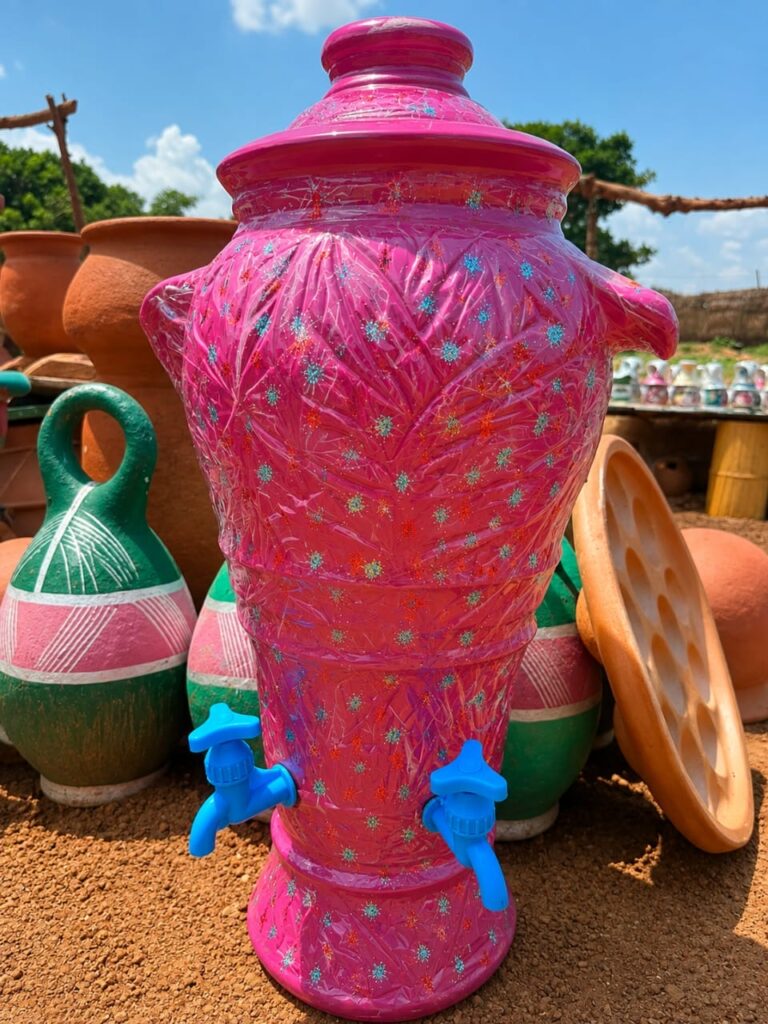
A colourful display of clay pots, flower vases, incense burners and other pottery items stretches for about a kilometre along a busy road in Rege, Kano State, catching the attention of passers-by.
Arranged in different shapes, sizes and earthy colours, the products are more than goods displayed for sale.
They tell the story of an age-old craft that has survived generations and continues to provide income for families in the community.
For Sani Audu, Chairman of the Pottery Makers Association, Rege, pottery is both a business and a family heritage.
“I learnt this business from my parents, and we, in this generation, have modernised it. The world is moving very fast in terms of modernisation, so we also have to follow suit,” he said.
Audu recalled that when he started, only a handful of people practised pottery along the road.
“Initially, we were only four people doing this business along this road. Today, we are more than 100, and we have spread across about one kilometre,” he said.
According to him, the growth has been driven partly by the interest of young people and the potters’ ability to introduce products that reflect changing consumer preferences.
While traditional water and cooking pots remain popular, the artisans now produce incense containers, flower vases, local stoves, piggy banks and children’s play beds, among other items.
Audu said the products attract customers from Kano and other parts of Nigeria, while some have also generated interest beyond the country.
Beyond preserving a cultural tradition, experts say the growth of the pottery trade reflects the broader contribution of small businesses and informal enterprises to Nigeria’s economy.
The National Bureau of Statistics (NBS) and Small and Medium Enterprises Development Agency of Nigeria (SMEDAN) recorded more than 41.5 million micro, small and medium enterprises in their 2017 national survey.
The survey also showed that MSMEs accounted for about 48 per cent of Nigeria’s Gross Domestic Product (GDP), underscoring the importance of small-scale businesses to production, employment and household incomes.
In Kano alone, the survey recorded more than 2.7 million people employed by micro enterprises in 2017, placing the state among those with a substantial concentration of small businesses.
Although pottery is only one component of this broad informal economy, its activities illustrate how cottage industries can generate employment, support household incomes and keep money circulating within local communities.
Behind the colourful displays are women who play an important role in the production process.
Maryam Umaru, one of the women involved in the business, said she also inherited the trade from her parents.
“I inherited this pottery business from my parents. We grew up watching them make pots, and today, we have continued the tradition they passed down to us,” she said.
Umaru explained that women mainly handle the moulding of the pots, while men take charge of firing and selling the finished products.
The work begins with the preparation of the sand, which she identified as one of the most demanding stages.
“We wet the sand and allow it to dry before pounding it thoroughly. It is then sieved to remove lumps and other unwanted particles,” she said.
The prepared material is spread on the floor and mixed with ash and water before it is kneaded to the right consistency for moulding.
The women then shape the mixture into different forms, allow the pots to dry and decorate them with various designs before handing them over to the men for firing.
For Umaru, the work provides women with an opportunity to earn an income while preserving a tradition passed down through their families.
Beyond income generation, such activities also create opportunities for people who may have limited access to formal employment.
This is especially relevant in an economy where micro-enterprises remain an important source of livelihood for millions of Nigerians.
The craft, however, is not without its difficulties.
One of the biggest challenges facing the potters is competition from modern metal and aluminium utensils.
Audu said the availability of modern cooking pots had reduced demand for some traditional pottery products and affected the income of practitioners.
“Looking at modern pots such as metal and aluminium pots, the demand for our traditional pots has drastically reduced our cash inflow,” he said.
The cost of production is another concern.
Potters spend money on firewood, dry grass and other materials required for firing, while the traditional production process itself is time-consuming.
“For example, what costs N800 to produce may only be sold for N1,000. The profit is small when you consider the labour and other expenses involved,” Audu said.
He believes modern equipment could make a significant difference by reducing production time and improving the quality of the products.
“Here, we still rely on crude methods of production. In making pots, at least three days are required before they are ready for firing.
“With modern methods, moulded pots can be produced within a few hours,” he said.
Similarly, access to raw materials is becoming a challenge.
Audu said much of the clay and other materials used by the potters were sourced from areas around rice and sugarcane farms, many of which belonged to private landowners.
“Sometimes, we find it difficult to dig the raw materials because the lands belong to private individuals.
“Our association does not have the financial capacity to acquire land for pottery production,” he said.
The challenge sometimes disrupts production and increases the cost of doing business.
Audu therefore appealed to the government to provide dedicated land for pottery makers, as well as modern equipment, training and financial assistance.
For him, supporting the industry is not only about preserving culture but also about creating opportunities for employment and local enterprise.
“Not every graduate secures a job after graduation. As a result, many people are coming into this line of business to make a livelihood,” he said.
He estimated that more than 100 people were directly involved in pottery making in the community, while several other family members depended on income from the trade.
The business, he added, had helped some practitioners improve their standard of living.
“Many of us have bought farmlands, married, fed our families and sponsored our children to school to some extent.
“Some have even built houses through this business,” he said.
Albeit these gains, Audu said declining profits were making it difficult for some practitioners to meet their family needs.
“What we get from this business is not enough to take care of all our family needs because we still depend on crude methods of production,” he said.
For Amina Musa, a regular customer of the potters, the business presents an opportunity for people with little capital to earn a living.
Musa said she had patronised the pottery makers for about three years, usually stopping to buy from them whenever she travelled along the Mokwa-Lagos axis to purchase charcoal.
Her regular visits eventually made her realise that pottery could also be a viable business.
“With a small amount of capital, one can start a pottery business and gradually earn good money with patience, commitment and perseverance,” she said.
Musa said the craft was also familiar to her family, recalling that her grandmother used to make pottery.
Her experience illustrates how the trade continues to connect generations, with people finding new livelihood opportunities in a business practised by their parents and grandparents.
Beyond its cultural value, the pottery trade also contributes to the local economy by creating jobs, generating income and making use of locally available resources.
Studies on pottery in the Kano area have documented the participation of men, women and children in different stages of production, including clay collection, preparation, moulding, decoration, firing and marketing.
The industry therefore creates economic activity beyond the person who sells the finished pot.
Those involved in sourcing clay, transporting raw materials, supplying firewood and other fuel, producing the items and selling them all form part of the local economic chain.
In addition, pottery provides a market for locally sourced materials and keeps part of the income generated within the community.
This is consistent with the wider role of MSMEs, which government agencies regard as important drivers of productivity, innovation, job creation and economic development.
The SMEDAN cluster-development programme, for instance, identifies business clusters as important platforms for improving productivity, innovation, market access and job creation.
For Rege, however, the challenge is how to translate the existing activity into a stronger and more sustainable enterprise.
Audu acknowledged the support provided by the Kano State Government under Gov. Abba Kabir-Yusuf, which gave financial assistance to members of the association in the previous year.
He said the intervention was helpful but that more sustained support was needed to address the structural challenges facing the industry.
“We were all given financial assistance to remain in the business. We appreciate the support, but we still need more help to enable us to continue and expand this business,” he said.
He particularly wants practitioners to receive training in the use of modern pottery equipment.
“If I have the opportunity to modernise this business, I would love to be trained in the use of modern tools so that we can bring more changes into the business,” he said.
With better equipment and training, Audu believes potters could produce more items in less time, improve their products and compete more effectively with modern utensils.
Another challenge is the value some customers place on the products.
Audu said some buyers did not fully appreciate the labour and resources involved in producing the pottery and therefore tried to force prices down.
“Some people think we get everything for free and therefore price our products very low.
“But there are also people who appreciate what we do. Some even pay more than the agreed price to encourage us,” he said.
Still, he remains hopeful that the craft will survive.
“I grew up on this business, and my children met me doing it. They have followed suit as well. The business cannot die,” he said.
His confidence is reflected in the participation of younger people and the determination of women such as Umaru to continue a trade inherited from their parents.
For the potters of Rege, every moulded pot represents more than water, food or incense.
It represents a family tradition, hours of labour and a source of income that has helped people raise families, acquire farmland and educate their children.
More importantly, it demonstrates how traditional skills can contribute to local economic development when linked to markets, skills development, finance and modern production methods.
The question now is whether the age-old craft can obtain the land, equipment, skills and investment required to move beyond survival and become a stronger cottage industry.
“If the government can support us with land, equipment, training and finance, I believe the problem of unemployment can be addressed from this angle of pottery making,” Audu said.
For now, the potters continue to mould clay as their parents and grandparents did.
What they need, stakeholders say, is support to modernise the process without losing the tradition that has kept the craft alive for generations.
Discover more from Keeping Them Honest
Subscribe to get the latest posts sent to your email.