

By Peter Salami
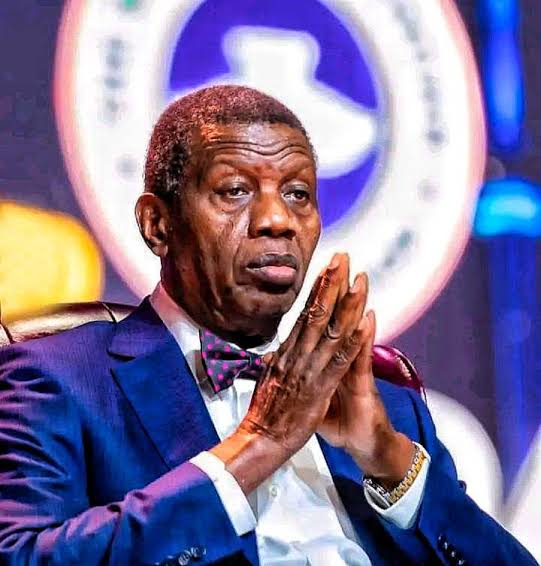
The General Overseer of the Redeemed Christian Church of God (RCCG), Pastor Enoch Adeboye, has revealed how his refusal to sanction retaliation against Muslims after a series of deadly attacks on Christians helped prevent what he described as a looming religious war in Nigeria.
Speaking at the “Faith Heroes Award Gala” organised by the Save Nigeria Group in Washington, D.C., Adeboye gave an emotional account of years of violent persecution against Christians, particularly in northern Nigeria, and the burden he has borne as leader of one of the country’s largest Christian denominations.
The revered cleric said he came under intense criticism from many Christians who accused him of remaining silent in the face of incessant killings, kidnappings, and attacks on churches. According to him, his silence was not borne out of indifference but of restraint, prayer, and a determination not to plunge Nigeria into religious conflict.
“I told them, ‘If there is going to be a religious war in Nigeria, I will not be the one who will start it,’” he declared.
Adeboye disclosed that one of the most painful incidents occurred when a female RCCG pastor was allegedly murdered while carrying out morning evangelism near a mosque in northern Nigeria.
According to him, following the killing, angry youths within the church demanded permission to retaliate against the mosque and its leaders.
“They told me, ‘We know the mosque. We know the chief imam. Let us do something because the police will not come.’ But I refused. I knew that if I gave the go-ahead, the consequences would be uncontrollable,” he said.
The cleric also narrated what he described as one of the darkest moments of his ministry, recalling how Boko Haram insurgents allegedly murdered newborn twins belonging to one of his pastors after failing to find the pastor at home.
He said the pastor had earlier refused to flee despite repeated terrorist attacks on churches in the Middle Belt.
“They came looking for him. When they did not find him, they slaughtered his newborn twins and left them behind as a warning,” Adeboye recounted.
He said he subsequently advised the pastor to relocate to southern Nigeria, believing he had paid the ultimate price for his faith, but the pastor declined.
“He reminded me of what I had taught him—that Christians do not run from darkness. He remained there, and today we have established an Internally Displaced Persons camp, schools, and humanitarian projects in that community,” he said.
Adeboye said the killings, kidnappings, and persecution of Christians had left him deeply frustrated, particularly because of his responsibility for more than 8,000 RCCG churches across northern Nigeria.
He noted that many people wrongly assumed he ignored the plight of Christians in the North because he hails from southern Nigeria.
“I smiled in pain because those accusing me did not know what we have endured. If I had reacted emotionally, Nigeria would probably not be where it is today,” he said.
The cleric also recalled praying intensely during the abduction of a group of schoolchildren after kidnappers murdered their teacher and released a video of the killing.
According to him, he cried to God after critics mocked Christians, asking, “Where is your God?”
He said he believed God assured him that the children would eventually regain their freedom dramatically and also revealed to him that those sponsoring terrorism and kidnapping in Nigeria would ultimately face divine judgement.
Adeboye lamented that terrorism, which was once largely concentrated in northern Nigeria, had spread into the South, saying insecurity had deteriorated significantly.
He maintained that while Christians were not the only victims of terrorism, no terrorist attack in the country had been traced to Christians.
He warned that younger Christians were becoming increasingly impatient with the continued attacks and cautioned that unless decisive steps were taken to restore peace, it might become difficult to restrain them indefinitely.
“The younger Christians are not as patient as some of us. If God were to take me home today, God have mercy,” he warned.
The RCCG leader also disclosed that he privately advised President Bola Tinubu to move decisively against terrorism by engaging the United States, directing security chiefs to eliminate insurgency within a specified period, and targeting financiers of terrorism rather than only the gunmen operating in forests.
While acknowledging criticism of the Federal Government, Adeboye said he did not believe President Tinubu should personally be blamed once he had issued directives to security agencies, arguing that implementation rested with military commanders.
He appealed to the United States and the international community to deploy diplomatic influence to help Nigeria tackle insecurity, stressing that his desire was not for military intervention or revenge but for Christians and Muslims to return to the peaceful coexistence they once enjoyed.
“I don’t even want a Muslim to die,” he said. “They are my potential brothers. If you kill them, who will I have left to convert?”
Adeboye concluded by urging world leaders to help restore peace in Nigeria through diplomacy and international cooperation, insisting that despite the pain and persecution, Christians would continue to pray while hoping for lasting peace between adherents of both faiths.
Discover more from Keeping Them Honest
Subscribe to get the latest posts sent to your email.