

…Defections Derail Single-Candidate Strategy Against Tinubu
…Presidency Mocks Move, Analysts Predict Replay of 2023 Race
By Our Reporter
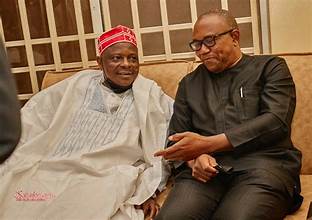
The fragile coalition effort by Nigeria’s opposition to field a single presidential candidate against President Bola Ahmed Tinubu in 2027 appeared to unravel on Sunday, following the dramatic defection of Peter Obi and Rabiu Kwankwaso from the African Democratic Congress (ADC) to the Nigeria Democratic Congress (NDC).
The twin moves, coming just hours after both men exited the ADC, have effectively upended a widely publicised opposition agreement to rally behind a consensus candidate to challenge the ruling All Progressives Congress (APC).
Obi and Kwankwaso were formally received at the NDC national secretariat in Abuja by the party’s National Leader, former Bayelsa Governor, Senator Seriake Dickson, in what insiders described as a calculated political realignment with far-reaching implications for the 2027 electoral map.
Only last weekend, opposition leaders, including stakeholders from the ADC, Peoples Democratic Party (PDP), and the New Nigeria People’s Party (NNPP), had resolved at a summit in Ibadan to present a unified presidential front.
The communiqué from that meeting underscored a shared determination to resist what they termed APC’s “machinations” and to consolidate votes around a single candidate capable of unseating Tinubu.
However, the defection of Obi and Kwankwaso, two of the most influential opposition figures from the 2023 elections, has now thrown that plan into disarray, raising fresh doubts about the opposition’s ability to overcome entrenched divisions and personal ambitions.
Despite the political implications of their exit, both men said their move is a principled step towards national renewal rather than ambition.
Kwankwaso commended the NDC leadership for what he described as its clarity of vision and commitment to development, noting that his engagement with the party revealed strong alignment on education reform and inclusive governance.
“Our discussions have shown shared priorities, particularly in youth and women empowerment, and the need to build a peaceful and united Nigeria,” he said.
Obi, on his part, emphasised the urgency of addressing Nigeria’s deepening socio-economic crisis, warning that political infighting had distracted leaders from the real issues.
“Nigeria is going through difficult times. We cannot afford to keep fighting ourselves. Our priority must be the Nigerian people,” he stated, adding that over half of the population remains unproductively engaged.
Both leaders pledged commitment to what they called a broader movement for national progress, even as critics argue their decision has deepened opposition fragmentation.
Welcoming the defectors, Dickson described the NDC as an ideological platform anchored on inclusiveness, integrity, and reform, saying that the party is a credible alternative for disillusioned Nigerians.
The party’s National Chairman, Moses Cleopas, called the development a “significant turning point,” insisting the movement was driven by a collective resolve to “rescue Nigeria.”
The event drew lawmakers, party chieftains, and supporters from across the country, signalling what the NDC hopes will be an expansion of its national footprint ahead of 2027.
The development has, however, triggered sharp reactions across the political spectrum, with many arguing that the opposition may have inadvertently handed President Tinubu a strategic advantage.
Presidential spokesman Bayo Onanuga dismissed Obi’s move as predictable, branding him a “political nomad” incapable of sustaining alliances.
“He pursues the easy road that will only lead him to doom, like in 2023,” Onanuga wrote on social media, suggesting the former Anambra governor lacked the staying power for a serious presidential contest.
Political analyst Ugoji Maximilian was even more blunt, arguing that Obi’s decision may have “simplified Tinubu’s path to victory.”
According to him, the greatest threat to the APC had been the possibility of a united opposition ticket, particularly a hypothetical alliance between Obi and Atiku Abubakar.
“That would have mobilised both the North and the Obidient movement in the South,” he noted, warning that such a coalition could have created a “delicate and dicey” electoral contest.
Instead, he said, the fragmentation now leaves Atiku isolated in the North, while Obi and Kwankwaso are confined to limited regional strongholds.
Public affairs commentator Ajibola Amzat echoed similar sentiments, predicting that the 2027 election may mirror the fractured dynamics of 2023.
“With Atiku likely in ADC, Obi in NDC, and Tinubu in APC, we may be heading for a rerun of 2023,” he said, arguing that none of the opposition figures currently appears capable of building a nationwide coalition strong enough to dislodge an incumbent president.
He pointed to structural advantages available to Tinubu, including control of state resources and entrenched party networks, as factors that could further tilt the contest in APC’s favour.
Amzat also warned that voting patterns may again follow ethnic and regional lines, diminishing the prospects of a unified national opposition.
Legal practitioner Obasi Nzubechi offered a different perspective, suggesting that the crisis may have been triggered by miscalculations within Atiku’s camp.
According to him, the former vice president may have attempted to draw Obi into a primary contest within the ADC, only for the strategy to backfire.
“What he didn’t anticipate was that Obi and Kwankwaso would chart their own course,” Nzubechi argued, adding that the developments underscore deeper leadership and strategic issues within the opposition ranks.
Across political circles, there is a growing consensus that the opposition now faces an uphill task of rebuilding trust and coordination if it hopes to present a credible challenge in 2027. Without a unifying framework or shared platform, analysts warn that the fragmentation could ultimately redefine the race in favour of the incumbent, leaving the opposition divided at a critical moment in Nigeria’s political trajectory.