

…Confusion as Presidency, Lawmakers, Others Scramble to Respond Amid Global Attention
By Yinka Giwa
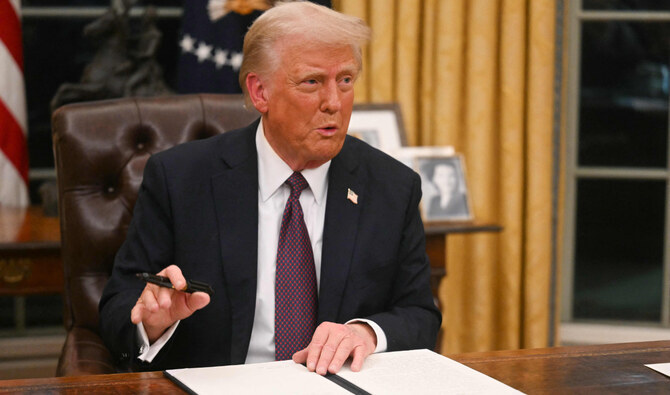
A wave of uncertainty swept through Abuja over the weekend following former U.S. President Donald Trump’s startling remarks threatening to halt aid and possibly take military action against Nigeria, “with guns blazing” over alleged persecution of Christians. The statement, which reverberated across diplomatic and political circles worldwide, has triggered mixed reactions within the Presidency, the National Assembly, and among regional and traditional leaders, exposing unease over Nigeria’s international standing and internal security narrative.
Trump’s post on his Truth Social platform, in which he declared Nigeria a “Country of Particular Concern,” cited “mass killings of Christians” and warned that the United States would “go into that now disgraced country, guns blazing,” if the violence persisted. The remarks have stirred both relief and apprehension: relief among groups that see Washington’s position as a needed push for action, and apprehension within government circles wary of strained U.S.–Nigeria relations.
In a swift reaction, the Special Adviser to President Bola Ahmed Tinubu on Information and Strategy, Bayo Onanuga, said the President was “well ahead of the orchestrated game unfolding in America.” He stressed that Tinubu had already directed new service chiefs to act decisively against emerging security threats across the country. “No more excuses,” Onanuga quoted the President as saying. “Nigerians want results.”
He explained that Tinubu’s renewed charge to the military last week underscored the administration’s awareness of global attention on Nigeria’s internal security. “The President is proactive and determined to ensure safety for all Nigerians, regardless of religion or ethnicity,” Onanuga noted.
However, a separate statement by the Special Adviser on Policy Communication, Daniel Bwala, sparked confusion when he claimed that President Tinubu and former U.S. President Trump “will in the coming days meet either in the State House, Abuja, or the White House in Washington.” Diplomats and political observers have described the remark as premature, with many dismissing it as speculative and unhelpful in an already tense atmosphere.
Meanwhile, Trump’s comments have been welcomed by some domestic groups, including the Middle Belt Forum (MBF), whose National President, Dr. Bitrus Pogu, said the declaration would “put the Nigerian government on its toes.” Pogu described Trump’s stance as a “welcome development” that could compel the government to act more decisively against recurring violence. He argued that the frequency of attacks in some parts of the country reflected a gap in political will, urging Tinubu to “weed out compromisers within the security forces” and “restore control to the government.”
But others have cautioned against taking Trump’s statements at face value. Former Senate Leader, Senator Ali Ndume, urged the Federal Government to quickly engage in diplomatic dialogue with Washington. He advised deploying Nigeria’s most seasoned diplomats, including Emeka Anyaoku, Bolaji Akinyemi, and Babagana Kingibe, to present Nigeria’s position and prevent mischaracterization of its security situation.
Ndume warned that “failure to act swiftly could have grave diplomatic and economic consequences,” including possible sanctions and restrictions on cooperation. Former Jigawa State Governor, Sule Lamido, echoed similar concerns, describing Trump’s comments as “very ominous.” He called on President Tinubu to convene a meeting of past leaders to develop a unified national response, stressing that Nigeria “cannot afford internal division at such a delicate moment.”
In Lagos, the Oba of Lagos, Rilwan Akiolu, strongly criticised Trump’s statement, describing it as “incorrect and capable of creating unnecessary tension.” Speaking at his 82nd birthday celebration, the monarch emphasised that terrorism in Nigeria is not religiously motivated but a national security challenge. “Christians and Muslims have coexisted peacefully for decades,” he said, urging global leaders to verify facts before making pronouncements that could strain relations.
Other Nigerian voices have sought a more balanced approach. Former presidential candidate of the National Conscience Party (NCP), Chief Martin Onovo, said the government should act decisively to end insecurity but avoid framing the crisis along religious lines. “The terrorists kill both Christians and Muslims,” Onovo said. “We need full national capacity, intelligence sharing, and community cooperation to secure our people.”
Similarly, PDP chieftain Prince Laja Adeoye cautioned against any foreign military intervention, urging instead for assistance through equipment and intelligence support. “Foreign troops could worsen instability,” he warned.
Amid the flurry of statements, the National Assembly was also forced into defensive mode after a fake social media post falsely quoted Senate President Godswill Akpabio as dismissing Trump’s remarks and claiming Nigerians were “fully satisfied with the condition of Nigeria.” The Office of the Senate President quickly issued a formal rebuttal, describing the report as “a malicious and completely fabricated post.”
Signed by his Special Adviser on Media, Hon. Eseme Eyiboh, the statement described Akpabio as “a statesman of global repute and advocate of international friendship and diplomacy.” It added that the Senate President “would never make comments that fall within the exclusive domain of the Executive arm of government or Nigeria’s foreign policy establishment.” The rebuttal also warned against the spread of misinformation capable of straining relations with foreign partners.
Several foreign policy observers have described the unfolding situation as a reminder of the need for more coherent communication within government. According to one diplomatic source in Abuja, the flurry of conflicting statements from different officials “reflects both the urgency and confusion inside the administration.” The source added that “Nigeria’s messaging must be harmonised; inconsistency can easily be misread abroad as weakness or panic.”
Another senior analyst familiar with Nigeria–U.S. relations told KTH Daily that the Tinubu government faces the delicate task of “defending national sovereignty while keeping open channels with Washington.” According to him, “The government’s immediate concern should be to calm nerves, clarify facts, and avoid appearing defensive. Quiet diplomacy will achieve more than reactive press statements.”
Security observers have also suggested that the controversy could serve as an opportunity for Nigeria to reframe its global narrative. One expert noted that “if Abuja takes this moment to demonstrate measurable progress in combating terrorism, it can reclaim control of the conversation and reduce foreign pressure.”
According to multiple diplomatic observers, the key challenge now is for Aso Rock to “move from reaction to strategy.” As one put it, “This is not just about responding to Trump. It’s about showing that Nigeria can manage global pressure with composure and coherence. The coming days will reveal whether the government can project calm leadership or allow the storm of mixed messaging to deepen.”
For now, the consensus among Abuja watchers is that what began as a social media threat from America’s top politician has evolved into a test of Nigeria’s diplomatic discipline: one that will demand careful words, steady hands, and, above all, unity of purpose at the highest levels of government.
Discover more from Keeping Them Honest
Subscribe to get the latest posts sent to your email.