

• Declares ‘emergency treatment over,’ vows to defeat poverty, revive factories, expand credit, agriculture
By Peter Salami
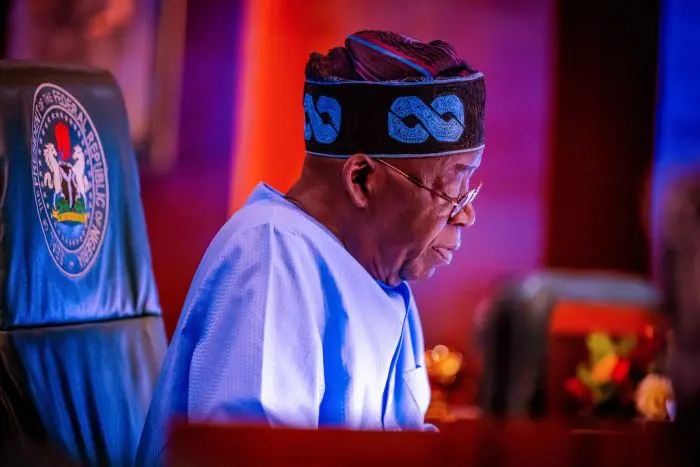
President Bola Tinubu on Thursday declared that Nigeria has turned the corner after more than three years of painful economic reforms, saying the country is now moving from an “age of reform” into an “age of prosperity” in which the gains of stabilisation must translate into cheaper food, more jobs, higher production, and improved living standards for ordinary Nigerians.
In a sweeping Independence Day address marking Nigeria’s 66th anniversary, Tinubu said the harshest phase of the economic adjustment was over and promised to make shared prosperity, rather than macroeconomic recovery alone, the central mission of his administration.
“The emergency treatment is over. The foundation has been repaired,” the President declared. “For three years, our overriding purpose was to correct our nation’s course. Now, our purpose is simple: shared and widespread prosperity.”
Tinubu said the next phase would focus aggressively on reducing the cost of living, expanding food production, creating productive jobs, reviving factories, improving infrastructure, widening access to credit, and strengthening support for vulnerable Nigerians.
“The age of reform has done its work. Now begins the age of prosperity,” he said.
The President also issued a strong defence of the removal of petrol subsidy and other reforms undertaken since May 2023, warning against reversing policies he said had begun to restore the economy to health.
Using the analogy of a cancer patient confronted with the choice between painful treatment and temporary relief, Tinubu said successive governments had for too long avoided fundamental economic problems.
He said Nigeria had effectively been administered “morphine” while deep structural problems were allowed to worsen.
“Our reforms did not create the weaknesses in our economy. They confronted them,” Tinubu said.
He cautioned Nigerians against calls for a return to what he described as “addictive subsidies,” arguing that abandoning the reforms now would risk reversing the gains already achieved.
Tinubu pointed to economic indicators which, he said, showed that Nigeria had moved into a stronger position.
According to him, the economy has grown by more than four per cent in 2026, with both oil and non-oil sectors contributing to growth.
He said oil theft had declined, inflation had fallen substantially from its peak, foreign reserves had been rebuilt and the foreign exchange market had stabilised.
Nigeria, he added, recorded more than $6 billion in non-oil export revenue in 2025 — the highest in the country’s history.
“This is real money being made by real Nigerian businesses,” the President said.
But Tinubu acknowledged that improving economic indicators were not enough if millions of citizens continued struggling to pay for food, transportation, education and healthcare.
He defined the prosperity his government was pursuing as one in which farmers could cultivate safely and profitably, factories enjoyed reliable power, businesses obtained affordable credit and young Nigerians found productive employment.
“Our priority is to bring down the cost of living,” he said.
Tinubu said the government would attack high living costs by reducing the cost of producing and transporting goods.
He pledged further expansion of mechanised irrigation and dry-season farming, improved access to seeds and fertiliser, greater agricultural mechanisation and increased investment in storage and transportation.
The administration, he said, would also continue building and completing roads, railways and ports linking farms and factories to markets.
The President argued that cheaper agricultural production, lower post-harvest losses, improved electricity supply, faster transportation and greater competition would eventually translate into lower market prices for Nigerians.
Tinubu also promised a major push for jobs, enterprise and industrialisation, saying Nigeria’s youthful population must become an engine of economic production.
“We are therefore placing jobs, enterprise, and industrial growth at the heart of our government’s policies,” he said.
The President said Nigeria’s abundant gas resources would increasingly be deployed to power industries, while government would support efforts to revive dormant factories across the country’s traditional industrial centres.
He also pledged expanded digital connectivity, greater investment in employable skills, infrastructure and financing for Nigerian businesses.
“I want to see more Nigerians making things,” Tinubu said. “I want to see more Nigerian farms feeding our cities and supplying our factories. I want to see Nigerian businesses selling Nigerian goods to the whole world.”
The President acknowledged that millions of Nigerians remained under severe financial pressure and could not simply wait for future economic growth to improve their circumstances.
He said the government would therefore strengthen direct assistance to poor households and improve the National Social Register to better target vulnerable citizens.
Tinubu cited the Nigerian Education Loan Fund, NELFUND, which provides financing for students from low-income families, and CREDICORP, through which working Nigerians can access consumer credit for vehicles, solar systems, digital devices and other assets.
He also promised continued investment in primary healthcare, basic education and other essential services in collaboration with states and local governments.
According to the President, salaries and pensions have been paid on time and in full since 2023, while reforms to the pension system are intended to improve support for retirees and vulnerable Nigerians.
“These programmes are not substitutes for prosperity. They are a bridge,” Tinubu said.
“Our objective is not to manage poverty more efficiently. We will defeat it.”
The President conceded that decades of weak productivity, inadequate infrastructure and limited economic opportunities could not be reversed within a single term of government, but insisted that Nigeria’s fundamental economic direction had changed.
“We cannot erase in four years what accumulated over generations. But we can change its course,” he said.
Tinubu concluded on an optimistic note, likening the difficulties Nigerians have endured during the reform period to crossing the biblical Red Sea.
“Nigeria has corrected its course. We have passed through our own Red Sea. This is not the time to look back,” he declared.
“The Promised Land before us is a Nigeria of abundance and opportunity; a nation where prosperity is broadly shared, where every child can dream beyond the circumstances of his birth, and where our country’s immense promise is finally reflected in the lives of our people.
“Our destination is in sight. Our foundations are strong. Our direction is clear. So let us go forward. No looking back.”
Discover more from Keeping Them Honest
Subscribe to get the latest posts sent to your email.