

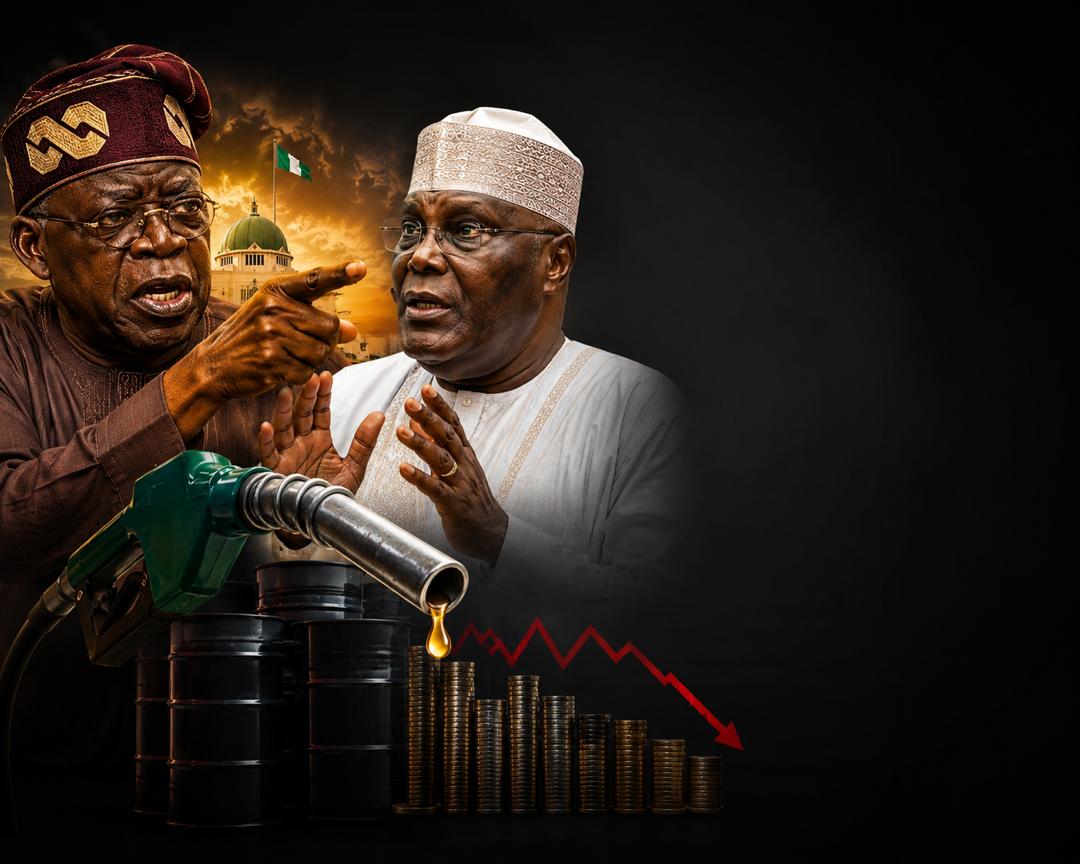
…Onanuga to Atiku: Disclose cost of targeted crude oil subsidy, financing plan, beneficiaries and exit strategy
…Says plan exposes deep misunderstanding of refining economics
By Franklin Adole
The battle over petrol prices and subsidy intensified yesterday, with the Presidency launching a blistering attack on former Vice-President Atiku Abubakar’s proposed subsidy model. This was as Accord Party presidential candidate, Dr Gbenga Olawepo-Hashim, in a windy analysis, promised to bring petrol down to a startling ₦605 per litre.
Special Adviser to the President on Information and Strategy, Bayo Onanuga, on Wednesday accused Atiku of displaying a fundamental misunderstanding of petroleum refining economics, arguing that his proposal for subsidy to “follow the barrel of crude” raises more questions than answers.
Onanuga, in a State House statement, said Atiku’s latest explanation represented yet another shift in his position on subsidy within one week and challenged the former vice-president to explain precisely how his proposed intervention would work.
The presidential adviser specifically questioned Atiku’s plan to supply crude to domestic refineries at a discounted price as a means of subsidising petrol, pointing out that petrol accounts for only a portion of the products obtained from a barrel of crude oil.
“Atiku says his subsidy will follow the barrel of crude. Is he aware that refined petrol only constitutes 45 per cent of the by-products of a refined barrel of crude?” Onanuga asked.
He said a barrel of crude also produces diesel, aviation fuel, kerosene, petrochemical feedstocks, asphalt, hydrocarbon gas liquids, lubricants, waxes, petroleum coke and sulphur, many of which operate in long deregulated markets.
According to the Presidency, diesel, which was deregulated under the Olusegun Obasanjo-Atiku administration in 2004, accounts for roughly 25 per cent of the barrel, while aviation fuel and kerosene together constitute about nine per cent.
Onanuga said another 10 to 15 per cent of the barrel produces feedstocks used for synthetic rubber, nylon, polyester, and plastics, while asphalt represents about two to four per cent.
Hydrocarbon gas liquids such as propane and butane, he added, constitute about four per cent, while lubricants and waxes account for another one to two per cent.
The presidency consequently challenged Atiku to explain whether his proposed subsidy would extend to all products produced from discounted crude or whether refiners would be permitted to sell the other products at market prices.
“Will Atiku subsidise all these by-products of the barrel as well, since kerosene is used by the underprivileged to cook, and many homes and factories use diesel to power generators and delivery trucks?” Onanuga asked.
“And will he allow the refineries he will supply discounted crude oil to profit from 55 per cent of the by-products, while focusing subsidy only on petrol, his obsession?”
Onanuga said the unanswered questions demonstrated what he described as Atiku’s lack of basic understanding of his “newfound policy prescription.”
Atiku had announced that if elected, he would introduce a targeted subsidy designed to support domestic refining and lower prices for consumers rather than return Nigeria to the previous system of subsidising imported petroleum products.
But Onanuga accused the former vice-president and his campaign of offering contradictory explanations of the proposal.
He recalled that Atiku’s spokesman, Paul Ibe, initially said the former vice-president would restore petrol subsidy and later phase it out as Nigerians and businesses recovered from current economic pressures.
Another senior Atiku aide, Phrank Shaibu, subsequently described that account as an “unauthorised and misleading characterisation,” saying Atiku’s proposed subsidy would not have a predetermined termination date.
He said that the intervention would continue until domestic refining capacity expanded, petroleum supply stabilised, competition increased, and market conditions could deliver affordable petrol without government support.
Atiku later personally declared that his position had not changed, insisting that he would restore a “targeted subsidy” and “put purchasing power back in the hands of Nigerians.”
The Presidency said the competing explanations amounted to a serious policy contradiction rather than a disagreement on semantics.
“If Atiku’s position has not changed, why did one of his principal aides say the subsidy would be temporary and phased out?” Onanuga asked.
“Why did another senior aide have to publicly disown that explanation and introduce a completely different framework based on market conditions? And why did Atiku then step in to reaffirm the original position?”
He said Nigerians deserved a clearly defined and properly costed petroleum policy rather than what he described as “policy by trial and error.”
The Presidency also disputed the opposition candidate’s broader argument linking petrol prices directly to Nigeria’s cost-of-living crisis.
While acknowledging that fuel and transportation costs affect food prices, Onanuga argued that food inflation also reflects insecurity, agricultural productivity, exchange rates, logistics, storage, flooding, farm input costs, money supply, and other supply constraints.
He maintained that competition among refiners and marketers could improve efficiency and margins but could not completely shield domestic petrol prices from crude prices, exchange rates, refining costs, transportation, and distribution expenses.
The presidential aide therefore challenged Atiku to disclose the projected cost of his targeted subsidy, how it would be financed, who would qualify to benefit, and the economic conditions that would trigger its termination.
“Nigerians cannot afford another opaque and potentially costly subsidy regime dressed up in new language,” he said.
Onanuga maintained that subsidy removal had improved the fiscal position of federal, state, and local governments and contributed to macroeconomic stabilisation, warning against what he called “policy somersaults, incoherence, destructive populism, and election gimmicks.”
But the Presidency’s defence of the existing petrol-pricing framework is facing a different challenge from Olawepo-Hashim, who has introduced an alternative proposal that seeks to reduce pump prices without formally returning to the old subsidy system.
The Accord Party presidential candidate said Nigerians should not pay more than about ₦605 per litre under his administration, with the possibility of petrol eventually falling to between ₦200 and ₦300 per litre if crude production costs and the exchange rate are substantially reduced.
“₦605 per litre is our starting sustainable price for petrol. Nobody will buy petrol above ₦610 under our government. It could be as low as ₦200,” Olawepo-Hashim said.
He insisted that the proposed ₦605 price would not be an artificially subsidised figure and would not be achieved by reducing government revenue or Federation Account Allocation Committee receipts.
Instead, the Accord candidate said Nigeria must overhaul what he described as a distorted petroleum production and accounting system.
Olawepo-Hashim, who has opposed the manner in which subsidy was removed, argued that the government must first determine the actual domestic cost of producing crude, refining it, and transporting the finished products before using international prices to calculate what it calls subsidy.
He described the previous approach as “accounting magic.”
According to him, the difference between the international value of petroleum products and their domestic production and delivery cost should not automatically be treated as a subsidy loss.
“A country does not subsidise itself simply because it chooses to use its own resources to provide affordable energy to its citizens,” he said.
Olawepo-Hashim consequently proposed an independent forensic audit of the entire petroleum cost chain, including crude production, contracting, procurement, refining, transportation, storage, insurance, pipeline operations, and distribution.
“Show Nigerians the books. Publish the production cost. Publish refinery cost. Publish transportation. Publish insurance. Publish every margin. Let the data speak,” he said.
The Accord candidate said his administration would seek to bring the naira to between ₦525 and ₦700 to the dollar, arguing that a stronger and more stable exchange rate, combined with lower oil production costs, would substantially reduce the naira price of petroleum products.
He maintained that the projected reduction would not come at the expense of government finances.
“We are not going to make petrol cheaper by making government poorer,” he said.
According to him, lower energy costs would instead reduce transportation and manufacturing expenses, strengthen household purchasing power, encourage production, and ultimately expand the economic base from which government collects revenue.
Olawepo-Hashim said the ₦200–₦300 projection should therefore be regarded as a possible medium-term outcome if Nigeria successfully lowers petroleum production costs, strengthens the naira, expands domestic refining, and eliminates inefficiencies and leakages.
“Our objective is not simply cheap petrol,” he said. “Our objective is a productive Nigerian economy in which affordable energy, stronger production, and stronger government revenue reinforce one another.”
Discover more from Keeping Them Honest
Subscribe to get the latest posts sent to your email.