

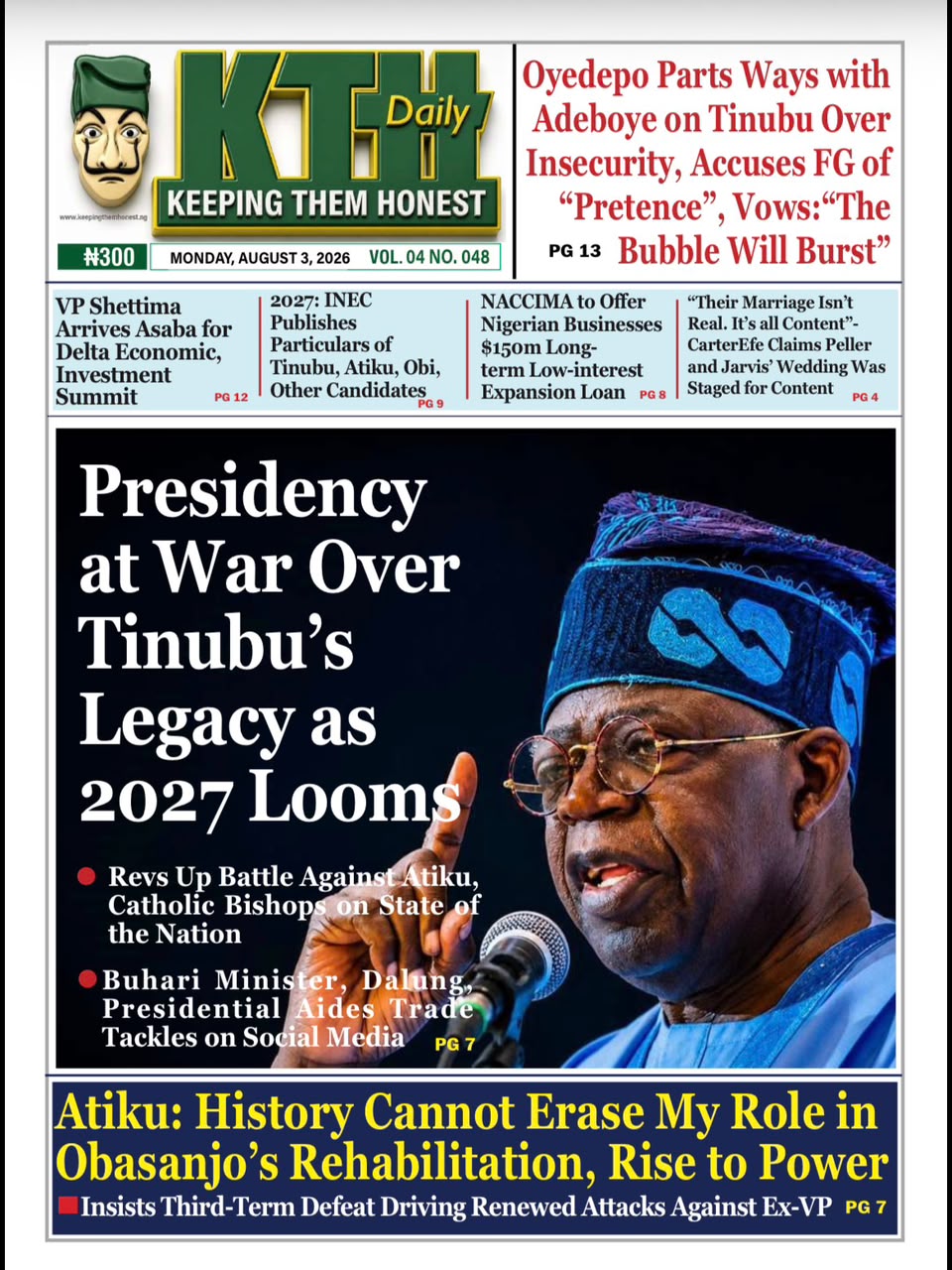
…Revs Up Battle Against Atiku, Catholic Bishops on State of the Nation
…Buhari Minister, Dalung, Presidential Aides Trade Tackles on Social Media
By Emmanuel Olugua
The Presidency has launched what appears to be a full-scale political and media offensive to defend President Bola Tinubu’s legacy, opening multiple fronts against former Vice President Atiku Abubakar, the Catholic Bishops Conference of Nigeria (CBCN), Cardinal John Onaiyekan and other prominent critics, in a bitter war of narratives over the true state of the nation.
Within 48 hours, presidential spokespersons and loyalists unleashed a coordinated barrage of statements seeking to dismantle criticisms of Tinubu’s economic reforms, while Atiku, former Sports Minister Solomon Dalung and other opposition figures fired back, accusing the administration of intolerance, propaganda and an inability to accept criticism.
The escalating exchanges have transformed what began as a disagreement over the Catholic bishops’ assessment of Nigeria’s economic and security situation into one of the fiercest public battles yet over Tinubu’s record at the near twilight of his first term.
In the centre of the storm is a lengthy State House statement issued on Sunday by Special Adviser to the President on Information and Strategy, Bayo Onanuga, in which the Presidency mounted a point-by-point rebuttal of Atiku Abubakar’s recent criticism of the administration’s economic management.
In the unusually detailed response, Onanuga accused the former vice president of relying on outdated economic data, insisting that critics were judging the administration solely by the painful early stages of its reforms while ignoring what he described as significant recovery.
According to the Presidency, Nigeria’s economy has rebounded substantially since the exchange-rate adjustment, with dollar GDP rising from about $253 billion after the currency reset to approximately $377 billion, while naira GDP has expanded from about ₦314 trillion to ₦530 trillion.
The statement argued that Tinubu inherited deep structural distortions, including unsustainable fuel subsidies, multiple exchange rates, and weak public finances, insisting that the administration’s reforms, though painful, were necessary to avert fiscal collapse.
On debt, the Presidency rejected Atiku’s allegation of reckless borrowing, maintaining that Nigeria’s debt-to-GDP ratio remains below 40 per cent, considerably lower than many peer economies, while debt-service obligations have fallen significantly as government revenues improved.
The statement also defended the removal of fuel subsidies, arguing that the policy had dramatically increased allocations to states and local governments, enabling greater spending on roads, schools, healthcare, and social services.
The administration equally dismissed Atiku’s claim of a ₦7.98 trillion oil windfall as economically ill-informed, arguing that crude production shortfalls, production costs, and pre-existing contractual obligations made such calculations misleading.
Beyond economics, the Presidency catalogued what it described as major achievements in healthcare, education, and infrastructure, citing the revitalisation of more than 3,000 primary healthcare centres, retraining of over 78,000 frontline health workers, expansion of cancer treatment facilities, implementation of thousands of education projects, and the Nigerian Education Loan Fund (NELFUND), which it said has benefited more than 1.64 million students.
It also pointed to extensive road, rail, airport, power, and digital infrastructure projects as evidence that the administration was laying the foundation for long-term economic growth.
Declaring that “the worst is over,” Onanuga insisted inflation was again trending downward after temporary disruptions caused by the Middle East conflict and maintained that Nigeria’s economy was firmly on the path of recovery.
But while the economic rebuttal dominated official communication, another battle erupted over comments made by Cardinal Onaiyekan following the recent meeting between President Tinubu and members of the Catholic Bishops Conference of Nigeria.
Senior Special Assistant to the President on Media and Publicity, Temitope Ajayi, accused the Cardinal of abusing what he described as “clerical privilege” by granting a television interview in which he recounted discussions held during the private meeting.
Ajayi argued that although the bishops were entitled to present their concerns to the President, it was inappropriate for one of the participants to publicly disclose his interpretation of what transpired afterward.
According to him, President Tinubu had responded comprehensively to every issue raised by the bishops, acknowledging Nigeria’s continuing challenges while outlining progress made in economic management, security, and governance.
Ajayi maintained that Onaiyekan’s suggestion that the President dismissed the bishops’ concerns was inaccurate, insisting Tinubu merely presented evidence that the country had made measurable progress despite persistent difficulties.
He further argued that, unlike religious leaders who rely largely on publicly available information, the President receives daily intelligence and operational briefings that provide a broader understanding of the nation’s security challenges.
Ajayi also rejected suggestions that only religious leaders could “tell the truth to power,” insisting that Tinubu constantly receives candid advice from intelligence agencies, senior officials, associates, and public opinion.
He concluded that the confidentiality and dignity of the meeting should have been preserved rather than becoming the subject of a public media debate.
Special Adviser to the President on Media and Public Communications, Sunday Dare, reinforced that position in a separate statement titled When the Cassock Abandons the Pulpit.
Without naming Onaiyekan directly, Dare warned against what he described as political opportunism by religious institutions, arguing that the moral authority of the Church depended on remaining above partisan politics.
He said Tinubu inherited a nation crippled by subsidy payments, fiscal distress, and foreign exchange distortions and urged critics to accompany their criticisms with practical alternatives.
Presidential foe turned ally, Reno Omokri, also joined the fray, defending Tinubu’s relationship with the Catholic community.
Citing historical ties between his own family and the Catholic Church, Omokri argued that no Nigerian leader had demonstrated greater goodwill toward Catholics than Tinubu, pointing particularly to the President’s attendance at the inauguration Mass of Pope Leo XIV at the Vatican in May 2025.
But the Presidency’s offensive immediately provoked a sharp response from Atiku Abubakar.
In a statement issued by his media aide, Phrank Shaibu, the former vice president condemned what he called the Presidency’s attack on the Catholic Church and Cardinal Onaiyekan, describing it as evidence of growing intolerance towards dissenting voices.
Atiku said the Catholic Church had always served as one of Nigeria’s principal moral voices and insisted that its duty was to “speak truth to power” rather than flatter those in office.
He argued that the bishops merely discharged their patriotic responsibility by confronting the President with the country’s economic and security realities.
The former vice president accused Tinubu’s media team of attempting to rewrite the bishops’ engagement with the President by selectively reframing events to favour the government.
He defended Onaiyekan’s television interview as a legitimate effort to correct what he described as distortions introduced by the Presidency and demanded an immediate apology to the Catholic Church and millions of Nigerian Catholics.
According to Atiku, the Presidency’s response reflected arrogance, intolerance, and contempt for independent voices unwilling to endorse government policies.
Joining the growing controversy, former Minister of Youth and Sports Development, Solomon Dalung, also criticised the Presidency’s handling of the dispute.
Dalung argued that the administration appeared comfortable with religious leaders who praised the government but became hostile whenever clerics expressed concerns.
He contrasted the favourable reception accorded Pastor Enoch Adeboye’s comments defending the administration on insecurity with the hostile reaction that followed Cardinal Onaiyekan’s remarks.
According to Dalung, Cardinal Onaiyekan has consistently spoken out on governance, corruption, insecurity, and justice under successive administrations, including those of former Presidents Goodluck Jonathan and Muhammadu Buhari, making it difficult to portray his recent intervention as politically motivated.
He warned that governments confident in their performance should answer criticism with facts rather than attacking the motives of their critics.
Political observers say the rapidly escalating exchanges underscore the increasingly intense contest over Tinubu’s political legacy as preparations quietly gather momentum ahead of the 2027 general election.
They note that with the Presidency vigorously defending its reform agenda, the opposition portraying the administration as intolerant of criticism, and respected religious leaders drawn into the confrontation, the debate has moved beyond policy disagreements into a broader struggle over who controls the national narrative on Nigeria’s economy, governance, and future.
Discover more from Keeping Them Honest
Subscribe to get the latest posts sent to your email.