

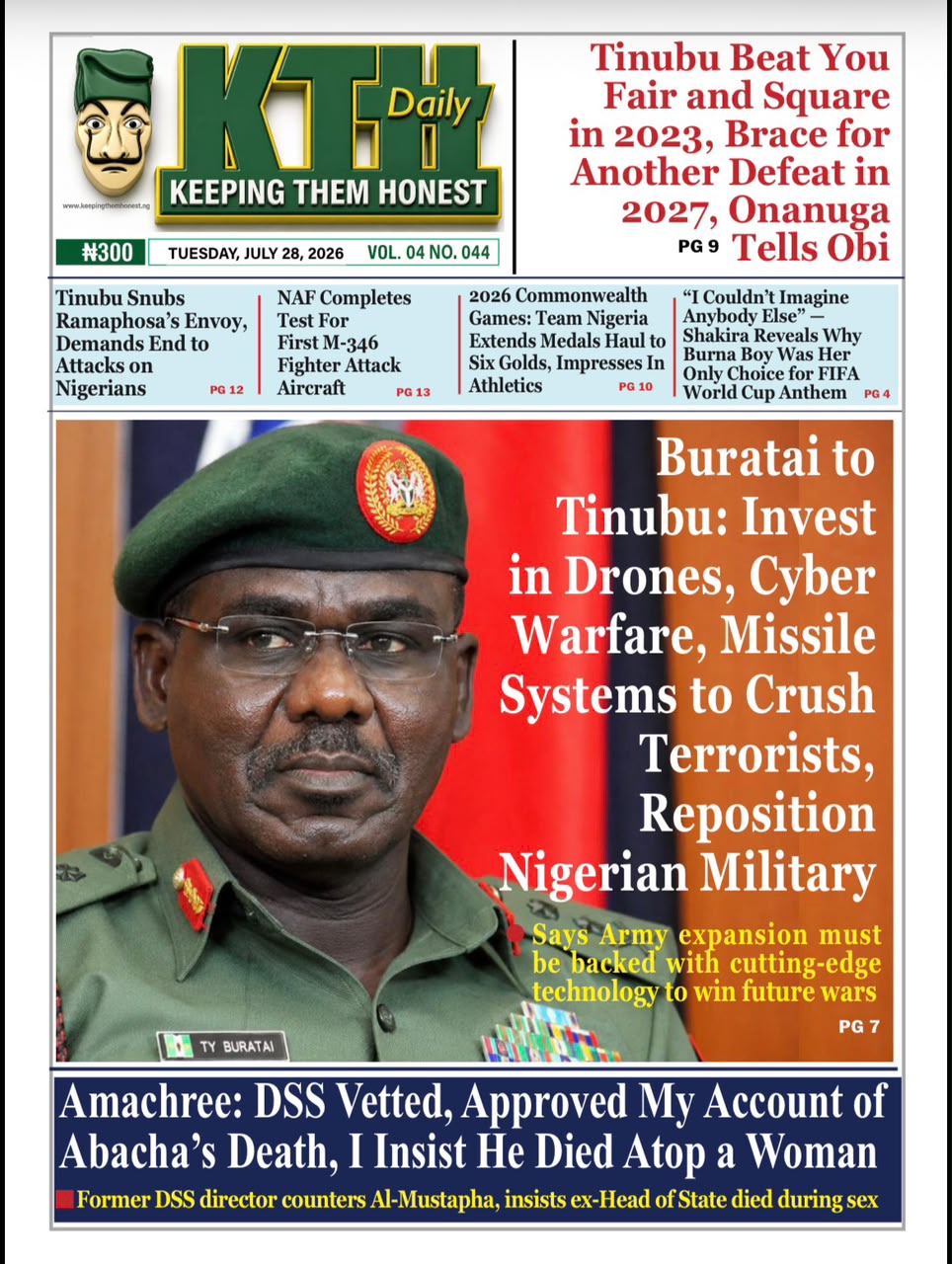
…Says Army expansion must be backed with cutting-edge technology to win future wars
By Abu Adamu
Former Chief of Army Staff, Lt.-Gen. Tukur Buratai (rtd), has urged President Bola Tinubu’s administration to complement the ongoing expansion of the Nigerian Army with massive investments in drones, cyber warfare, missile defence systems and other advanced military technologies to decisively defeat terrorism and reposition the Armed Forces for future conflicts.
Buratai made the call while commending President Tinubu’s recent approval for the expansion of the Nigerian Army from eight to 12 divisions, describing the decision as a landmark shift in Nigeria’s national security architecture and the most significant restructuring of the land forces in decades.
In a paper titled “A New Dawn for Nigerian Defence: The Strategic Expansion of the Nigerian Army to 12 Divisions,” made available to journalists in Abuja on Monday, the former army chief said the expansion represents a strategic response to Nigeria’s increasingly complex security environment.
He argued that while the creation of four additional divisions would significantly strengthen operational capacity, the initiative must be accompanied by aggressive military modernisation if Nigeria hopes to overcome terrorism, banditry, kidnapping and other emerging security threats.
According to Buratai, future warfare will be driven largely by technology, making it imperative for the Federal Government to invest heavily in intelligence, surveillance and reconnaissance drones, precision strike systems, electronic warfare capabilities and cyber defence infrastructure.
He also advocated the acquisition of advanced communication systems, armoured fighting platforms, engineering equipment, and logistics assets, insisting that Nigeria should establish specialised military formations dedicated to missile defence, drone warfare, cyber operations, and information warfare.
“The future of armed conflict lies in these domains, and Nigeria must begin investing in them now,” he said, adding that technological superiority would enable the military to conduct more precise operations, reduce casualties, and significantly improve operational effectiveness across various theatres of conflict.
Buratai stressed that modern force multipliers would transform the Nigerian Army into a technologically driven and intelligence-led fighting force capable of staying ahead of increasingly sophisticated security threats.
Beyond technological upgrades, the retired general described President Tinubu’s approval of the army expansion as a watershed in Nigeria’s defence strategy, saying the existing eight-division structure had become inadequate to address the country’s expanding security challenges.
He said the new 12-division structure would decentralise command and control, improve operational responsiveness, strengthen intelligence coordination, and enhance logistics, troop deployment, and collaboration with other security agencies.
Buratai also applauded the President’s approval for the recruitment of 28,000 additional military personnel to support the expanded force structure, noting that the move would not only relieve pressure on overstretched troops but also create employment opportunities for thousands of young Nigerians.
He equally praised the Chief of Army Staff, Lt.-Gen. Waidi Shaibu, for championing the restructuring initiative, describing the expansion as evidence of strategic foresight that would strengthen Nigeria’s capacity to confront terrorism, insurgency, banditry, kidnapping, and other security threats.
According to him, a stronger, better-equipped, and more professional military remains the ultimate safeguard of democratic governance, national unity, and constitutional order, protecting the country against both external aggression and internal subversion.
Buratai maintained that citizens were more likely to embrace democratic values when they felt secure, adding that the Nigerian Army remained one of the country’s strongest symbols of national unity because its personnel are drawn from every ethnic, religious, and regional background.
He expressed confidence that the expansion would deepen democracy, promote national cohesion, and contribute to lasting peace and stability across the country.
The former army chief also called on Nigerians to support the Armed Forces, stressing that security is a collective responsibility requiring cooperation between government, local communities, the private sector, and ordinary citizens.
He appealed to state governments to provide land for new barracks, training facilities, and other military infrastructure required for the additional divisions, while urging the private sector to complement government efforts through investments in troop accommodation, logistics, and personnel welfare.
Buratai said a more secure Nigeria would provide the stable environment needed for economic growth, infrastructure development, and sustainable national prosperity, while urging the Federal Government to sustain investments in military modernisation to ensure the Armed Forces remain prepared for future security challenges.
Discover more from Keeping Them Honest
Subscribe to get the latest posts sent to your email.