

… Orders Troops to Shoot Terrorists on Sight
… Reps Join Senate to Demand End to Rehabilitation of Repentant Insurgents
By Abu Adamu
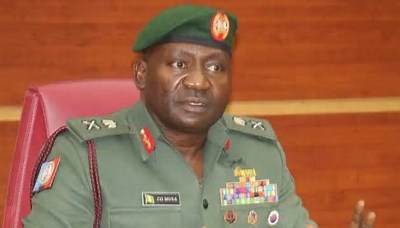
Nigeria’s Minister of Defence, Gen. Christopher Musa (retd.), has issued a hardline directive to troops battling terrorism and banditry, declaring that any soldier who hesitates to engage terrorists or bandits while waiting for orders would be treated as an accomplice of the criminals.
The minister gave the warning on Wednesday in Sokoto during the commissioning of a N27.6 billion security intervention package procured by the Sokoto State Government to strengthen the fight against insecurity.
Addressing frontline troops and other security personnel, Musa said soldiers deployed to operational theatres already possess the authority to neutralise terrorists and bandits without seeking further approval.
“Once you are deployed, do not wait for any order from anybody to shoot any bandit or any terrorist,” he declared.
He warned that any operative who fails to confront armed criminals under the excuse of awaiting instructions would face severe consequences.
“Anybody who refuses to shoot or kill any bandit or terrorist in the name of waiting for an order, we will treat you like a bandit. This is a general order,” the defence minister said.
The directive came as he commissioned an extensive security package comprising armoured personnel carriers, tactical vehicles and 300 motorcycles acquired by the Sokoto State Government to improve security operations across the state.
The event, held at the Giginya Memorial Stadium, was attended by senior military officers, heads of security agencies, traditional rulers, government officials and residents.
Governor Ahmed Aliyu described the procurement as one of the largest security investments ever undertaken by the state, saying it was designed to strengthen the operational capacity of security agencies in tackling terrorism, banditry, kidnapping, and other violent crimes.
He said the investment forms part of his administration’s broader strategy to restore peace in communities devastated by insecurity, particularly border settlements and rural areas frequently targeted by criminal gangs.
According to the governor, sustainable economic growth, agricultural production, and social development can only thrive in a secure environment.
Aliyu said the newly acquired armoured vehicles and motorcycles would significantly improve troop mobility, surveillance, intelligence gathering, and rapid response capabilities, especially in difficult terrains.
He commended President Bola Tinubu, the Armed Forces, and other security agencies for their continued support in the fight against insecurity, pledging sustained collaboration with the Federal Government to improve security across the state.
The governor also praised Musa’s leadership in the war against terrorism and banditry and honoured him by naming a major road in Sokoto metropolis General Christopher Musa Road.
Responding, the defence minister lauded the Sokoto State Government for making security a priority, describing the intervention as a demonstration of visionary leadership and commitment to protecting lives and property.
He stressed that defeating insecurity requires close cooperation among the federal, state, and local governments, as well as active support from citizens through timely intelligence sharing.
Musa assured Nigerians that the Armed Forces remain determined to eliminate terrorists, bandits, and other criminal elements across the country, saying the newly commissioned equipment would enhance operational effectiveness and boost troop morale throughout Sokoto and the wider North-West region.
Meanwhile, the House of Representatives on Wednesday joined the Senate in calling on the Federal Government to discontinue the rehabilitation and reintegration of repentant terrorists, kidnappers, and bandits.
The House adopted the resolution after considering a motion sponsored by Ademorin Kuye, who argued that Nigeria must dismantle the financial networks sustaining kidnapping and terrorism.
Kuye cited estimates by the National Bureau of Statistics and independent security organisations indicating that Nigerians paid about N2.23 trillion in ransom between January 2021 and June 2025.
He said investigations by the National Counter Terrorism Centre under the Office of the National Security Adviser revealed that Point-of-Sale operators and other financial channels have been used to facilitate ransom payments and conceal financial transactions linked to criminal groups.
According to him, terrorists and kidnappers also exploit bureau de change operators, cryptocurrency platforms, livestock transactions, and trade-based money laundering schemes to move illicit funds.
He warned that weak enforcement of anti-money laundering regulations has deepened insecurity, undermined public confidence, and exposed Nigeria to the risk of international sanctions and continued placement on the Financial Action Task Force grey list.
Chairman of the House Committee on Public Accounts, Bamidele Salam, cautioned against criminalising ransom payments, arguing that citizens often pay to save the lives of loved ones when government protection fails.
However, Chairman of the House Committee on Navy, Yusuf Gagdi, insisted that paying ransom only emboldens criminal gangs and proposed an amendment demanding an end to the rehabilitation of terrorists, kidnappers, and bandits.
“Anybody who kills deserves to be killed, except in cases such as a motor accident, where the law is clear. But if you invade innocent Nigerians’ homes, kidnap them, take them into the bush, subject them to terrible torture before taking their lives, including those of traditional rulers, you don’t deserve one second of survival,” Gagdi said.
He also alleged that some rehabilitated former insurgents could be leaking intelligence to terrorist groups, thereby contributing to attacks on security personnel.
The amendment was unanimously adopted through a voice vote presided over by Speaker Tajudeen Abbas.
Ahmadu Jaha, representing Damboa/Gwoza/Chibok Federal Constituency, said only families that had experienced abduction truly understood the trauma of kidnapping and questioned whether those opposing ransom payments would maintain the same position if their own relatives became victims.
The Federal Government launched Operation Safe Corridor in 2016 as a military-led deradicalisation and rehabilitation programme for repentant Boko Haram members, a policy that has remained the subject of intense national debate.
Discover more from Keeping Them Honest
Subscribe to get the latest posts sent to your email.