

By Yinka Giwa
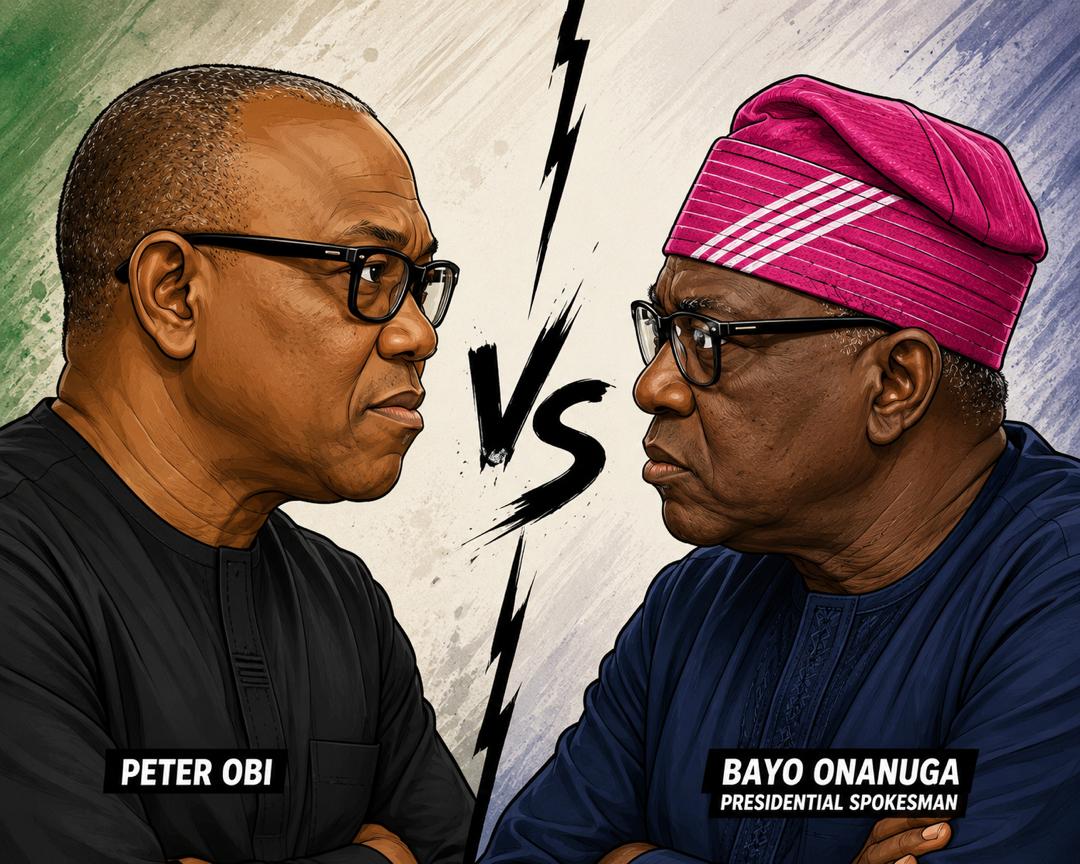
A fierce war of words erupted on Monday between Labour Party presidential candidate in the 2023 election, Peter Obi, and the Presidency, after the former Anambra State governor called on President Bola Ahmed Tinubu to resign over what he described as “monumental failure in governance.”
Obi’s demand, which drew inspiration from the recent decision of British Prime Minister Keir Starmer to step down amid mounting public dissatisfaction in the United Kingdom, immediately triggered a blistering response from the Presidency, with Presidential Adviser on Information and Strategy, Bayo Onanuga, dismissing the call as “childish,” “anti-democratic” and politically motivated.
In a statement titled Owning Up to Leadership Failures and Political Responsibility, Obi said developments in Britain offered valuable lessons on accountability in public office and should serve as a reminder that leaders must accept responsibility when they fail to meet the expectations of the people.
The former governor recalled that before the 2015 elections, Tinubu had repeatedly demanded the resignation of then President Goodluck Jonathan, particularly following the abduction of the Chibok schoolgirls, arguing at the time that the government had failed in its primary responsibility of protecting citizens.
Obi noted that during the 2023 presidential campaign, Tinubu promised improved electricity supply, enhanced security, stronger anti-corruption measures, and better living conditions for Nigerians. He also recalled that Tinubu publicly challenged Nigerians not to return him for a second term if he failed to deliver on those promises.
According to Obi, conditions in the country have deteriorated significantly since Tinubu assumed office.
He argued that insecurity has worsened across many parts of the country, kidnappings have become more rampant, electricity supply remains unreliable, and economic hardship has deepened, leaving millions of Nigerians struggling to survive.
“At present, however, these conditions have worsened. Electricity supply remains unreliable, insecurity has intensified in many areas, including kidnappings, and economic hardship has deepened rather than eased,” Obi stated.
Maintaining that several critical sectors had regressed under the current administration, Obi declared that Nigeria was experiencing one of its most difficult periods and urged the President to resign in the interest of accountability and democratic responsibility.
“I therefore join Nigerians of goodwill in calling for the resignation of the President over monumental failure in governance,” he said.
According to him, such a move would help establish a culture in which leaders accept responsibility for failure and recognise that public office is a sacred trust rather than an entitlement.
But the Presidency fired back almost immediately.
In a lengthy statement, Onanuga accused Obi of distorting facts and deliberately ignoring what he described as the substantial achievements of the Tinubu administration.
The presidential spokesman argued that Obi’s comparison of Nigeria with the United Kingdom was fundamentally flawed because Britain operates a parliamentary system, while Nigeria runs a presidential system in which elected leaders serve constitutionally fixed terms.
He further pointed to recent electoral victories recorded by the ruling All Progressives Congress (APC) in Ekiti State and several National Assembly by-elections as evidence that Nigerians still support Tinubu and his policies.
“Obi should wait until the presidential election to know what the people think of Tinubu’s government,” Onanuga said.
The presidential aide reserved some of his harshest words for Obi’s record as governor of Anambra State, insisting that the former governor lacked the credentials to question Tinubu’s performance.
“It is laughable that Obi, who, as governor, was a colossal failure, unable to secure lives and property in his small state of Anambra, as documented by his successor, Willie Obiano, is now the one calling for President Tinubu’s resignation over security breaches in some parts of the country,” Onanuga said.
In effect, the presidential spokesman argued that a politician who allegedly failed to tackle insecurity in a single state could not credibly present himself as an alternative national leader.
Onanuga also defended the administration’s security record, insisting that Tinubu inherited deeply entrenched security challenges and had since expanded military operations across the country.
According to him, thousands of terrorists have been neutralised, hundreds of kidnapped victims rescued, and significant investments made in surveillance technology, drones, and intelligence gathering.
On the economy, he rejected Obi’s assertion that Nigeria was in its worst condition, pointing instead to sustained GDP growth, rising foreign reserves, increased oil production, and improved government revenues since Tinubu came to office.
He claimed that the administration’s economic reforms had reversed years of decline and restored investor confidence, citing improvements in foreign investment inflows and strong performance on the Nigerian stock market.
The presidential spokesman further highlighted ongoing infrastructure projects such as the Lagos-Calabar Coastal Highway and the Sokoto-Badagry Super Highway as evidence of the government’s commitment to long-term national development.
Onanuga also defended Tinubu’s record on electricity, insisting that the President never promised instant 24-hour power supply for all Nigerians but rather pledged reforms that would gradually improve electricity generation, transmission, and distribution.
He cited the Electricity Act, the expansion of prepaid meter installations, and ongoing investments in off-grid solar power projects as key achievements of the administration.
While acknowledging that many Nigerians continue to face economic hardship, Onanuga attributed much of the pressure to global economic disruptions and geopolitical tensions, particularly in the Middle East.
He maintained that Tinubu remained focused on implementing reforms designed to stabilise the economy and improve living conditions over time.
Describing Obi’s call for resignation as “political grandstanding,” Onanuga said the Labour Party leader was living in a “self-constructed echo chamber” and was disconnected from realities on the ground.
The sharp exchange has further heightened political tensions ahead of the 2027 general election, with both camps now engaged in an increasingly direct battle over the Tinubu administration’s performance and Nigeria’s future direction.
Discover more from Keeping Them Honest
Subscribe to get the latest posts sent to your email.