

…Col. Abubakar Umar to Tinubu: No Security, No Nation
By Abu Adamu
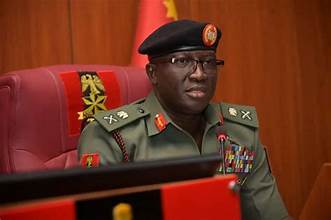
Nigeria’s worsening security crisis has triggered fresh alarm from retired military officers, even as the Chief of Army Staff (COAS), Lieutenant General Waidi Shaibu, ordered newly trained soldiers to confront bandits, terrorists and kidnappers with decisive force.
The twin interventions came amid renewed national outrage over the abduction and death of retired Major General Rabe Abubakar in Katsina State and growing concerns that insecurity is undermining the very foundations of the country’s democracy.
Addressing graduating recruits under the Nigerian Army’s Restore Hope Initiative at the Depot Nigerian Army Shooting Range in Zaria on Thursday, Lt.-Gen. Shaibu declared that the military must adapt aggressively to confront the evolving threats posed by terrorism, banditry and other asymmetric criminal activities.
“The security challenges confronting Nigeria today are complex, uncertain and ambiguous. Terrorism, banditry and other asymmetric threats demand not only courage, but also intelligence, discipline and strategic thinking,” the Army Chief said.
Charging the recruits, who are due to be formally inducted into military service, the COAS urged them to remain resolute and professional while applying decisive force against criminal elements threatening the peace and stability of the country.
Nigeria, he said, is passing through a critical phase in its history as bandits and kidnappers continue to inflict hardship on citizens through abductions and the destruction of lives and property.
While assuring the soldiers that the Army had acquired modern combat enablers and was procuring additional capabilities to strengthen operational effectiveness, Shaibu stressed that the era of relying solely on conventional responses to unconventional threats was over.
The Army Chief’s charge came as a group of retired senior military officers demanded an urgent review of Nigeria’s security architecture, warning that the country can no longer afford incremental responses to an escalating national emergency.
At a press conference in Kaduna, Brigadier General Isma’ila Abdullahi (rtd), speaking on behalf of colleagues, friends, and associates of the late Major General Rabe Abubakar, described the retired officer’s death in the hands of bandits as a grim symbol of the insecurity confronting millions of Nigerians.
“Our colleague, friend, and brother, Major General Rabe Abubakar, died following his abduction by cruel bandits. His sudden death has left us shocked and deeply saddened,” Abdullahi said.
The retired officers acknowledged efforts by security agencies and the Katsina State Government that reportedly led to the rescue of the deceased’s wife, Hajiya Amina Rabe Abubakar, but insisted that the tragedy underscored the urgent need for far-reaching reforms.
According to them, the killing of a retired general after years of military service demonstrates that no Nigerian is immune from the growing threat of banditry, kidnapping, and terrorism.
“The death of General Rabe Abubakar is not merely a headline. It underscores the difficulties facing a system struggling to guarantee the safety of citizens,” Abdullahi said.
The former military officers cautioned against politicising insecurity or interpreting it through ethnic or regional lenses, arguing that terrorism and violent criminality constitute a national challenge requiring a united national response.
They called for stronger security institutions, enhanced intelligence gathering, tighter border controls to stem the influx of illegal weapons, and better coordination among security agencies.
The group also advocated increased support for organised community-based security structures, particularly in rural communities that remain vulnerable to attacks by heavily armed criminal gangs.
According to Abdullahi, local vigilante and community defence groups should receive proper training, equipment, and supervision to complement conventional security efforts.
The retired officers further urged state governments to establish and adequately equip forest guard units, while reiterating conditional support for the creation of state police structures where states possess the financial and institutional capacity to sustain them.
They maintained that although international cooperation remains important in the fight against terrorism, the responsibility for securing Nigeria ultimately rests with Nigerian institutions and leaders.
“No foreign nation can secure Nigeria for us. International cooperation is important, but the responsibility for protecting Nigerians lies with our institutions and leadership,” Abdullahi said.
The concerns raised by the retired generals echoed sentiments expressed by former military governor and prominent June 12 activist, Colonel Abubakar Dangiwa Umar (rtd), who warned President Bola Tinubu that national security remains the most fundamental obligation of government.
In an open letter thanking the President for recognising military and civilian heroes of the June 12 democratic struggle, Umar said security must remain the cornerstone upon which all other democratic aspirations rest.
Reflecting on the sacrifices made by officers who opposed the annulment of the June 12, 1993 presidential election, Umar argued that they had taken the security of citizens as a basic assumption for the existence of government.
“If national security is missing, that would be the end of the discussion; nothing else matters. Nothing!” he declared.
The retired colonel noted that while democracy remained a work in progress, those who fought for its restoration had envisioned a nation founded on security, justice, institutional independence, economic opportunity, and social welfare.
He urged the President to recommit himself to those ideals and ensure that the sacrifices made during the June 12 struggle were not rendered meaningless by insecurity, poverty, and institutional decline.
The growing concern from serving and retired military officers comes as the Federal Government says it is strengthening collaboration with state governments and security institutions to tackle emerging threats through intelligence sharing, coordinated operations, and inclusive governance.
Speaking at the opening of the 2026 Federal and States Security Administrators Meeting in Jos, Plateau State, officials said stakeholders were working to improve responses to internal security challenges, including terrorism, cybercrime, communal conflicts, and the proliferation of small arms and light weapons.
Discover more from Keeping Them Honest
Subscribe to get the latest posts sent to your email.