

By Franklin Adole
Tension heightened across the opposition landscape on Wednesday as the Supreme Court reserved judgment in critical leadership disputes rocking both the African Democratic Congress (ADC) and the Peoples Democratic Party (PDP), even as a faction of the PDP aligned with Federal Capital Territory Minister, Nyesom Wike, rolled out its timetable for the 2027 general elections.
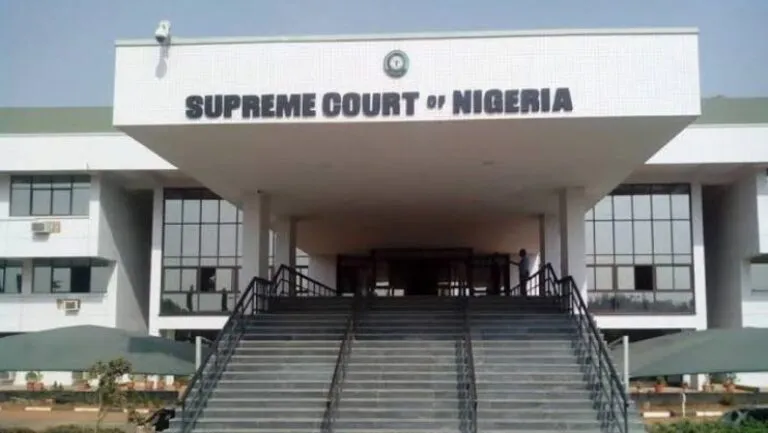
A five-member panel of the apex court, led by Justice Lawal Garba, reserved judgment in an appeal filed by former Senate President David Mark, who is contesting the leadership of the ADC against a rival faction led by Nafiu Bala. The court announced that a date for judgment would be communicated to all parties after counsel adopted their briefs of argument.
The ADC crisis, which began as an internal transition disagreement in mid-2025, has since escalated into a full-blown legal battle, leaving the party without a recognised national leadership. The situation worsened following the Independent National Electoral Commission’s (INEC) decision on April 1 to withdraw recognition from both factions, citing a subsisting Court of Appeal order to maintain the status quo.
INEC’s stance has effectively paralysed the party’s operations and raised serious concerns about its capacity to function as a credible opposition platform ahead of the 2027 elections.
Mark’s faction maintains that it emerged through due process, relying on decisions of the party’s National Executive Committee (NEC), including the ratification of a caretaker leadership and provisions within the ADC constitution that empower the NEC to manage transitions and fill vacancies. It also argues that membership requirements were duly waived to accommodate coalition-building efforts.
In a parallel development, the Supreme Court also reserved judgment in a separate appeal concerning the PDP’s controversial national convention held in Ibadan in November 2025, which produced a factional leadership led by Tanimu Turaki, SAN.
The Turaki-led executives are seeking to overturn judgments of the Federal High Court and Court of Appeal, which invalidated the convention on grounds that it violated existing court orders and failed to comply with statutory requirements, including proper conduct of state congresses and issuance of valid notices.
The appellate court had earlier faulted the PDP for proceeding with the convention despite a subsisting court order halting the exercise to allow former Jigawa State Governor Sule Lamido to contest for the position of national chairman. It described the party’s action as a “gross abuse of court process” and an affront to judicial authority.
The apex court is also considering a related appeal by the PDP, its National Working Committee (NWC), and National Executive Committee (NEC), challenging decisions that barred INEC from recognising the outcome of the Ibadan convention.
Amid the legal uncertainty, the Wike-backed faction of the PDP moved ahead with preparations for the 2027 elections, releasing a detailed timetable and schedule of activities.
According to the timetable issued by the party’s National Organising Secretary, Umar Bature, the cost of the presidential expression of interest and nomination forms has been fixed at N51 million. Governorship forms will cost N31 million, while those for the Senate, House of Representatives, and State Houses of Assembly are pegged at N7 million, N4 million, and N3 million respectively.
Female aspirants are to pay only for expression of interest forms, set at N1 million across all categories.
The party announced that sales of forms would commence on April 27 and close on May 4, with submission deadlines fixed for May 9. Screening of aspirants is scheduled for May 11 and 12, while the presidential primary election will hold between May 17 and 18.
Primaries for other positions have been staggered, with the House of Representatives slated for May 21, Senate on May 23, Houses of Assembly on May 25, and governorship on May 27. Appeals arising from the primaries are to be concluded by May 30.
Bature stated that the timetable was issued in compliance with the 1999 Constitution (as amended), the Electoral Act 2026, and INEC’s revised election schedule.
Discover more from Keeping Them Honest
Subscribe to get the latest posts sent to your email.