

By Abu Adamu
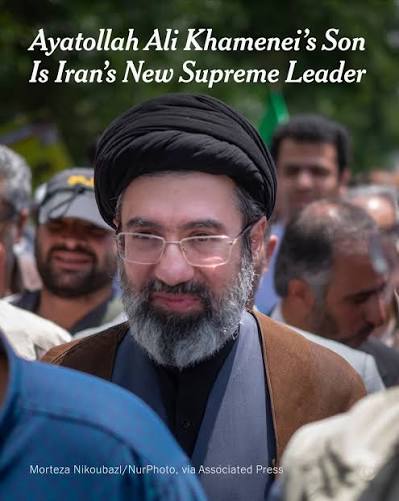
Iran’s clerical establishment has chosen Mojtaba Khamenei, the 56-year-old son of the late supreme leader Ali Khamenei, as the new supreme leader, defying external pressure and signalling continuity of the Islamic Republic’s hardline leadership.
Members of the powerful Assembly of Experts announced the decision on Sunday, saying Mojtaba Khamenei was selected through a decisive vote. In a statement carried by Iranian state media, the clerical body called on Iranians to rally behind the new leader and preserve national unity at a critical moment for the country.
The selection immediately drew attention abroad. US President Donald Trump had earlier described Mojtaba Khamenei as an “unacceptable” successor and warned that Iran’s next supreme leader “was not going to last long” without Washington’s approval. Speaking in an interview with The Times of Israel, Trump said: “We’ll see what happens,” while adding that any decision on ending the war would be taken together with Israeli Prime Minister Benjamin Netanyahu.
Iran-backed allies swiftly welcomed the announcement. Yemen’s Houthi movement congratulated Iran’s leadership and people, describing Mojtaba Khamenei’s selection as “a new victory for the Islamic Revolution and a resounding blow to the enemies of the Islamic Republic”.
Israel responded militarily, with the Israel Defence Forces announcing a wave of strikes on what it described as regime infrastructure in central Iran. The military also said it carried out attacks on Hezbollah targets in Lebanon.
Mojtaba Khamenei’s elevation marks the first time since the Iranian Revolution that Iran’s supreme leadership has effectively passed from father to son, a development likely to intensify debate inside the country about dynastic rule in a system founded to overthrow monarchy.
Across Iran’s political and security establishment, officials quickly pledged loyalty to the new leader. Senior figures, including former parliament speaker Ali Larijani, called for unity, while state media reported that the country’s armed forces and the Islamic Revolutionary Guard Corps declared their readiness to follow him.
Analysts say the decision reflects a determination by Iran’s ruling clerics to project strength and continuity despite mounting external pressure and war.
Mojtaba Khamenei has spent much of his life close to the centre of power but largely out of public view. Born in 1969 in Mashhad, he studied theology in the seminaries of Qom and later developed close ties with conservative clerics and elements of the Revolutionary Guards, building influence within his father’s office without holding elected office.
His name surfaced publicly during the disputed 2009 presidential election, when reformist politicians accused him of supporting the security crackdown that followed mass protests, though he has never publicly addressed the succession issue.
His father, Ali Khamenei, ruled Iran for 37 years after succeeding Ruhollah Khomeini. He was killed in a US-Israeli strike on Tehran on 28 February, the opening day of the war with Iran, triggering an urgent search within the clerical establishment for a successor.
The conflict has already widened across the region. Iran has threatened to target oil facilities in neighbouring Gulf countries after Israeli strikes hit multiple energy sites around Tehran, raising fears of major disruption to global energy markets. Saudi Arabia, the United Arab Emirates, Qatar, Bahrain and Kuwait all reported drone or missile incidents on Sunday as tensions escalated further.
Discover more from Keeping Them Honest
Subscribe to get the latest posts sent to your email.