

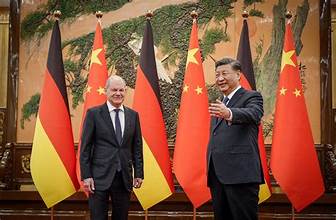
Germany’s chancellor has touched down in China as German businesses sound the alarm about a yawning trade imbalance.
Imports into Germany from China were more than double the value of those exported back last year – according to federal statistics.
“We want a partnership with China that is balanced, reliable, regulated and fair,” said Friedrich Merz, before leaving for Beijing.
Merz is also expected to press China to use its influence with Moscow to help end the war in Ukraine. However, the huge trade gap looms large over these talks as the chancellor takes along a sizeable business delegation.
China once again took the top spot as Germany’s biggest trade partner in 2025, supplanting the US.
Behind that headline is a stark and worrying imbalance for Germany, the EU’s largest economy.
In 2025, goods worth €170.6 billion (£148.8bn; $200.9bn) came from China into Germany – an 8.8% annual increase – while German exports to China fell by 9.7% to €81.3 billion.
The situation “is eroding the core of German industry, especially in the car, machinery and chemicals sectors,” warns Jürgen Matthes at the German Economic Institute (IW).
Matthes, the IW’s head of International Economic Policy, believes distortions are chiefly down to “massive” Chinese subsidies and currency under-valuation.
Chinese price advantages “cannot just come from more innovation and efficiency,” he told the BBC.
Beijing has previously said its subsidy policies are transparent and fully consistent with international trade rules.
While, in response to past allegations of unfairly controlling its currency’s value, it’s said it’s committed to implementing a floating exchange rate regime, based on market supply and demand, but managed where necessary.
The bloating trade deficit, that’s hitting the EU as a whole, is being dubbed the latest “China shock”.
A trend partly caused by the pandemic and Russia’s full-scale invasion of Ukraine which led to rising production costs in Europe, according to Brussels-based economic think tank Bruegel.
“During the same period, China entered a prolonged deflationary phase, stemming from over-investment in manufacturing, creating the overcapacity we see today.”
It’s left leaders weighing how best to offset the impact of cheap Chinese goods.
That’s as the continent’s already been rocked by the turbulence of US President Donald Trump’s tariff policies.
Discover more from Keeping Them Honest
Subscribe to get the latest posts sent to your email.