

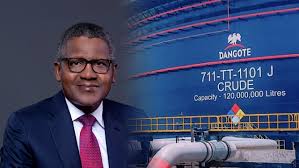
The Dangote Petroleum Refinery has signed an offtake agreement with 12 major fuel marketing companies to distribute up to 65 million litres of petrol daily across Nigeria, a move that could reshape domestic fuel supply and reduce reliance on imports.
Aliko Dangote, president of the Dangote Group, said in Lagos that the agreement establishes a structured nationwide distribution framework for Premium Motor Spirit, or petrol. Under the deal, the refinery will supply between 60 million and 65 million litres per day to the domestic market. Any excess output, estimated at 15 million to 20 million litres daily, will be exported.
Nigeria’s petrol consumption is estimated at between 50 million and 60 million litres a day, according to industry data. At full domestic allocation, the refinery would supply roughly 1.8 billion to more than 2 billion litres monthly, depending on output and the number of days in the month.
The agreement builds on an earlier arrangement reached in October 2025 between the refinery and downstream operators aimed at stabilising supply and moderating pump price volatility following market deregulation.
The distribution framework, endorsed by the Nigerian Midstream and Downstream Petroleum Regulatory Authority, assigns selected marketers responsibility for nationwide logistics to curb hoarding and speculative practices.
Participating firms include MRS Oil Nigeria Plc, Nigerian National Petroleum Company Limited Retail, 11 Plc, TotalEnergies Marketing Nigeria, Ardova Plc and other regional distributors. The companies will lift agreed volumes directly from the refinery and manage distribution across retail networks nationwide.
Dangote said the model is designed to guarantee consistent availability while enabling the refinery to export surplus production once local demand is met. Exports could generate foreign exchange earnings and improve Nigeria’s trade balance, as the country reduces its dependence on imported refined fuel.
For decades, Africa’s largest crude oil producer has relied heavily on imported petrol due to limited domestic refining capacity. That dependence exposed the economy to currency volatility, global supply shocks and periodic shortages.
The Dangote facility, located in Lagos, was built with a nameplate capacity of 650,000 barrels per day, making it the largest refinery in Africa. Bayo Bashir Ojulari, group chief executive officer of the Nigerian National Petroleum Company Limited, recently described the plant as a “transformative national asset” for energy security. He said live operational parameters showed output reaching 661,000 barrels per day during a recent visit, exceeding initial expectations.
The federal government has pursued sweeping oil-sector reforms since the removal of petrol subsidies and deregulation of the downstream market under President Bola Tinubu. Authorities have said domestic refining expansion is central to ending fuel import dependence and stabilising supply chains.
Industry analysts say the structured offtake arrangement could help smooth distribution bottlenecks that have historically disrupted supply. By allocating volumes across established marketers with national footprints, the system seeks to reduce panic buying and regional shortages.
However, execution will be critical. Logistics infrastructure, retail pricing dynamics and foreign exchange availability remain key variables. While increased local refining capacity reduces exposure to international supply constraints, crude feedstock supply, transportation networks and storage capacity will determine how efficiently petrol reaches end users.
If the refinery sustains output at projected levels and distribution flows smoothly, Nigeria could transition from a net petrol importer to a net exporter of refined products, particularly to West and Central African markets.
The 65 million-litre daily framework marks the most concrete step yet toward that objective. Whether it delivers sustained price stability and supply security will become clearer in the months ahead as the arrangement moves from agreement to full-scale implementation.
Discover more from Keeping Them Honest
Subscribe to get the latest posts sent to your email.