

…Nigeria Government Not Involved in Rescue of Ex-President—Source
…Country’s Army Installs ex-President Émbaló ally, General Horta N’Tam, as President for one-year transition.
By Jeremy Fregene
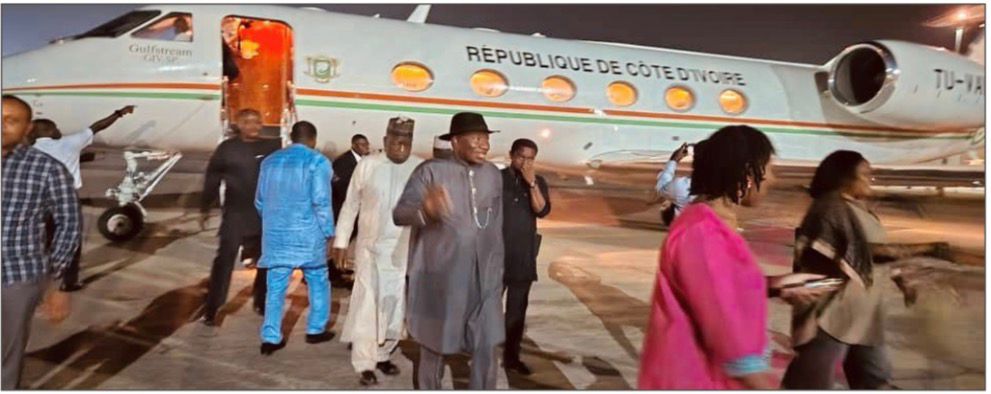
Former Nigerian President Goodluck Ebele Jonathan is back in Abuja after a dramatic evacuation from coup-stricken Guinea-Bissau: but not through any action by the Nigerian government. Despite a Ministry of Foreign Affairs official briefing claiming he had departed Bissau aboard a “special flight,” authoritative diplomatic and security sources confirmed to KTH Daily that Nigeria had no involvement whatsoever in Jonathan’s rescue. In reality, it was Côte d’Ivoire’s President Alassane Ouattara who dispatched a presidential Gulfstream jet, TU-VAI, to extract Jonathan and his delegation. No Nigerian official contacted Jonathan or his team about any possible evacuation plan until after he was already airborne.
Jonathan, who led the West African Elders Forum Election Observation Mission, had been in Guinea-Bissau monitoring last Sunday’s presidential and legislative elections when heavy gunfire erupted near the presidential palace, soldiers seized major access routes, borders were closed, and the military declared “total control” of the state. The swift collapse of order, despite the deployment of more than 6,700 security personnel including the ECOWAS Stabilisation Force, threw the country into turmoil and left international observers stranded.
The military takeover deepened on Thursday when soldiers appeared on state television to announce that General Horta N’Tam, the army chief of staff and a close ally of deposed President Umaro Sissoco Embaló, had been sworn in as Transitional President. The junta declared that N’Tam will preside over a one-year transition period. His elevation has fuelled speculation that the coup was an internal power play orchestrated from within the presidency itself, timed to halt the release of election results that many believed would not favour Embaló.
Meanwhile, Embaló has surfaced in Senegal. Dakar’s Ministry of Foreign Affairs confirmed on Thursday night that he had arrived aboard an aircraft chartered by the Senegalese government, following diplomatic engagement with actors inside Guinea-Bissau to secure his release. Senegal reaffirmed its commitment to working with ECOWAS, the African Union, and other partners to restore constitutional order “in this brotherly nation.”
Before his evacuation, Jonathan joined Filipe Nyusi, former president of Mozambique and head of the African Union Election Observation Mission, and Issifu Kamara, head of the ECOWAS Election Observation Mission, in condemning the coup as “a direct attempt to disrupt Guinea-Bissau’s democratic process.” They appealed for calm and reiterated their commitment to supporting the country during what they described as a “sensitive period.”
Back home in Nigeria, the House of Representatives raised alarm about Jonathan’s safety during Thursday’s plenary, calling on the Federal Government to deploy every available diplomatic channel to secure his evacuation. Lawmakers highlighted Jonathan’s long record of global service as an election observer in Zimbabwe, Liberia, Ghana, Mozambique, Pakistan, Tanzania, and South Africa. Minority Leader Kingsley Chinda added that ordinary Nigerians caught up in the crisis must also be protected, not just the former president.
The Nigerian Ministry of Foreign Affairs later issued its own condemnation of the coup, describing it as an unconstitutional change of government that violates the ECOWAS Protocol on Democracy and Good Governance and poses “a serious threat to regional stability.”
Guinea-Bissau, one of the world’s poorest countries, has been no stranger to instability, having endured four successful coups and numerous failed attempts since independence. This latest upheaval, marked by the installation of General N’Tam, the exile of Embaló, and lingering suspicions of an insider plot, has plunged the country into yet another uncertain chapter. Though borders were reopened on Thursday, the nation remains fragile, its democratic trajectory disrupted once more.
For Jonathan, his ordeal ended safely in Abuja, thanks not to Nigeria, but to the timely intervention of President Ouattara. But for Guinea-Bissau, the crisis is far from over.
Discover more from Keeping Them Honest
Subscribe to get the latest posts sent to your email.