

…China to Trump: Nigeria is Our Strategic Partner; Has Our Support
By Yinka Giwa
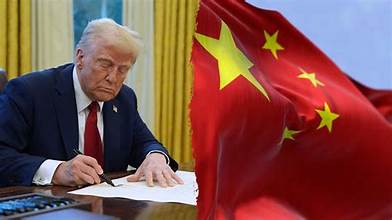
Nigeria has found itself at the centre of a global power play as the world’s two biggest nations, the United States and China, flex muscles over Africa’s largest democracy. The diplomatic storm erupted after former US President Donald Trump threatened possible military action against Nigeria over what he called “the killing of Christians,” drawing a sharp rebuke from Beijing and a chorus of condemnation from Nigerian regional leaders.
In a strongly worded statement, China’s foreign ministry warned against “using religion and human rights as excuses” to interfere in Nigeria’s internal affairs. Spokesperson Mao Ning declared in Beijing that China “firmly supports the Nigerian government as it leads its people on the development path suited to its national conditions,” stressing that “no nation should threaten others with sanctions or force.”
The Chinese statement was a direct response to Trump’s Truth Social post in which he accused Nigeria of “religious genocide” and ordered the US “Department of War” to prepare for “possible action” if the Tinubu administration failed to “stop the killing of Christians.” He wrote, “If we attack, it will be fast, vicious, and sweet — just like the terrorist thugs attack our cherished Christians!”
The Nigerian government swiftly dismissed Trump’s claim, describing it as “a mischaracterisation of Nigeria’s religious reality.” President Bola Tinubu, in a statement, insisted that “religious freedom and tolerance are core tenets of our national identity” and reaffirmed his administration’s commitment to protecting all citizens regardless of faith.
China’s caution came as it deepens its economic and strategic footprint in Nigeria through multibillion-dollar infrastructure investments and defence cooperation. Analysts see Beijing’s response as part of a broader contest for influence in Africa, where Washington and Beijing are jostling for dominance over emerging markets and political alliances.
Meanwhile, Nigeria’s domestic stakeholders have entered the fray. The Southern and Middle Belt Leaders Forum (SMBLF), a coalition of major regional organisations including Afenifere, Ohanaeze Ndigbo, PANDEF, and the Middle Belt Forum, rejected Trump’s “unsolicited foreign intervention,” warning that such threats “only worsen Nigeria’s fragile peace.”
In a communiqué signed by Oba Oladipo Olaitan, Dr. Bitrus Pogu, Senator John Azuta-Mbata, and Ambassador Godknows Igali, the SMBLF declared that while the US designation of Nigeria as a “Country of Particular Concern” over religious persecution was alarming, it should, however, serve as “a wake-up call to the Federal Government.” The group urged the Tinubu administration to “halt the ongoing killings, disarm the militias and killer herdsmen, and restore occupied lands to rightful owners across Benue, Plateau, Southern Kaduna, and Taraba.”
Significantly, the SMBLF also renewed its call for the release of detained IPOB leader, Nnamdi Kanu, describing it as “a necessary step toward national reconciliation.” The group argued that Kanu’s agitation, initially peaceful, was “radicalised by ill-advised military operations under the Buhari administration,” and urged Tinubu to adopt a “nationalist approach” in resolving the issue.
Beyond internal matters, the forum linked its position to Nigeria’s sovereignty in the face of growing global tension. “We affirm our opposition to any foreign military intervention in Nigeria,” it said. “Our country’s challenges must be addressed internally, not dictated by foreign powers pursuing their own strategic interests.”
The communiqué also touched on 2027 politics, reaffirming support for a southern presidency “to complete the national balance and strengthen unity.” It urged political parties to “respect the spirit of rotation” that produced President Tinubu in 2023.
According to keen diplomatic watchers, Nigeria now stands in a delicate position: walking a tightrope between Washington’s warnings and Beijing’s assurances. The US, long a key security partner, increasingly frames Nigeria’s governance through the lens of human rights and counterterrorism, while China’s approach is anchored on trade, energy, and non-interference.
Insiders familiar with Nigeria’s foreign policy dynamics warn that the country risks becoming a pawn in this intensifying rivalry. “The US speaks the language of democracy and force; China speaks the language of development and sovereignty,” one diplomatic source observed. “Nigeria is caught between both, and how it navigates this will determine its place in the new global order.”
According to a top foreign ministry official who spoke to KTH Daily, Nigeria’s official stance remains one of “strategic neutrality.” But he cautioned that as the superpowers posture and domestic pressures mount, Nigeria must strike a balance in its strategic interests, between superpower ambitions and its own national survival. This, he advised, should define its foreign policy trajectory for years to come.
Discover more from Keeping Them Honest
Subscribe to get the latest posts sent to your email.