

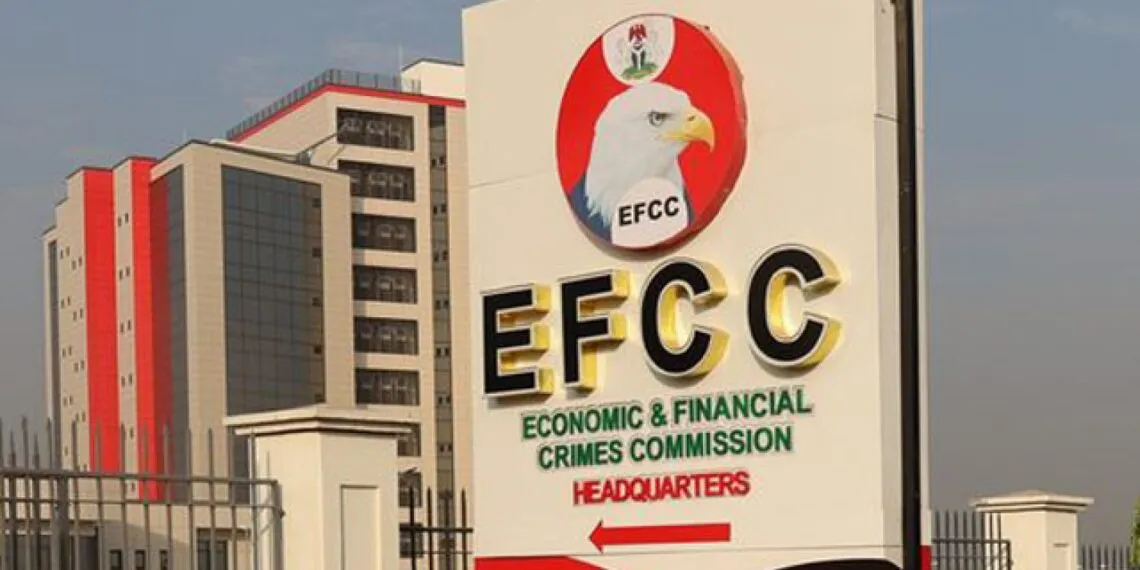
…Olukoyede unveils new fraud-risk directorate, vows to block leakages before they occur
…Anti-graft agency recovers 1,502 assets, channels ₦100bn to national development funds
…Says defections to APC won’t shield corrupt politicians
By Franklin Adole
The Economic and Financial Crimes Commission (EFCC) says it is pivoting its anti-graft war from reactive enforcement to proactive prevention, with particular focus on Ministries, Departments and Agencies (MDAs).
Chairman Ola Olukoyede, represented by the Director of Public Affairs, Wilson Uwujaren, made this known on Thursday in Abuja while marking his second anniversary in office.
According to him, the Commission has recorded unprecedented progress in both enforcement and system reforms aimed at reducing opportunities for corruption in public institutions.
Between October 2023 and September 2025, the EFCC received over 19,000 petitions, conducted 29,240 investigations, filed 10,525 cases, and secured 7,503 convictions.
“Within the same period, the Commission recovered ₦566,319,820.343, $411,566,192.32, £71,306.25, €182,877.10, and other foreign currencies from the proceeds of financial and economic crimes,” Olukoyede said.
He added that 1,502 non-monetary assets were also recovered, including 402 properties in 2023, 975 in 2024, and 125 so far in 2025. Landmark recoveries include the final forfeiture of 753 duplexes in Lokogoma, Abuja, and Nok University, now the Federal University of Applied Sciences, Kachia, Kaduna State.
Olukoyede noted that portions of recovered funds have been redirected to key national programmes such as the Students Loan Scheme and Consumer Credit Scheme, with ₦100 billion invested. Other agencies, including the NDDC, AMCON, FIRS, and NHIA, have also benefited from returned assets.
“In line with our new approach, some recovered properties have been allocated to government institutions for official use. This ensures that recovered assets are not wasted but returned to productive use,” he said.
The EFCC chairman emphasized that prevention, not just prosecution, has become the Commission’s new frontier. To this end, a Directorate of Fraud Risk Assessment and Control (FRAC) has been created to deploy risk-based strategies in monitoring the budget performance of MDAs.
“Prevention is more cost-effective than enforcement,” Olukoyede explained. “Our goal is to detect and block corruption risks before they mature into losses. That is what FRAC is designed to do.”
He also cited the establishment of a Task Force on Naira Abuse and Dollarisation, which he said has reduced speculative pressure on the naira and sanitized currency operations.
Olukoyede highlighted the Commission’s strengthened global and regional partnerships, noting joint investigations with the FBI, the UK’s National Crime Agency (NCA), INTERPOL, and Japan’s JICA, which led to the repatriation of stolen assets to victims in Spain, Canada, and the United States.
“In 2024, we hosted Christopher Wray, then FBI Director, and NCA’s Graeme Biggar, a testament to EFCC’s growing international credibility,” he said.
At the regional level, his leadership as President of the Network of National Anti-Corruption Institutions in West Africa (NACIWA) has led to the establishment of a permanent secretariat in Abuja, further positioning Nigeria as a hub for anti-corruption policy in West Africa.
On enforcement, Olukoyede said several major prosecutions are ongoing, including those involving former governors Willie Obiano, Abdulfatah Ahmed, Darius Ishaku, Theodore Orji, and Yahaya Bello; as well as former ministers Olu Agunloye, Saleh Mamman, Hadi Sirika, and Charles Ugwu; and ex-CBN Governor Godwin Emefiele.
He added that the EFCC has revived old corruption cases involving Fred Ajudua, Haliru Bello Mohammed, Sambo Dasuki, and Ngozi Olojeme, among others.
Olukoyede also disclosed that the Commission arrested 792 suspects linked to cryptocurrency and investment fraud in Lagos in December 2024, including 192 foreigners who were subsequently prosecuted and deported.
“This sent a strong message that Nigeria will not be a safe haven for cybercriminals,” he stated.
Within the Commission itself, Olukoyede said integrity reforms have been enforced. All staff were directed to declare their assets, while 55 officers were dismissed for misconduct, including one now facing prosecution for tampering with exhibits.
“You cannot fight corruption with corruption,” he said, noting that high-performing officers have been rewarded with promotions, allowances, and CNG buses.
Meanwhile, the EFCC reiterated that it would not shield any politician or public official from prosecution because of party affiliation.
Speaking through the Director of Legal and Prosecution, Sylvanus Tahir, the chairman dismissed allegations that the Commission protects politicians who defect to the ruling APC.
“It is not true that anyone is being shielded,” Tahir said. “Investigations are ongoing in all cases, and justice will be served. No one is above the law.”
He also debunked claims that the EFCC deducts a percentage from recovered funds without approval, clarifying that only the President, under the Proceeds of Crime Act, can authorise statutory deductions.
“The EFCC operates strictly within the law and due process. We have never made unauthorised deductions from recovered assets,” Tahir stated.
Olukoyede concluded that the EFCC under his watch is committed to both accountability and prevention: “Our mission is clear — to build systems that make corruption impossible, not just punish it when it happens.”
Discover more from Keeping Them Honest
Subscribe to get the latest posts sent to your email.